Transcription of JOURNAL CITATION REPORTS - Clarivate Analytics
1 WHAT IS JOURNAL CITATION REPORTS ? JOURNAL CITATION REPORTS (JCR ) provides a systematic, objective means to evaluate the world s leading research journals. It offers a unique perspective for JOURNAL evaluation and comparison by accumulating and tabulating CITATION and article counts from virtually all specialties in the sciences, social sciences, and technology help you compare journals and discover which are the most significant to you, JOURNAL CITATION REPORTS can show: Most frequently cited journals in a field Hottest journals in a field Highest impact journals in a field Most published articles in a field Subject category data for benchmarkingCoverage in Two EditionsJCR CITATION data comes from over 10,500 journals, representing over 2,500 publishers worldwide in over 230 disciplines. Each annual edition contains the previous year s publication data and shows the relationship between citing and cited journals in a clear, easy-to-use Comes with Two Editions: JCR Science Edition: Contains data from over 8,000 journals in 171 subject categories.
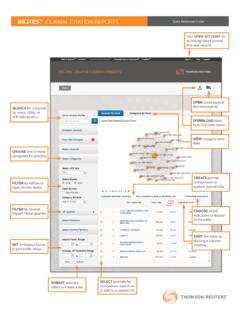
2 JCR Social Sciences Edition: Over 2,900 journals in the 55 subject CITATION REPORTS QUICK REFERENCE CARDPOWERED BY WEB OF SCIENCE NAVIGATION OVERVIEWFrom the JCR homepage, select a JCR edition, a year, and one of the following search CATEGORYThis option lists all the journals within a specific subject category or discipline, or alternatively, category-level data that can be used for benchmarking. You can choose more than one subject option lists all the journals published by a specific publisher. You can choose more than one option lists all the journals published in a specific country. You can choose more than one FOR A SPECIFIC JOURNALYou can search for a specific JOURNAL by full title, abbreviated title, title word, or ISSN. See left sidebar for more information and ALL JOURNALSUse this option to list all of the journals in the JCR edition and year you selected on the JCR homepage.
3 The JCR product displays all journals alphabetically by abbreviated JOURNAL title. You can find the full title of a JOURNAL at the top of the Full Record SUMMARY LIST PAGEJ ournals from the selected JCR edition and year that meet your search criteria display on the JOURNAL Summary List page. From the Summary page: View summary details View a listing of all JOURNAL title changes occurring in the past two years View detailed information by clicking a JOURNAL s abbreviated title to access the Full Record page, and Select journals to add to your marked listFULL RECORD PAGEYou can find complete details about each JOURNAL on the Full Record page, including the full title of the JOURNAL and publisher information. The table below the title displays information about the JOURNAL record. Links take you to expanded details on the CitesTotal Cites indicate the total number of times that each JOURNAL has been cited by all journals included in the database within the current JCR FactorThe Impact Factor identifies the frequency with which an average article from a JOURNAL is cited in a particular year.
4 You can use this number to evaluate or compare a JOURNAL s relative importance to others in the same field or see how frequently articles are cited to determine which journals may be better for your Factor Trend GraphThis graph shows the Impact Factor of a JOURNAL over the last five years. It measures the frequency with which the average article in a JOURNAL is cited in a particular year, and compares the impact of a JOURNAL over the last five Impact FactorThe Five-Year Impact Factor is the average number of times articles from the JOURNAL published in the last five years have been cited in the JCR year. This metric can be used to better gauge the impact of journals in fields where the influence of published research evolves over a longer period of IndexThe Immediacy Index measures how frequently the average article from a JOURNAL is cited within the same year as publication.
5 This number is useful for evaluating journals that publish cutting-edge CountsThis is the number of articles published in a JOURNAL in a particular year or Half-LifeThe Cited Half-Life benchmarks the age of cited articles by showing the number of years back from the current year that account for 50 percent of the total number of citations to a JOURNAL in the current year. This number is useful in making collection management and archiving decisions. A publisher may use this number to adjust editorial policies to compete in different market OPTIONSS pecific JOURNAL SearchSearch for a specific journal1. From the JCR homepage, select the Search for a specific JOURNAL Click Submit to display the JOURNAL Search Select one of the following search options: Full JOURNAL Title, JOURNAL Abbreviation, Title Word, or Enter your search query.
6 Capitalization does not matter. Use the asterisk (*) wildcard in the search query to find all journals that match the search JOURNAL TitleFind journals with full titles that match the search query. JOURNAL of Cell Biology finds only that JOURNAL . JOURNAL of Cell* finds JOURNAL of Cell Biology, JOURNAL of Cellular Biochemistry, JOURNAL of Cellular Plastics, etc. JOURNAL * finds all journals beginning with the word AbbreviationFind journals with the abbreviated version of the JOURNAL title that matches the search query. J Cell Biol finds JOURNAL of Cell Biology. J Cell* finds JOURNAL of Cell Biology, JOURNAL of Cellular Biochemistry, JOURNAL of Cellular Plastics, etc. J Cell Bio* finds JOURNAL of Cell Biology and JOURNAL of Cellular WordFind journals with titles that contain the word in the search query. Cell finds Cell, JOURNAL of Cell Biology, Plant Cell, etc.
7 Cell* finds Cell, JOURNAL of Cell Biology, Plant Cell, etc. Cell Bio* finds Cell Biochemistry and Biophysics, JOURNAL of Cell Biology, Cell Biology and Toxicology, NumberFind journals with the ISSN that matches exactly the number in the search query. Do not use wildcards in this type of search. 0248-4900 finds the JOURNAL that s ISSN is 0248-4900. 02484900 finds the JOURNAL that s ISSN is REFERENCE CARD - JOURNAL CITATION REPORTSC iting Half-LifeThe Citing Half-Life identifies the number of years from the current year that account for 50% of the cited references from articles published by a JOURNAL in the current year. Used together with the Cited Half-Life, this number aids the evaluation of editorial JOURNAL GraphThis graph shows the distribution by cited year of citations to articles published in the selected JOURNAL GraphThis graph shows the distribution by cited year of citations from current year articles in the selected Data TableThe Source Data table provides information regarding the number of review articles versus original research articles that are published by a particular JOURNAL .
8 This number also includes the number of references cited by the articles. A blank entry indicates that the references from a JOURNAL were not processed for inclusion in the CITATION JOURNAL DataThe Cited JOURNAL page identifies those publications that most frequently cite a particular JOURNAL . These CITATION links can reveal a JOURNAL s subject orientation, point to its closest peer or competitor publication, and highlight a specialty-specific network of JOURNAL DataThe Citing JOURNAL page identifies those publications that were most frequently cited by a particular JOURNAL . These CITATION links can reveal a JOURNAL s subject orientation, point to its closest peer or competitor publication, and highlight a specialty-specific network of in Category This information places a JOURNAL in the larger context of its assigned subject area(s).
9 The Rank in Category table displays the JOURNAL s numerical rank and its quartile distribution based on Impact Factor. The box plot graph visualizes the quartile distribution of JOURNAL Impact Factors in each category, as well as the mean and median Impact Factor values and any outlier values for the Self-Cites (adjusted Impact Factor)This table shows what percentage of a JOURNAL s total CITATION count is a result of JOURNAL self- CITATION ( a paper in Nature cites another paper published in Nature). The table displays Total Cites, Total Cites without self-cites, Impact Factor, and an adjusted Impact Factor excluding JOURNAL JournalsThe Related Journals page identifies journals which have a subject relationship with the object JOURNAL based on citations either given or received. They are ranked by their degree of relatedness.
10 This list can be useful for identifying journals that are dependent upon one another, but which may be classified in different subject Category DataAggregate category data is available for all subject categories in the JCR. These category statistics can be useful for placing JOURNAL data in a larger context. All data elements available for individual journals are also available at the category level, including Aggregate Impact Factor, Aggregate Immediacy Index and Aggregate Cited/Citing THAT MAY AFFECT JOURNAL RANKINGS AND IMPACT FACTORS If a JOURNAL publishes a large number of reviews one year, there may be a temporary increase in the number of citations received. Sudden changes in a JOURNAL s size can affect the Impact Factor. For example, when an article count drops, the Impact Factor may rise temporarily. In the first year after a JOURNAL title change, the new title is listed without an Impact Factor because the article count for the two preceding years used in the Impact Factor calculations is JOURNAL LISTThe Marked JOURNAL List page displays all the journals you have marked during a session.