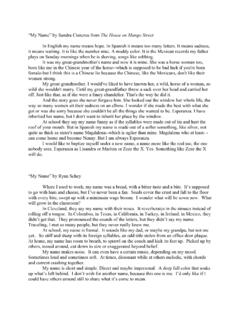
Transcription of Journal Guide for - Skills
1 Journal Guide for The house on Mango Street Journal Guide for Chapter One The house on Mango Street Questions Answer the following questions in complete sentences. did the narrator live before she moved to The house on Mango Street? were her previous homes different? what kind of house would she like to live? Themes In the first chapter a major theme of the novel is introduced. Discuss what the narrator s view of a home is. What makes a house a home? Is the narrator satisfied with her house ? Does she feel that she belongs there? Explain. Style Cisneros has a poetic style. She incorporates both vivid imagery and spare prose. She uses both to create a picture of the narrator s world.
2 1. What words does the narrator use to describe her mother s hair? What food words are used to describe her mother s hair? What images do these words create? 2. How do these words create a vivid visual of her mother? 3. How does the description of snuggling with her mother at night provide a sense of a loving and supportive family? 4. What lines in this chapter create the sense of security and familial love that the narrator feels? 5. The last paragraph in this chapter is a run-on sentence. It is missing several verbs. How does the overall image created in the paragraph develop? How does the unusual grammar help with this development? Personal Response Describe the house you live in.
3 Where did you live before this house ? What does your house look like on the inside and the outside? Do family members share rooms? How do you feel about your house ? The house on Mango Street Journal Guide for Chapter Two Hairs Questions Answer the following questions in complete sentences. 1. Who are the members of the narrator s family? How is the hair of each member different? 2. What makes her mother s hair special? What are the narrator s feelings for her mother? Themes In the first chapter a major theme of the novel was introduced. This very short chapter reinforces part of that theme. Discuss how the narrator s view of her family is part of her idea of what makes a home. Style Cisneros has a poetic style.
4 She incorporates both vivid imagery and spare prose. She uses both to create a picture of the narrator s world. 1. What words does the narrator use to describe her mother s hair? What food words are used to describe her mother s hair? What images do these words create? 2. How do these words create a vivid visual of her mother? 3. How does the description of snuggling with her mother at night provide a sense of a loving and supportive family? 4. What lines in this chapter create the sense of security and familial love that the narrator feels? 5. The last paragraph in this chapter is a run-on sentence. It is missing several verbs. How does the overall image created in the paragraph develop?
5 How does the unusual grammar help with this development? Personal Response What is it about your home and your family that provides you with a sense of security? Can you identify with the narrator and her point of view? The house on Mango Street Journal Guide for Chapter Three Boys & Girls Questions Answer the following questions in complete sentences. 1. What does the narrator say about the relationship between boys and girls? What evidence does she provide to support this idea? 2. What does the narrator say about her sister? How does this impact their relationship? 3. About what does the narrator dream? What does this say about her? Quotes Explain the significance of the following quotes.
6 1. The boys and the girls live in separate worlds. 2. Carlos and Kiki are each other s best friend.. not ours. 3. Someday I will have a best friend all my own. One I can tell secrets to. One who will understand my jokes without my having to explain them. 4. Until then I am a red balloon, a balloon tied to an anchor. Themes Another major theme of the novel is introduced in this chapter. What do you think that theme is? Why? What textual proof is there to support your idea? Style Cisneros has a poetic style. She incorporates both vivid imagery and spare prose. She uses both to create a picture of the narrator s world. 1. What words does the narrator use to describe the relationship between her brothers?
7 Between the brothers and the sisters? Between the two sisters? 2. How do these words create a sense of the responsibility the narrator feels towards her sister? 3. How does the description of the dream best friend contrast with the description her sister? 4. What lines in this chapter create the sense of separation that the narrator feels? What metaphor is used to reinforce this idea? Personal Response What do you think the narrator of the novel means when she says The boys and the girls live in separate worlds? In what way does this quote apply to your life? Do you think that that the genders in your home are treated differently? The house on Mango Street Journal Guide for Chapter Four My Name Questions Answer the following questions in complete sentences.
8 1. What does her name mean? 2. After whom was she named? Why does she connect her name with the records her father plays on Sunday morning? 3. What point does Esperanza make about both the Chinese and the Mexicans? Does she seem to resent this? 4. How did her grandmother get married? 5. What does what happened to Esperanza s grandmother tell you about women s roles in Mexican society? 6. Why does she want to baptize herself with a new name? Quotes Explain the significance of the following quotes. 1. It was my great-grandmother s name and now it is mine. She was a horse woman, too, born like me in the Chinese year of the horse which is supposed to be bad luck if you re born female but I think it this is a Chinese lie because the Chinese, like the Mexicans, don t like their women strong.
9 2. I have inherited her name, but I don t want to inherit her place by the window. 3. I would like to baptize myself under a new name, a name more like the real me, the one nobody sees. Themes 1. The theme of women as second-class citizens is reinforced in this chapter. What lines from the text support this theme? 2. How does Esperanza rebel against this idea of women as inferior? 3. Another theme introduced in this chapter is the idea of a woman waiting. Who waits? Where does she wait? For what is she waiting? How does Esperanza feel about this? Style Cisneros has a poetic style. She incorporates both vivid imagery and spare prose to create a picture of Esperanza s world. 1. Esperanza explains the various meanings of her name in a series of metaphors and similes.
10 What do the metaphors and similes mean on a literal level? On a figurative level? How does this description add to the overall explanation of her name? 2. What words does the narrator use to describe Esperanza s name? 3. How do these words create a sense of the whole of Esperanza? How does the description provide a sense of both the meaning of her name and her personality? 4. What does Esperanza feel is her legacy? What connects her to the past? What images does the author use to create this connection? Personal Response Esperanza discusses her name and what it means to her. What does your name mean? What does your name mean to you? How was your name chosen? Does it have family significance?