Transcription of K to 12 BASIC EDUCATION CURRICULUM SENIOR HIGH …
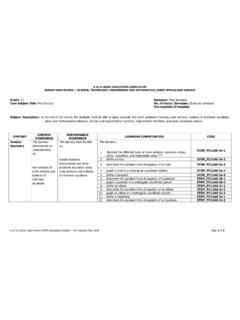
1 K to 12 BASIC EDUCATION CURRICULUM . SENIOR high SCHOOL ACADEMIC TRACK. Grade: 12 Semester: 1st Semester Subject Title: Philippine Politics and Governance No. of Hours/ Semester: 80 hours Prerequisite: Subject Description: This course introduces the students to the BASIC concepts and vital elements of politics and governance from a historical-institutional perspective. In particular, it attempts to explain how the important features of our country's political structures/institutions, processes, and relationships developed across time. In the process, the course helps the learners gain a better appreciation of their rights and responsibilities as individuals and as members of the larger sociopolitical community to strengthen their civic competence.
2 PERFORMANCE. CONTENT CONTENT STANDARD LEARNING COMPETENCY CODE. STANDARD. The learners . 1. Introduction: The concepts of politics and The learners demonstrate The learners shall be able HUMSS_PG12- 1. articulate definitions of politics governance an understanding of to Ia-1. The meaning of politics HUMSS_PG12- 2. differentiate the various views on politics How politics can be studied politics and political clearly identify a specific Ia-2. The meaning of governance science, governance, political phenomenon and 3. explore the connection between the political ideologies, power, how it can be studied HUMSS_PG12- phenomenon (politics) and the method states, nations, and Ia-3.
3 Of inquiry (Political Science). globalization 4. recognize the value of politics HUMSS_PG12- Ia-4. 5. differentiate governance from HUMSS_PG12- government Ia-5. 2. Political Ideologies 1. identify the BASIC tenets of major HUMSS_PG12- political ideologies ( , liberalism, Ib-c-6. The BASIC tenets of the major socialism, conservatism, etc.). political ideologies ( , liberalism, socialism, HUMSS_PG12- 2. differentiate the political ideologies conservatism, etc.) Ib-c-7. 3. examine the relationship between HUMSS_PG12- political ideologies and configurations of Ib-c-8. political communities K to 12 SENIOR high School Humanities and Social Sciences Strand Philippine Politics and Governance May 2016 Page 1 of 10.
4 K to 12 BASIC EDUCATION CURRICULUM . SENIOR high SCHOOL ACADEMIC TRACK. PERFORMANCE. CONTENT CONTENT STANDARD LEARNING COMPETENCY CODE. STANDARD. 4. critique ideas that have a direct impact HUMSS_PG12- on how we try to manage ourselves as a Ib-c-9. political community 5. analyze how political ideologies impact on HUMSS_PG12- the social and political life of Filipino Ib-c-10. 3. Power HUMSS_PG12- 1. define power Id-11. Nature Dimensions 2. recognize the nature, dimensions, types, HUMSS_PG12- Types and consequences of power Id-12. Consequences 3. analyze the nature, dimensions, types, HUMSS_PG12- deployments, and consequences of power Id-13.
5 4. assess how power is exercised in different HUMSS_PG12- situations Id-14. 4. States, Nations, and Globalization HUMSS_PG12- 1. define nation and state Ie-15. The State as different from the Nation as a political concept HUMSS_PG12- 2. differentiate nation from state Globalization as a context of Ie-16. relations among nation-states HUMSS_PG12- 3. explain meanings of globalization Ie-17. 4. evaluate how globalization influences HUMSS_PG12- nation-states Ie-18. Philippine democratic politics The learners demonstrate The learners shall be able The learners . HUMSS_PG12- an understanding of to 1.
6 Relate the evolution of Philippine If-g-19. 5. Historical Background of Philippine politics and governance Democratic Politics the historical explain the roles of 2. describe the different stages in the HUMSS_PG12- The evolution of Philippine background of different political evolution of the Philippine politics and If-g-20. politics, government, and Philippine institutions governance governance democratic 3. analyze the evolution of Philippine HUMSS_PG12- K to 12 SENIOR high School Humanities and Social Sciences Strand Philippine Politics and Governance May 2016 Page 2 of 10.
7 K to 12 BASIC EDUCATION CURRICULUM . SENIOR high SCHOOL ACADEMIC TRACK. PERFORMANCE. CONTENT CONTENT STANDARD LEARNING COMPETENCY CODE. STANDARD. politics, the politics and governance If-g-21. executive, the legislative, the 4. assess the effects of the colonial HUMSS_PG12- judiciary, and experience on Philippine politics and If-g-22. decentralization and local governance governance 5. appraise the influence of prior stages HUMSS_PG12- of Philippine political developments on If-g-23. contemporary Philippine politics 6. The Executive 1. explain the roles and powers of the HUMSS_PG12- Philippine president Ih-24.
8 The role of the Philippine President in relation to his/her 2. analyze how contemporary Philippine HUMSS_PG12- powers presidents exercised their powers Ih-25. 3. critique the Philippine presidents' HUMSS_PG12- exercise of power Ih-26. 7. The Legislative 1. discuss the roles and responsibilities HUMSS_PG12- of the Philippine Senate and the Ii-27. The role and responsibilities of House of Representatives the Philippine Senate and the House of Representatives 2. assess the performance of the HUMSS_PG12- Philippine Congress Ii-28. 3. appraise the impact of Congress's HUMSS_PG12- performance on Philippine Ii-29.
9 Development 4. articulate a position or advocacy to a HUMSS_PG12- Philippine legislator through a formal Ii-30. correspondence 8. The Judiciary 1. identify the roles and responsibilities HUMSS_PG12- of the Philippine Judiciary Ij-31. The role and responsibilities of 2. discuss how the Judiciary exercises HUMSS_PG12- the Philippine Judiciary political neutrality and fairness Ij-32. K to 12 SENIOR high School Humanities and Social Sciences Strand Philippine Politics and Governance May 2016 Page 3 of 10. K to 12 BASIC EDUCATION CURRICULUM . SENIOR high SCHOOL ACADEMIC TRACK.
10 PERFORMANCE. CONTENT CONTENT STANDARD LEARNING COMPETENCY CODE. STANDARD. 3. Evaluate the performance of the Philippine Judiciary as a dispenser of HUMSS_PG12- justice and a protector of Ij-33. constitutional safeguards to freedom 9. Decentralization and Local 1. identify the different levels of the HUMSS_PG12- Governance Philippine Local Government IIa-b-1. Local Governance in the context 2. explain the roles and functions of HUMSS_PG12- of the 1991 Local Government Local Government Unit IIa-b-2. Code (LGC) of the Philippines and 3. examine how decentralization affects HUMSS_PG12- National-Local Government governance IIa-b-3.