Transcription of K to 12 BASIC EDUCATION CURRICULUM SENIOR HIGH …
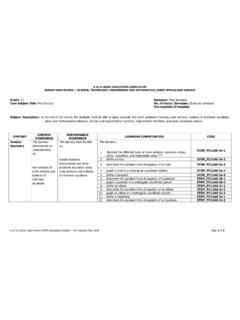
1 K to 12 BASIC EDUCATION CURRICULUM SENIOR HIGH SCHOOL ACADEMIC TRACK HUMANITIES AND SOCIAL SCIENCES K to 12 SENIOR High School Humanities and Social Sciences Strand Disciplines and Ideas in the Social Sciences February 2014 Page 1 of 7 Grade: 11 Semester: Second Semester Subject Title: Disciplines and Ideas in the Social Sciences (DISS) No. of Hours/ Semester: 80 hours/ semester Prerequisite (if needed): Subject Description: The course introduces students to BASIC concepts, subjects, and methods of inquiry in the disciplines that comprise the Social Sciences. It then discusses influential thinkers and ideas in these disciplines, and relates these ideas to the Philippine setting and current global trends. CONTENT CONTENT STANDARD PERFORMANCE STANDARD LEARNING COMPETENCY CODE EMERGENCE OF THE SOCIAL SCIENCES 1.
2 Defining Social Sciences as the study of society 2. Introducing the disciplines within the Social Sciences Anthropology Economics Geography History Linguistics Political Science Psychology Sociology and Demography 3. Historical context of the emergence of each discipline The learners demonstrate an understanding the emergence of the Social Sciences and the different disciplines The learners shall be able connect the disciplines with their historical and social foundations The 1. define Social Sciences as the study of society HUMSS_DIS 11- IIIa-1 2. distinguish Social and Natural Sciences and Humanities HUMSS_DIS 11- IIIa-2 3. compare and contrast the various Social Science disciplines and their fields, main areas of inquiry, and methods HUMSS_DIS 11- IIIb-d-3 4.
3 Trace the historical foundations and social contexts that led to the development of each discipline HUMSS_DIS 11- IIId-4 DOMINANT APPROACHES AND IDEAS Part 1 1. Structural-Functionalism 2. Marxism 3. Symbolic Interactionism 4. Psychoanalysis key concepts and approaches in the Social Sciences interpret personal and social experiences using relevant approaches in the Social Sciences evaluate the strengths and weaknesses of the approach 1. Structural-Functionalism Structuralism determine manifest and latent functions and dysfunctions of sociocultural phenomena HUMSS_DIS 11 -IIIe-f-1 2. Marxism analyze social inequalities in terms of class conflict HUMSS_DIS 11-IIIg-2 3. Symbolic Interactionism appraise the meanings that people attach to everyday forms of interaction in order to explain social HUMSS_DIS 11-IIIh-3 K to 12 BASIC EDUCATION CURRICULUM SENIOR HIGH SCHOOL ACADEMIC TRACK HUMANITIES AND SOCIAL SCIENCES K to 12 SENIOR High School Humanities and Social Sciences Strand Disciplines and Ideas in the Social Sciences February 2014 Page 2 of 7 CONTENT CONTENT STANDARD PERFORMANCE STANDARD LEARNING COMPETENCY CODE behavior 4.
4 Psychoanalysis analyze the psychodynamics of the person s personality in terms of Id, Ego, and Superego HUMSS_DIS 11-IIIi-5 THIRD-QUARTER EXAM 3rd quarter exam DOMINANT APPROACHES AND IDEAS Part 2 6. Rational Choice 7. Institutionalism 8. Feminist Theory 9. Hermeneutical Phenomenology 10. Human-Environment Systems key concepts and approaches in the Social Sciences interpret personal and social experiences using relevant approaches in the Social Sciences evaluate the strengths and weaknesses of the approach 5. Rational Choice predict the social consequences of decision making based on scarcity HUMSS_DIS 11-IVa-6 6. Institutionalism examine the constitutive nature of informal and formal institutions and their actors and how it constrains social behavior HUMSS_DIS 11-IVb-7 7.
5 Feminist Theory determine the relationship between gender ideology and gender inequality HUMSS-DIS 11-IVc-8 8. Hermeneutical Phenomenology analyze significance of data HUMSS_DIS 11-IVd-9 9. Human-Environment Systems distinguish the ways by which human-environment interactions shape cultural and natural landscapes interpret thematic and mental maps to understand landscape changes and an individual s sense of place explain environmental and social issues through the analysis of spatial distributions and spatial processes HUMSS_DIS 11-IVd-10 INDIGENIZING THE SOCIAL SCIENCES 1. Filipino Social Thinkers 2. Institute of Philippine Culture s study on Philippine values key concepts in the Social Sciences rooted in Filipino language/s and carry out an exploration of personal and social experiences using 1.
6 Examine the social ideas of Filipino thinkers starting from Isabelo de los Reyes, Jose Rizal, and other Filipino HUMSS_DIS 11-IVe-1 K to 12 BASIC EDUCATION CURRICULUM SENIOR HIGH SCHOOL ACADEMIC TRACK HUMANITIES AND SOCIAL SCIENCES K to 12 SENIOR High School Humanities and Social Sciences Strand Disciplines and Ideas in the Social Sciences February 2014 Page 3 of 7 CONTENT CONTENT STANDARD PERFORMANCE STANDARD LEARNING COMPETENCY CODE 3. Sikolohiyang Pilipino 4. Pantayong Pananaw experiences indigenous concepts intellectuals 2. value the role of interpersonal relations in Philippine culture HUMSS_DIS 11-IVe-2 3. evaluate the person s personality using the core values of Sikolohiyang Pilipino HUMSS_DIS 11-IVf-3 4. explain the significance of using a particular language for discourse HUMSS_DIS 11-IVg-4 5.
7 Critique dominant approaches using Filipino perspectives HUMSS_DIS 11-IVg-5 SOCIAL SCIENCES IN THE REAL WORLD 1. Professions 2. Applications and intersections of the approaches in addressing social problems the role of Social Science in the real world illustrate situations and contexts in which Social Science can be applied 1. determine how Social Science can be used to address social concerns HUMSS_DIS 11-IVh-6 2. recognize multidisciplinarity and/or interdisciplinarity as an approach to looking at society HUMSS_DIS 11-IVh-7 3. generate an analysis of a social phenomenon using at least two approaches from the Social Sciences HUMSS_DIS 11-IVi-j-8 FOURTH-QUARTER EXAM 4th quarter exam K to 12 BASIC EDUCATION CURRICULUM SENIOR HIGH SCHOOL ACADEMIC TRACK HUMANITIES AND SOCIAL SCIENCES K to 12 SENIOR High School Humanities and Social Sciences Strand Disciplines and Ideas in the Social Sciences February 2014 Page 4 of 7 GLOSSARY1 Absolute location The exact position of an object or place stated in spatial coordinates of a grid system designed for locational purposes Anthropology The study of humans.
8 The social science that seeks to understand human origins and adaptation, and the diversity of cultures and worldviews Binary opposition The means by which the units of language have value or meaning; each unit is defined against what it is not Class conflict Conflict between entire classes over the distribution of a society s wealth and power Constitutive nature Forming an essential part or a component of Core values In Sikolohiyang Pilipino, the core of Filipino personhood is the concept of kapwa (shared identity), associated with which are other societal values Discourse A formal way of thinking expressed through language Economics A social science that deals with the optimum allocation of scarce resources among its alternatives to satisfy the unlimited human wants and needs of the people Ego The Freudian structure of personality that deals with the demand of reality Environment Surroundings.
9 The totality of things that in any way may affect an organism, including both physical and cultural conditions; a region characterized by a certain set of physical conditions Feminist theory A theory that (1) emphasizes gender as key basis of structured inequality, (2) challenges conventional distinctions between public and private, and (3) problematizes the fundamentally political relationship between gender and power Formal institutional constraint Rules, procedure, and formal political organizations (such as government) Gender ideology Meanings involved in the assignment of roles for women and men within the household and outside of it Geography The study of the earth s surface; a specialized investigation of the physical structure of the earth, including its terrain and its climates, and the nature and character of its contrasting inhabited portions Geographical imagination A sensitivity toward the significance of place and space, landscape and nature, in the constitution and conduct of life on Earth History A study of the past, one that describes/narrates and analyzes human activities in the past and the changes that these had undergone Hermeneutical Phenomenology/Phenomenological hermeneutics Historical phenomena (or the world outside) is interpreted differently in proper context through one s consciousness Humanities The study of the ways in which the human experience is processed and documented.
10 The fields of philosophy, literature, religion, art, music, history and language Id The part of personality that Freud called it consisting of unconscious drives; the individual s reservoir of sexual energy Informal institutional constraint Uncodified rules of conduct such as sanctions, taboos, customs, and traditions that may create and/or sustain temporary organizations in potentially underdeveloped/ immature political worlds K to 12 BASIC EDUCATION CURRICULUM SENIOR HIGH SCHOOL ACADEMIC TRACK HUMANITIES AND SOCIAL SCIENCES K to 12 SENIOR High School Humanities and Social Sciences Strand Disciplines and Ideas in the Social Sciences February 2014 Page 5 of 7 Institutionalism An approach that views institutions as humanly devised constraints that structure political, economic, and social interactions Institutions Stable, recurring patterns of behavior.