Transcription of K to 12 BASIC EDUCATION CURRICULUM SENIOR HIGH …
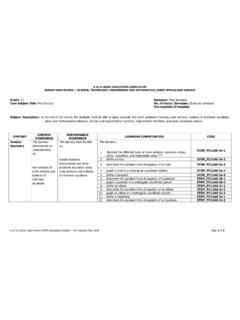
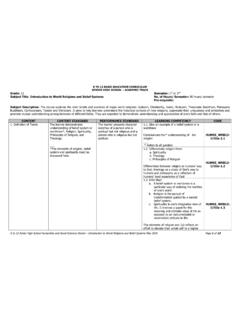
1 K to 12 BASIC EDUCATION CURRICULUM SENIOR HIGH SCHOOL CORE SUBJECT K to 12 SENIOR High School Core CURRICULUM Personal Development May 2016 Page 1 of 7 Grade: 11/12 Semester: Core Subject Title: Personal Development No. of Hours/ Semester: 80 hours/semester Prerequisite: Core Subject Description: This course makes SENIOR high school students aware of the developmental stage that they are in, for them to better understand themselves and the significant people around them as they make important career decisions as adolescents. The course consists of modules, each of which addresses a key concern in personal development. Using the experiential learning approach, each module invites students to explore specific themes in their development. Personal reflections, sharing, and lectures help reveal and articulate relevant concepts, theories, and tools in different areas in psychology.
2 CONTENT CONTENT STANDARD PERFORMANCE STANDARD LEARNING COMPETENCIES CODE Quarter I Unit 1: Self-Development (20 hours) 1. Knowing Oneself Understanding oneself during middle and late adolescence The learners demonstrate an understanding himself/herself during middle and late adolescence The learners shall be able conduct self-exploration and simple disclosure The explain that knowing oneself can make a person accept his/her strengths and limitations and dealing with others better EsP-PD11 share his/her unique characteristics, habits, and experiences EsP-PD11 maintain a journal EsP-PD11 2. Developing the Whole Person the various aspects of holistic development: physiological, cognitive, psychological, spiritual, and social development illustrate the connections between thoughts, feelings, and behaviors in a person s holistic development discuss the relationship among physiological, cognitive, psychological, spiritual, and social development to understand his/her thoughts, feelings, and behaviors EsP-PD11 evaluate his/her own thoughts, feelings, and behaviors EsP-PD11 show the connections between thoughts, feelings, and behaviors in actual life situations EsP-PD11 3.
3 Developmental Stages in Middle and Late Adolescence the skills and tasks appropriate for middle and late adolescence, and preparatory to early make a list of ways to become responsible adolescents prepared for adult life classifiy various developmental tasks according to developmental stage EsP-PD11 evaluate one s development in comparison with persons of the same age group EsP-PD11 K to 12 BASIC EDUCATION CURRICULUM SENIOR HIGH SCHOOL CORE SUBJECT K to 12 SENIOR High School Core CURRICULUM Personal Development May 2016 Page 2 of 7 CONTENT CONTENT STANDARD PERFORMANCE STANDARD LEARNING COMPETENCIES CODE adulthood list ways to become a responsible adolescent prepared for adult life EsP-PD11 4. The Challenges of Middle and Late Adolescence the developmental changes in middle and late adolescence, and expectations of and from adolescents clarify and manage the demands of the teen years (middle and late adolescence) discuss that facing the challenges during adolescence may able to clarify and manage the demands of teen years EsP-PD11 express his/her feelings on the expectations of the significant people around him/her (parents, siblings, friends, teachers, community leaders) EsP-PD11 make affirmations that help one become more lovable and capable as an adolescent EsP-PD11 Quarter I Unit 2: Aspects of Personal Development (20 hours) 5.
4 Coping with Stress in Middle and Late Adolescence stress and its sources; various stress responses; and coping strategies for healthful living in middle and late adolescence identify personal ways of coping for healthful living discuss that understanding stress and its sources during adolescence may help in identifying ways to cope and have a healthful life EsP-PD11 identify sources of one s stress and illustrate the effect of stress on one s system EsP-PD11 demonstrate personal ways of coping with stress for healthful living EsP-PD11 6. The Powers of the Mind the whole brain theory, or two hemispheres of the brain: artistic (right-brain dominant) and linear (left-brain dominant) identify ways to improve learning using both the left and right brain discuss that understanding the left and right brain may help in improving one s learning EsP-PD11 explore two types of mind-mapping techniques, each suited to right brain- or left brain-dominant thinking styles EsP-PD11 make a plan to improve learning using left and right brain through mind-mapping activities EsP-PD11 7.
5 Mental Health and Well-being in Middle and Late adolescence the concepts about mental health and well-being in middle and late adolescence identify his/her own vulnerabilities and make a plan on how to stay mentally healthy interpret the concepts of mental health and psychological well-being in everyday observations about mental health problems during adolescence EsP-PD11 identify his/her own vulnerabilities EsP-PD11 K to 12 BASIC EDUCATION CURRICULUM SENIOR HIGH SCHOOL CORE SUBJECT K to 12 SENIOR High School Core CURRICULUM Personal Development May 2016 Page 3 of 7 CONTENT CONTENT STANDARD PERFORMANCE STANDARD LEARNING COMPETENCIES CODE make a mind map on ways of achieving psychological well-being EsP-PD11 create a plan to stay mentally healthy during adolescence EsP-PD11 8. Emotional Intelligence the different types of emotions and how they are expressed identify ways to communicate and manage emotions in a healthy manner discuss that understanding the intensity and differentiation of emotions may help in communicating emotional expressions EsP-PD11 explore one s positive and negative emotions and how one expresses or hides them EsP-PD11 demonstrate and create ways to manage various emotions EsP-PD11 Quarter II Unit 3: Building and Maintaining Relationships (20 hours) 9.
6 Personal Relationships the dynamics of attraction, love, and commitment appraise one s present relationships and make plans for building responsible future relationships discuss an understanding of teen-age relationships, including the acceptable and unacceptable expressions of attractions EsP-PD11 express his/her ways of showing attraction, love, and commitment EsP-PD11 identify ways to become responsible in a relationship EsP-PD11 10. Social Relationships in Middle and Late Adolescence the concepts about social influence, group leadership and followership identify the different roles of leaders and followers in society distinguish the various roles of different individuals in society and how they can influence people through their leadership or followership EsP-PD11 compare one s perception of himself/herself and how others see him/her EsP-PD11 conduct a mini-survey on Filipino relationships (family, school, and community) EsP-PD11 11.
7 Family Structures and Legacies the impact of one s family on his/her personal development during middle and late adolescence identify the firm and gentle sides of family care that affect a person s development during middle and late adolescence appraise one s family structure and the type of care he/she gives and receives, which may help in understanding himself/herself better EsP-PD11 make a genogram and trace certain physical, personality, or behavioral attributes through generations EsP-PD11 prepare a plan on how to make the family members firmer and gentler with each other EsP-PD11 K to 12 BASIC EDUCATION CURRICULUM SENIOR HIGH SCHOOL CORE SUBJECT K to 12 SENIOR High School Core CURRICULUM Personal Development May 2016 Page 4 of 7 CONTENT CONTENT STANDARD PERFORMANCE STANDARD LEARNING COMPETENCIES CODE Quarter II Unit 4: Career Development (20 hours) 12. Persons and Careers the concepts of career development, life goals, and personal factors influencing career choices set a personal career goal based on the results of self-assessment of various personal factors explain that through understanding of the concepts of career and life goals can help in planning his/her career EsP-PD11 identify the personal factors influencing career choices EsP-PD11 take a self-assessment tool to know his/her personality traits and other personal factors in relation to his/her life goals EsP-PD11 13.
8 Career Pathways the external factors influencing career choices make a career plan based on his/her personal goal, and external factors influencing career choices discuss the external factors influencing career choices that may help in career decision making EsP-PD11 identify pros and cons of various career options with the guidance of parent, teacher, or counselor EsP-PD11 prepare a career plan based on his/her personal goal and external factors influencing career choices EsP-PD11 14. Insights into One s Personal Development his/her personal development as an important component of setting career and life goals analyze and synthesize his/her personal development as an important component of setting career and life goals explain the factors in personal development that may guide him/her in making important career decisions as adolescents EsP-PD11 share insights that make him/her realize the importance of personal development in making a career decision as adolescent EsP-PD11 construct a creative visualization of his/her personal development through of the various stages he/she went through, stressors, influences, and decision-making points, and a personal profile analysis EsP-PD11 K to 12 BASIC EDUCATION CURRICULUM SENIOR HIGH SCHOOL CORE SUBJECT K to 12 SENIOR High School Core CURRICULUM Personal Development May 2016 Page 5 of 7 GLOSSARY Term (Filipino) Term (English)
9 Definition Alalahanin Stress A state of mental or emotional strain or tension resulting from adverse or very demanding circumstances Antas ng Pag-unlad Developmental stage Subdivisions of the life span, each of which is characterized by certain behavioral or developmental traits Huling Bahagi ng Pagdadalaga/Pagbibinata Late adolescence The final stage of physical and emotional growth as children pass into adulthood; happens somewhere between 17 and 22 years of age, when teens become fully mature mentally and physically Kaayusang Pangkatauhan Well-being The state of being comfortable, healthy, or happy Kalagitnaan ng Pagdadalaga/Pagbibinata Middle Adolescence A transitional stage of physical and psychological human development that generally occurs between ages 15 and 17 Layunin sa Buhay Life goals Target, vision, mission, or objectives of a person Paghubog ng Kurso Career development The series of activities or the ongoing/lifelong process of developing one's work, profession, occupation, or vocation Panlipunang Impluwensiya Social influence Occurs when one's emotions, opinions, or behaviors are affected by others Pansariling Kaunlaran Adolescence A period of life in which the child transitions into an adult Pansariling Paglago Personal development/Self-development Understanding of one s physiological, cognitive, psychological.
10 Spiritual, and social development to understand one s thoughts, feelings, and behaviors, and making important decisions toward becoming a better person Teorya ng Pangingibabaw ng Kalahating-Kaliwa o Kalahating Kanan ng Utak Brain Lateralization or Brain Dominance Theory According to the theory of left-brain or right-brain dominance, each side of the brain controls different types of thinking. Additionally, people are said to prefer one type of thinking to the other. For example, a left-brained person is often said to be more logical, analytical, and objective, while a right-brained person is said to be more intuitive, thoughtful, and subjective. K to 12 BASIC EDUCATION CURRICULUM SENIOR HIGH SCHOOL CORE SUBJECT K to 12 SENIOR High School Core CURRICULUM Personal Development May 2016 Page 6 of 7 Code Book Legend Sample: EsP-PD11 DOMAIN/ COMPONENT CODE Knowing Oneself KO Developing the Whole Person DWP Developmental Stages in Middle and Late Adolescence DS The Challenges of Middle and Late Adolescence CA Coping with Stress in Middle and Late Adolescence CS The Powers of the Mind PM Mental Health and Well-being in Middle and Late adolescence MHWB Emotional Intelligence EI Personal Relationships PR Social Relationships in Middle and Late Adolescence SR Family Structures and Legacies FSL Persons and Careers PC Career Pathways CP Insights into One s Personal Development IOPD LEGEND SAMPLE First Entry Learning Area and Strand/ Subject or Specialization Edukasyon sa Pagpapakatao-Personal Development EsP-PD11/12 Grade Level Grade 11 or 12 Uppercase Letter/s Domain/Content/ Component/ Topic Knowing Oneself KO - Roman Numeral *Zero if no specific quarter Quarter 1st Quarter I Lowercase Letter/s *Put a hyphen (-)