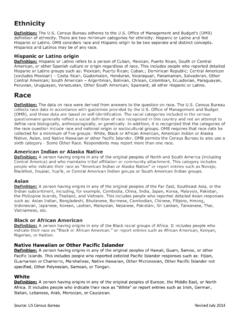
Transcription of Key Equity Terms and Concepts
1 SEPTEMBER Equity Terms & Concepts : A Glossary for Shared Understanding2 Center for the Study of Social PolicyINTRODUCTIOND eveloping a shared language for thoughtful discussion about Equity is critical for all of our work. This glossary of key Terms includes many words and Concepts that are foundational and relevant to CSSP's work. This is a living document. Just as our work has evolved over our history, so too does language and thinking on race, Equity , and justice evolve over time. We will update this document as our thinking and thinking in the field changes, and will note any time that we have made changes.
2 ACKNOWLEDGEMENTSThis glossary was compiled by a workgroup of CSSP staff, led by Maya Pendleton. Members of the workgroup in alphabetical order: Ali Jawetz, Ann Nguyen, Charlyn Harper Brown, E Feinman, Emily Verburg, Juanita Gallion, Miguel Amaguana, and Taysha Milagros Clark. This report is in the public domain. Permission to reproduce is not necessary provided proper cita-tion of CSSP is made. Original publication, September CITATIONCSSP (2019). Key Equity Terms and Concepts : A Glossary for Shared Understanding. Washing-ton, DC: Center for the Study of Social Policy.
3 Available at: : Citation information for all Terms and Concepts can be found at the conclusion of this for the Study of Social Policy 3 TERM/ CONCEPTDEFINITIONA bleismA set of beliefs or practices at the individual, community, or systemic level that devalue and discriminate against people with physical, intel-lectual, or psychiatric disabilities and often rests on the assumption that disabled people need to be fixed in one form or the extent to which a space is readily approachable and usable by peo-ple with disabilities. A space can be described as a physical or literal space, such as a facility, website, conference room, office, or bathroom, or a figurative space, such as a conversation or acknowledge, respect, value, and support someone s full identity and self including race, ethnicity, sexual orientation, gender identity and ex-pression, experiences, ideas, beliefs, etc.
4 And to encourage the devel-opment and exploration of who they RacismAny attitude, behavior, practice, or policy that explicitly or implicitly reflects the belief that Black people are inferior to another racial group. Anti-Black racism is reflected in interpersonal, institutional, and systemic levels of racism and is a function of White process of identifying and challenging racism, by changing sys-tems, organizational structures, policies and practices, and attitudes, to redistribute power in an equitable institutional, cultural, and individual set of practices and beliefs that assign differential value to people according to their socioeconomic status.
5 Classism also refers to the systematic oppression of poor and working class people by those who control resources. NOTE: Citation information for all Terms and Concepts can be found at the conclusion of this Center for the Study of Social PolicyTERM/ CONCEPTDEFINITIONC olor-Blind Racial IdeologyThe belief that people should be regarded and treated as equally as pos-sible, without regard to race or ethnicity. While a color-blind racial ideol-ogy may seem to be a pathway to achieve Equity , in reality it invalidates the importance of peoples culture; ignores the manifestations of racist policies which preserves the ongoing processes that maintain racial and ethnic stratification in social White skin color as the standard, colorism is the allocation of privilege and favor to lighter skin colors and disadvantage to darker skin colors.
6 Colorism operates both within and across racial and ethnic CompetenceThe ability to understand, communicate with, and effectively interact with people across cultures. Grounded in the respect and appreciation of cultural differences, cultural competence is demonstrated in the atti-tudes, behaviors, practices, and policies of people, organizations, and systems. Cultural HumilityWhen one maintains an interpersonal stance that is open to individuals and communities of varying cultures, in relation to aspects of the cultur-al identity most important to the person.
7 Cultural humility can include a life-long commitment to self-critique about differences in culture and a commitment to be aware of and actively mitigate power imbalances between cultures. CultureThe languages, customs, beliefs, rules, arts, knowledge, and collective identities and memories developed by members of all social groups that make their social environments ImageryPerpetuating stereotypes through the use of visuals, text/narratives, or data ( statistics) to highlight inequities without the appropriate his-torical and sociopolitical context. This can be remedied by leading with an explanation of historical and systemic barriers, and by focusing on strengths and solutions within the communities that are the subject of the visuals, text/narratives, or unequal treatment of members of various groups based on race, ethnicity, gender, gender expression, socioeconomic class, sexual orien-tation, physical or mental ability, religion, citizenship status, a combina-tion of those identified, and/or other categories.
8 See for the Study of Social Policy 5 TERM/ CONCEPTDEFINITIOND iversityA synonym for variety. A diversity focus emphasizes how many of these we have in the room, organization, etc. Diversity programs and cultural celebrations/education programs are not equivalent to racial justice or inclusion. It is possible to name, acknowledge, and celebrate di-versity without doing anything to transform the institutional or structural systems that produce, and maintain, racialized injustices in our GroupNot necessarily the majority, but the group within a society with the pow-er, privilege, and social status to control and define societal resources and social, political, and economic systems and effort to treat everyone the same or to ensure that everyone has access to the same opportunities.
9 However, only working to achieve equality ignores historical and structural factors that benefit some social groups and disadvantages other social groups in ways that create differ-ential starting points. See Racial Equity ; see effort to provide different levels of support based on an individual s or group s needs in order to achieve fairness in outcomes. Working to achieve Equity acknowledges unequal starting places and the need to correct the imbalance. See Racial Equity ; see groups that share a common identity-based ancestry, language, or culture. It is often based on religion, beliefs, and customs as well as memories of migration or PronounThe term one uses to identify themselves in place of their name ( ze/hir/hirs, ey/em/eirs, they/them/theirs, she/her/hers, he/him/his, etc.)
10 The use of the specific gender pronoun identified by each individual should be respected and should not be regarded as fear and hatred of or discomfort with people who are attracted to members of the same gender. Homophobia occurs in a broader hetero-sexist social context that systematically disadvantages LGBTQ+ people and promotes and rewards anti-LGBTQ+ Center for the Study of Social PolicyTERM/ CONCEPTDEFINITIONI mplicit BiasA belief or attitude that affects our understanding, decision, and actions, and that exists without our conscious awareness. InclusionA state of belonging, when persons of different backgrounds and identi-ties are valued, integrated, and welcomed equitably as decision-makers and collaborators.




![[Ch 6] Set Theory 1. Basic Concepts and Definitions](/cache/preview/c/e/2/4/1/3/7/e/thumb-ce24137e0a382875a0c9905ad219dbfc.jpg)