Transcription of LACQUER THINNERS 200 - .: TAG Solvent Products
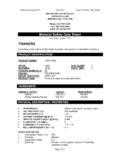
1 TAG Solvent Products (PTY) LTD. MATERIAL SAFETY DATA SHEET LACQUER THINNERS 200 1 CHEMICAL PRODUCT AND COMPANY IDENTIFICATION Common name : LACQUER THINNERS 200 Synonym : Not available Material uses : Not available Trade name : LACQUER THINNERS 200 Supplier : TAG Solvent Products Mallet Road/Weg Knights Germiston 1401 Republic of South Africa TEL: +27 11 822-1600 In case of emergency TAG: 011 822 1600 2 COMPOSITION / INFORMATION NAME CAS# % BY WEIGHT EXPOSURE LIMITS Aromatics 108-88-3 1330-20-7 19-26 7-12 ACGIH TLV (USA, 2003) TWA: 50ppm 8 hrs OSHA PEL Z2 (USA, 2003) TWA: 200ppm 8 hrs CEIL: 300ppm NIOSH ( USA, 1997) STEL.
2 150ppm 15 min STEL: 560 mg/m3 ACGIH TLV (USA, 2003) TWA: 100ppm 8 hrs STEL: 150ppm 15min OSHA PEL Z1 (USA, 1993) : 100ppm :435mg/m3 NIOSH (USA, 1997) STEL: 150ppm 15 min STEL: 665mg/m3 15 min Alcohol 71-23-8 26 ACGIH TLV (USA, 2003) STEL: 250ppm 15 min TWA: 200ppm 8 hrs OSHA PEL Z1 (USA, 1993) TWA: 200ppm 8 hrs TWA: 500mg/m3 Actives 17 6 ACGIH TLV (USA, 2002) TWA: 500ppm 8 hrs TWA: 1188mg/m3 8 hrs STEL: 750ppm 15 min STEL: 1782mg/m3 OSHA (USA, 2002) TWA: 750ppm 8 hrs TWA: 1800mg/m3 8 hrs STEL: 1000ppm 15min STEL: 2400mg/m3 15min ACGIH TLV (USA, 2003) TWA: 20ppm 8 hrs OSHA PEL Z1 (USA, 1993) : 50ppm : 240mg/m3 NIOSH REL (USA, 1997). SKIN REL: 5ppm 40 hrs REL: 24mg/m3 Hydrocarbon 611-14-3 78-92-2 1-43 Not PEL Z1 (USA, 2002) TWA: 150ppm 8hrs TWA: 450mg/m3 hrs 3.
3 HAZARDS IDENTIFICATION Physical state and appearance : overview : WARNING! FLAMMABLE LIQUID AND VAPOUR. VAPOUR MAY CAUSE FLASH FIRE. RISK OF SERIOUS DAMAGE TO EYES. HARMFUL BY INHALATION. REPEATED EXPOSURE MAY CASUE SKIN CRYNESS & CRACKING. Keep away from heat, sparks and flame. Avoid contact with eyes, skin and clothing. Keep container closed. Use only with adequate ventilation. Wash thoroughly after handling. Routes of entry : Eye contact. Ingestion. Inhalation. Potential acute health effects: Eyes Skin Inhalation Ingestion : risk of serious damage to eyes. : Repeated exposure may cause skin dryness or cracking. : Harmful be inhalation. : Hazardous in case of ingestion Potential chronic health : CARCINOGENIC EFFECTS classified A4 ( Not classifiable for human or animal).
4 By ACGIH, 3 ( not classifiable for human) by IARC [Toluene]. Classified A$ (Not classifiable for human or animal)by ACGIH,3 (Not classifiable for human) by IARC [xylenes]. Classified None, by OSHA, [Acetone]. Classified A4 ( not classifiable for human or animal)by ACGIH, D (Not classifiable for human or animal), by EPA [Acetone]. Classified A3 (Proven for animal) by ACGIH [Propyl alcohol]. Classified None, by OSHA, NONE. By NIOSH [propyl alcohol]. classified 4 (probably not for human) by IARC, none, by NIOSH [butan-2-ol]. Classified none, by NIOSH. Classified None by NIOSH[2-Methylpropan-1-ol]. Classified A3 (proven for animal) by ACGIH [Glycol ether]. MUTAGENIC EFFECTS: Non-mutagenic for bacteria and/or yeast [Xylenes]. TERATOGENIC EFFECTS classified none.
5 For human [Acetone]. Medical conditions aggravated by overexposure : No data : No data available. 4. FIRST AID MEASURES Eye contact : Check for and remove any contact lenses. Immediately flush eyes with running water for at least 15 minutes, keeping eyelids open. Get medical attention immediately. Skin contact : In case of skin contact, immediately flush skin with plenty of water for at least 15 minutes while removing contaminated clothing and shoes. Wash clothing before reuse. Thoroughly clean shoes before reuse. Get medical attention if symptoms appear. Inhalation : If inhaled, remove to fresh air and allow victim to rest. If not breathing, administer artificial respiration. If breathing is laboured, give oxygen. Get medical attention.
6 Ingestion : DO NOT induce vomiting unless directed to do so. Never give anything by mouth to an unconscious person. Loosen tight clothing such as a collar, tie, belt or waistband. If large quantities of this material are swallowed , seek immediate medical attention. Notes to physician : support respiratory and cardiovascular function. 5. FIRE FIGHTING MEASURES Flammability of the product: FlammableAutoignition temperature : The lowest known value is 238 C [Glycol ether] Flash points : Closed cup: <0 CFlammable limits : The greatest known range is LOWER: UPPER: [Glycol ether] Products of combustion : These Products are carbon oxides [CO, CO2]Fire hazards in the presence of various substances : Flammable in presence of open flames, sparks and static discharge of heat, of oxidizing materials, of combustible materials, of combustible materials, of reducing materials, of alkalis.
7 Explosive hazards in the presence of various substances : Not fighting media and instructions : SMALL FIRE: Use DRY chemical powder LARGE FIRE: Use water spray or fog. Cool containing vessels with jet in order to prevent pressure build-up, autoignition or explosion. Protective clothing (fire) : Be sure to use an approved/certified respirator or equivalent. Special remarks on fire hazards : Explosive in the form of vapour when exposed to heat or flame. Vapour may travel considerable distance to source of ignition and flash back. When heated to decomposition it emits acrid smoke and irritating fumes Special remarks on explosion hazards : No additional remark. 6. ACCIDENTAL RELEASE MEASURES Small spill or leak : Absorb with an inert dry material and place in an appropriate waste disposal container.
8 Large spill or leak : Poisonous flammable liquid, insoluble or very slightly soluble in water. Keep away from heat. Keep away from sources of Ignition. Stop leak if without risk. Absorb with DRY earth, sand or other non-combustible material. DO NOT get water inside the container. DO NOT touch spilled material. Prevent entry into sewers, basements or confined areas; dike if needed. Eliminate all sources of ignition. Call for assistance on disposal.. 7. HANDLING AND STORAGE Handling : keep away from heat, sparks and flame. Keep container closed. Use only with adequate ventilation. To avoid fire or explosion, dissipate static electricity during transfer by grounding and bonding containers and equipment before transferring material.
9 Use explosion-proof electrical (ventilating, lighting and material handling) equipment Storage : Store in a segregated and approved area. Keep container in a cool, well ventilated area. Keep container tightly closed and sealed until ready for use. Avoid all possible sources of ignition (spark or flames) 8. EXPOSURE CONTROLS, PERSONAL PROTECTION Engineering controls : Provide exhaust ventilation or other engineering controls to keep the airborne concentrations of vapour below their respective threshold limit values. Ensure that eyewash stations and safety showers are proximal to the work-station location. Personal protection Eyes Body Respiratory Hands Feet : Splash goggles. : Chemical resistant protective suite. : Vapour respirator. Be sure to use an approved/certified or equivalent.
10 Wear appropriate respirator when ventilation is inadequate. : Butyl rubber gloves. : Chemical resistant safety boots. Protective clothing : Splash goggles. Full chemical resistant protective suit. Vapor respirator. Butyl gloves. Chemical resistant boots. Personal protection in case of large spills : Splash goggles. Full suit. Vapor respirator. Boots. Gloves. A self-contained breathing apparatus should be used to avoid inhalation of the product. Suggested protective clothing might not be sufficient; consult a specialist BEFORE handling the product. NAME EXPOSURE LIMITSA romatics ACGIH TLV (USA, 2003)TWA: 50ppm 8 hrs OSHA PEL Z2 (USA, 2003) TWA: 200ppm 8 hrs CEIL: 300ppm NIOSH ( USA, 1997) STEL: 150ppm 15 min STEL: 560 mg/m3 ACGIH TLV (USA, 2003) TWA: 100ppm 8 hrs STEL: 150ppm 15min OSHA PEL Z1 (USA, 1993) : 100ppm :435mg/m3 NIOSH (USA, 1997) STEL: 150ppm 15 min STEL: 665mg/m3 15 min Alcohol ACGIH TLV (USA, 2003)STEL: 250ppm 15 min TWA: 200ppm 8 hrs OSHA PEL Z1 (USA, 1993) TWA: 200ppm 8 hrs TWA.