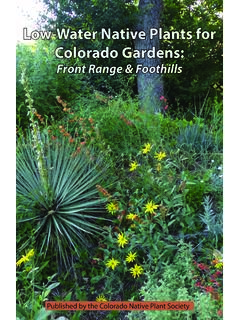
Transcription of Landscaping with native plants
1 SHORT-SEASON, HIGH-ALTITUDE GARDENINGBULLETIN 862 Landscaping with native plantsINTRODUCTIONT here are many reasons to consider a native plant landscape in Idaho s short-season, high-altitude regions, including water savings, decreased mainte-nance, healthy and adapted plants , and a desire to create a local themearound your home. Most plants sold for Landscaping are native to the easternUnited States and the moist climates of Europe. They require acid soils, con-stant moisture, and humid air to survive and remain attractive. Most alsorequire a longer growing season than we have available in the harshest cli-mates of Idaho.
2 Choosing to landscape with these unadapted plants meansaccepting the work and problems of constantly recreating a suitable artificialenvironment. native plants will help create a landscape that is more com-fortable in the climates and soils that surround us, and will reduce theresources necessary to maintain the single major factor that influences Idaho s short-season, high-altitudeclimates is limited summer moisture. Snow and rainfall are relatively abun-dant in the winter, but for 3 to 4 months beginning in June, we receive only afew inches of rain. Our environment is so dry that we have to apply from 20to 30 inches of water in summer to keep things green.
3 Many of the highdesert regions receive only 5 to 12 inches of total annual precipitation, withonly a small fraction of that comingin the summer. The high altituderegions of eastern Idaho and thecentral mountains may receivedouble the annual moisture of thedeserts, but they still have limitedsummer rainfall. The same dry sum-mer precipitation trends exist in themountain valleys of northern Idaho,though more moisture falls herethan in any other region of ARE A SHORT-SEASON, HIGH-ALTITUDE GARDENER IF:You live in Idaho at an elevation above 4,500 feet, ORYour USDA hardiness zone is 4 or lower, ORYou have a frost-free growing season of 110 days or lessby Stephen L.
4 Love, Kathy Noble, Jo Ann Robbins,Bob Wilson, and Tony McCammonCONTENTSI ntroduction .. 1 The concept of native .. 3 Landscaping Principles for native Plant Gardens .. 3 Establishing native Landscapes and Gardens .. 4 Designing a Dry High-Desert Landscape .. 5 Designing a Modified High-Desert Landscape .. 6 Designing a High-Elevation Mountain Landscape .. 6 Designing a Northern Idaho Mountain/Valley Landscape .. 8 Finding Sources of native plants .. 21 Much of Idaho experiences limited SHORT-SEASON, HIGH-ALTITUDE GARDENINGT hree additional factors have shaped the characteristics ofplants native to the harsh climates of Idaho.
5 The first is lowhumidity. plants adapted to Idaho s dry summer climatesmust be able reduce their tendency to lose moisture in thedry Idaho air. The second factor is the short frost-free plants must be able to survive and grow throughspring and fall frosts and be able to complete their life cyclein a short period of time. The third is bright, intense sunlightthat can scorch and damage the leaves of unadapted intensity becomes more problematic at altitudesabove 5,000 our local environment, and the characteristicsof the plants that inhabit our region, helps us make educateddecisions about using those plants to create an attractivelandscape.
6 The way many native grasses and perennials with -stand Idaho s dry summers is to rapidly complete their lifecycle and go dormant during the period of summer heat. Thisis a good survival trait, but may not contribute to our conceptof a beautiful yard. You can deal with this in two ways: youcan choose to add supplemental water to encourage sum-mer-long greenery and color, or you can adopt a concept ofbeauty that is not dependent on dark green, and insteadincorporates tones of soft sage, gray, and pale gold. Local climates within Idaho have a definite impact on how wedesign a landscape and choose native plants . Landscaping inhigh desert areas will require using the most drought-tolerantplants available.
7 A study of the plants growing naturally inIdaho s high desert regions will show that creating an irriga-tion-free landscape with summer-long attraction can be achallenge (a fascinating challenge). The few trees and shrubsthat will survive these climates grow along water courses oraround seeps and springs. native grasses and perennials godormant in midsummer with only very few fall-bloomingexceptions. When Landscaping with native plants in the desertclimates, expect to use xeriscape principles or to apply sup-plemental water, soil amendments, and fertilizer to create anenvironment where less durable plants can grow. Eitheroption is viable, but your choice will determine not only thefinal appearance, but also the plants that can be used and themaintenance techniques needed to keep those plants to the deserts, the mountain regions are easierplaces for creating native landscapes.
8 Many trees, shrubs,perennials, and grasses are completely at home on mountainridges and adjacent valleys. with minimal irrigation and otherinputs, you can create an attractive and pleasant four-seasonlandscape. In the mountains, using native plants reduces theneed to amend your soil, because many of these plants actu-ally prefer shallow, rocky gardeners are under the impression that native plantlandscapes are difficult to design and establish, and lookunkempt once in place. Others believe that native plants lackvariation in color, texture, and form key elements in land-scape design. Nowadays, more and more native plants areavailable to choose from, and landscapers have succeeded increating a wide variety of designs with them.
9 native plantingscan be informal and low maintenance; they can mimic tradi-tional landscape designs; or they can be formal in the Italianor French tradition, with hedges and a geometric layout. Youcan select any style that is compatible with the architectureof your house and/or that fits your personal in many mountainous regions are shallow and stony. High elevation regions are subject to intense sunlight rock garden is one form of native plant CONCEPT OF NATIVEWhat exactly is a native plant ? In the narrowest sense, plants native to our yard are those that actually grew therebefore cultivation and construction disturbed the site.
10 If weexpand the definition in logical increments, we can considernative plants to be those that reside in a local ecosystem, astate, or a region. These broader definitions begin to give usthe diversity we need to create an interesting landscape. Anyone wishing to plant a native landscape can choose adefinition that is personally comfortable. You may prefer anarrower definition if your goal is to protect the ecologicalintegrity of an undisturbed site and limit the importation ofplants not originally present. If you want to choose from thewidest variety of plants adapted to your climate and soil, youcan include plants that reside in a contiguous region withsimilar climate and geology.