Transcription of Language Development Milestones - ualberta.ca
1 Language Development Milestones Edited by Nicole Sax and Erin Weston (in partial fulfillment of the requirements of the degree of Master of Science in Speech- Language Pathology at the University of Alberta, January, 2007) The following charts provide a summary of typical Language developmental Milestones within the four major domains of Language ( pragmatics, semantics, syntax, and phonology). Each chart focuses on different age ranges, which include 0 to 8 months, 8 to 12 months, 12 to 18 months, 18 to 24 months, 24 to 36 months, 36 to 48 months, and 48 to 60 months. Within the chart, key findings from the international adoption literature pertaining to specific skills are highlighted in a shaded box. At the bottom of the chart, more general information for that specific age range is provided.
2 Each finding from the adoption literature is followed by a number, which corresponds to its number in the reference list. In addition, the following general findings from the international adoption research did not correspond to any specific age range: The majority of internationally-adopted children are within or above the normal range after two or more years of exposure to English. (3) In general, the older the child is at the time of adoption, the greater the delays that can be expected. However, they appear to start catching up by about one year post-adoption. (8) Although expressive Language and mean length of utterance is delayed, children showed the same developmental growth patterns as their non-adopted peers. (10) Overall, grammatical morphemes were acquired in the same developmental order as non-adopted peers, but a short-term delay was exhibited.
3 (11) 0 to 8 months: Pragmatics and Semantics Syntax Phonology - Perlocutionary stage preintentional stage when parents attribute intent to the child s actions - 0 to 3 months: Follows a moving person with his/her eyes Smiles when he/she hears a voice or sees another smile Gets excited when caregiver approaches Cries differently when tired, hungry or in pain Startles in response to a loud sound While lying on his/her back, will visually follow a moving object Orients to sound ( looks for the source of a sound) Mouths some objects - 3 to 6 months: Fixes gaze on others faces Responds to own name by looking for the source of the voice Sometimes vocalizes in response to speech Pays close attention to movement in his/her environment Smiles when he/she sees another s face Recognizes a spoon or bottle Laughs Cries when parents leave the room Imitates familiar sounds and actions - 6 to 8 months.
4 Initiates vocalizing to another person Has different vocalizations for different emotional states ( anger, contentment, hunger) Attempts to imitate gross gestures ( motor movements involving the arms and legs) Looks at some common objects when their names are spoken Comprehends some nouns Bangs objects together Post-institutionalized children may not have had opportunities to interact with objects and toys. They also may have had limited success in vocalizing to get attention, thus may be delayed. Also, English word comprehension will be delayed due to late onset of exposure to English. - 0 to 2 months: Makes vegetative sounds unintentional; attempts to use his/her voice, but productions are not speech-like. gurgles, burps, coughs Begins blowing bubbles - 2 to 4 months: Cooing moves tongue throughout mouth to produce vowel-like sounds - 3 to 6 months: Quasi-resonant nuclei mouth is closed or partially open; sounds are not quite vowel-like; sound similar to a nasal consonant Marginal babbling emerges (not well-formed syllables) - 6 to 10 months: Canonical babbling emerges consonant -vowel combinations, may be reduplicated ( da , muh , or ba-ba-ba ) Children at severe risk for speech and Language disorder and those with severe to profound hearing loss do not begin canonical babbling until after 11 months.
5 Produces the sounds m, n, d, b, y, w Also produces wide variety of sound combinations, including non-English sounds There is no published research on internationally-adopted children s communication skills at 0 to 8 months. Many are older at the time of adoption. Children adopted between 7 and 9 months of age were delayed relative to these norms at the time of adoption. However, they were performing well within the norms when measured at 2 years, and again at 2 years. (8) Infants adopted before 12 months of age were delayed for the first 5 to 6 months, however, they all caught up by 2 years post-adoption. (10) Children adopted at younger ages show slow Development at first, but this is followed by a period of rapid acceleration. (1) At 6 months post-adoption, children adopted between 10 and 18 months were found to already have reached the canonical babbling stage, but age of onset was unknown.
6 (15) 8 to 12 months: Pragmatics Semantics Syntax Phonology - Illocutionary stage expresses his/her intents with gestures and vocalizations Intents include requesting objects and actions, refusing, commenting, engaging in communicative games - Shouts or coughs to attract attention - Protests by pushing undesired objects away - Waves goodbye - Participates in pat-a-cake and peek-a-boo - Changes behaviour in response to the emotional reactions of others - Imitates novel sounds or actions - Understands 3 to 50 words - Begins to relate symbols and objects - Turns head in response to hearing his/her name - Understands simple commands - Gestures and/or vocalizes to indicate his/her wants and needs - First true word may emerge but for some, first true word does not emerge until later (up to 14 months) First words are often used for naming familiar people and objects, participating in communicative games, and for talking about appearance ( Look!)
7 , disappearance ( all gone , and recurrence ( again ) - Jargon babble emerges not repetitive patterns; changes in vowels and consonants; has intonational contours of the Language ( do-ba-di ) - Vocalizes during play and to the mirror Children adopted at younger ages show slow Development at first, but this is followed by a period of rapid acceleration. (1) Although there is considerable individual variation, children adopted from China between 7 and 12 months of age began producing English words by 9 to 12 months post-adoption. (1) 12 to 18 months: Pragmatics Semantics Syntax Phonology - Locutionary stage same intents expressed with words rather than through preverbal means ( gestures, eye contact, facial expressions) - Frequency of communicative acts: five in one minute of free play - Solicits another s attention vocally (possibly with a word) - Requests objects by pointing, vocalizing, or using word approximations - Also requests actions or help - Protests by saying no, shaking his/her head, or moving away - Comments on objects or actions by directing the listener s attention to it by pointing, vocalizing, or using word approximations - Answers simple wh- questions (who, what, when, where and why))
8 With a vocal response - Acknowledges speech of others by giving eye contact, vocally responding, or repeating a word said - Average receptive vocabulary of 200 words or more by 18 months - Words are understood outside of routine games - Points to familiar or desired objects - Follows simple one-step commands - First true words emerge (if not earlier) - Average expressive (spoken) vocabulary of 50 to 100 words by 18 months - Semantic roles expressed in one-word speech include: Agent ( Abigail) Action ( run) Object ( balloon) Location ( here) Possession ( Mine) Rejection ( No) Disappearance ( All-gone) Nonexistence ( No) Denial ( No) - Vocalizes with gestures - Says all gone - Can answer the question What s this? - Asks for more - MLU (mean length of his/her utterance in words) = only one or two words - 50% of all utterances are nouns - Unintelligible with the exception of a few words - Accurately imitates some words - First 50 words: Most often have CV shape ( ma , no ) or reduplicated CVCV ( bye bye ).
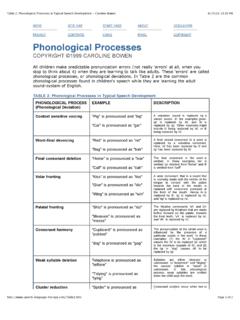
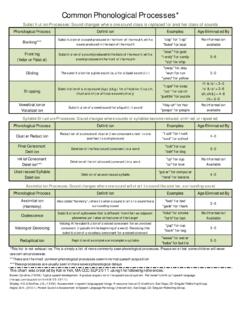
9 Use the same consonants that were used in babbling Commonly use reduplication (repetition of the same syllable - wawa for water , syllable deletion ( nana for banana ), assimilation (one consonant begins to sound similar to another boop for boot , consonant cluster reduction ( boo for blue ), and final consonant deletion ( be for bed ) - Words are selected or avoided for expression based on favoured sounds Children adopted between the ages of 13 and 18 months still showed delays in the Development of four grammatical morphemes ( verb endings -ed, -ing, possessives, and plurals) at 36 months of age. (10) Children adopted from China between 13 and 18 months of age were producing an average of 186 words by 12 months post-adoption. However, considerable variation was observed; the range in vocabulary size was 47 to 326 words.))
10 (1) Children adopted from China between 13 and 18 months of age had a ML3 ranging from approximately 2 to 4 by 9 to 12 months post-adoption. (1) Children between the ages of 11 and 23 months demonstrated a 9 month delay in grammatical morphemes. (11) 18 to 24 months: Pragmatics Semantics Syntax Phonology - New intents include requesting information, answering questions, and acknowledging - Frequency of communicative acts: of free play - Frequency of word use increases over preverbal communication - Says What s that to elicit attention - Uses single word or two-word phrases to command, indicate possession, and express problems - Names objects - Lots of verbal turn-taking - Understands single words for objects out of sight - Listens to simple stories - Average expressive vocabulary of 200 to 300 words by 24 months - Semantic relations understood and spoken include.