Transcription of LATIN CONJUGATIONS AND DECLENSIONS
1 LATIN CONJUGATIONS AND DECLENSIONST eachers often call us around lesson five trying to figure out what exactly is a declension. Read the Latina Christiana I Teacher Manual, pages 3-4 again. It should answer most of your questions. The most important things to remember about CONJUGATIONS and DECLENSIONS are:1. There are five DECLENSIONS and four DECLENSIONS are a system for organizing nouns. CONJUGATIONS are a system for organizing verbs3. DECLENSIONS have cases (Nominative, Genitive, Dative, Accusative, ablative ) which can be singular or plural. (They also have small variances based on whether the noun is Masculine, Feminine or Neuter)4.
2 CONJUGATIONS have 1st, 2nd, & 3rd person which can be singular or plural. They also have six tenses (present, past, etc)NOUNS IN LATIN ( DECLENSIONS ) DECLENSIONS Why are there five DECLENSIONS ? Well, there are many theories on why five. DECLENSIONS loosely group similar nouns together (although this doesn t always hold true). They are a system of classifying words like we have a system for classifying animals (genus, etc.). Also, since the ending of LATIN words (the case) determines the function (subject, direct object, etc), if every LATIN noun was in the same declension, every word in a sentence would have a similar ending.
3 This would have made it very difficult to distinguish words when they were spoken, and you would feel like you were speaking a constant nursery rhyme. Don t worry too much about why the DECLENSIONS exist. Just accept that they are a part of any inflected language like LATIN . All you really need to know about DECLENSIONS is that they tell you what group endings a noun uses. (You will learn different endings for each declension.)CASES In English the function of a noun (subject, direct object, indirect object, etc) is determined primarily by word placement. Notice how changing word order in the sentence below changes the function of the noun.
4 The girl (subject) sees the queen (direct object) The queen (subject) sees the girl (direct object) In LATIN , the function of the noun is determined by the ending. Remember: The endings come from the declension and then the case within that declension. There are five cases, and these cases exist for all DECLENSIONS and have the same functions for all DECLENSIONS . The only thing that changes between DECLENSIONS is the or predicate nounsGenitivepossessive nounsDativeindirect objectsAccusativedirect objects/prepositional objectsAblativeprepositional objects In Latina Christiana I, you will learn two DECLENSIONS , the First Declension and the Second Declension (Masculine & Neuter).
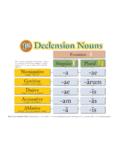
5 The endings for these DECLENSIONS are:First Declension2nd Declension Masculine2nd Declension NeuterSingularPluralSingularPluralSingul arPluralNominativeaaeusiumaGenitiveaearu miorumiorumDativeaeisoisoisAccusativeama sumosumaAblativeaisoisoisLATIN VERBS ( CONJUGATIONS ) CONJUGATIONS There are four CONJUGATIONS . Again, they are a system of classifying verbs and each conjugation has different endings. The important thing to remember about CONJUGATIONS is that they tell you what group of endings a specific verb uses. The endings themselves actually tell you the person (I, you, he/she/it, we, you, they) and the tense (future, past, present, etc.)
6 The tenses and person exist for all CONJUGATIONS and mean the same thing in all CONJUGATIONS . The only thing that changes in different CONJUGATIONS is the There are three persons in LATIN First person: Referring to the speaker or writer. Second person: Referring to the person or thing addressed. Third person: Referring to one that is neither the speaker or writer. In LATIN , the person of a verb is determined by its ending. In English, the person is determined by a noun or personal pronoun and word placement. The person of a verb operates somewhat like the case of a noun.
7 It can be singular or plural and the ending of the verb changes as you change the person. The chart below should help explain person. Notice how the person doing the action and the ending (in bold) changes each CONJUGATION VERB FORMPERSONSINGULARPLURAL1stvoco I callvocamus we call2ndvocas you (singular) callvocatis you (plural) call3rdvocat he, she, it callsvocant they callSIX TENSES The Present tense denotes a state or action in the very moment of the utterance. The Future tense denotes a state or action that will take place in the future. The Future Perfect tense denotes a state or action that will precede another future state or action.
8 The Imperfect tense denotes a state or action that is taking place with another past state or action. The Perfect tense denotes a state or action that has taken place in the past. The Pluperfect tense denotes a state or action that had happened in the remote past or had preceded another past state or action.