Transcription of Lead Metal SDS[2] - Teck
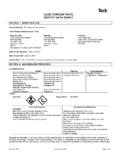
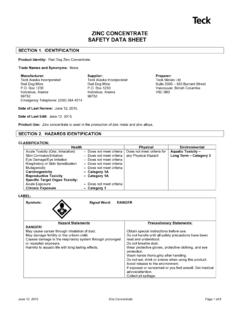
1 June 29, 2015 Lead Metal Page 1 of 6 LEAD Metal SAFETY DATA SHEET SECTION 1. IDENTIFICATION Product Identity: Lead Metal Trade Names and Synonyms: Lead; Pb; Plumbum; Metallic Lead; Inorganic Lead; ASTM B29; TADANAC Lead, Low-Alpha Lead. Manufacturer: Teck Metals Ltd. Trail Operations Trail, British Columbia V1R 4L8 Emergency Telephone: 250-364-4214 Supplier: In : Teck American Metal Sales Incorporated 501 North Riverpoint Blvd, Suite 300 Spokane, WA USA, 99202 Other than : Teck Metals Ltd. #1700 11 King Street West Toronto, Ontario M5H 4C7 Preparer: Teck Metals Ltd. Suite 3300 550 Burrard Street Vancouver, British Columbia V6C 0B3 Date of Last Review: June 29, 2015 . Date of Last Edit: June 29, 2015 .
2 Product Use: Used as a construction material for tank linings, piping, and equipment used in the manufacture of sulphuric acid and the refining and processing of petroleum; used in x-ray and atomic radiation shielding; used in the manufacture of paint pigments, organic and inorganic lead compounds, lead shot, lead wire for bullets, ballast, and lead solders; used as a bearing Metal or alloy; used in the manufacture of storage batteries, ceramics, plastics, and electronic devices; used in the metallurgy of steel and other metals; and used in the form of lead oxide for batteries. June 29, 2015 Lead Metal Page 2 of 6 SECTION 2. HAZARDS IDENTIFICATION CLASSIFICATION: Health Physical Environmental Acute Toxicity (Oral, Inhalation) Does not meet criteria Skin Corrosion/Irritation Does not meet criteria Eye Damage/Eye Irritation Does not meet criteria Respiratory or Skin Sensitization Does not meet criteria Mutagenicity Does not meet criteria Carcinogenicity Category 2 Reproductive Toxicity Category 1A Specific Target Organ Toxicity Chronic Exposure Category 1 Does not meet criteria for any Physical Hazard Aquatic Toxicity Short Term (Acute) Category 3 LABEL: Symbols: Signal Word: DANGER Hazard Statements DANGER!
3 Causes damage to kidneys, blood-forming systems, central nervous system and digestive tract through prolonged or repeated exposure. May damage the unborn child. May cause harm to breast-fed children. Suspected of damaging fertility. Suspected of causing cancer. Harmful to aquatic life. Precautionary Statements: Obtain special instructions before use. Do not handle until all safety precautions have been read and understood. Wear protective gloves/protective clothing/eye protection. Do not breathe dust or fumes. Wash hands thoroughly after handling. Do not eat, drink or smoke when using this product. If exposed or concerned or you feel unwell: Get medical advice/attention. Avoid release to the environment. Emergency Overview: A bluish-white to silvery-grey, heavy, soft Metal that does not burn in bulk.
4 Finely-divided lead dust clouds are a moderate fire and explosion hazard, however. When heated strongly in air, highly toxic lead oxide fumes can be generated. Inhalation or ingestion of lead may produce both acute and chronic health effects. Possible cancer and reproductive hazard. SCBA and full protective clothing are required for fire emergency response personnel. Potential Health Effects: Inhalation or ingestion of lead may result in headache, nausea, vomiting, abdominal spasms, fatigue, sleep disturbances, weight loss, anemia and leg, arm, and joint pain. Prolonged exposure may also cause central nervous system damage, hypertension, gastrointestinal disturbances, anemia, kidney dysfunction and possible reproductive effects.
5 Pregnant women should be protected from excessive exposure in order to prevent lead crossing the placental barrier and causing infant neurological disorders. Lead and inorganic lead compounds are listed as an A3 Carcinogen (Confirmed Animal Carcinogen with Unknown Relevance to Humans) by the ACGIH. IARC has listed lead compounds as Group 2A Carcinogens (Probably Carcinogenic to Humans) while lead Metal is listed as Group 2B (Possibly Carcinogenic to Humans). The NTP lists lead and lead compounds as Reasonably Anticipated to be a Human Carcinogen. OSHA and the EU does not currently list lead as a human carcinogen (see Toxicological Information, Section 11). Potential Environmental Effects: Lead Metal has relatively low bioavailability; however, compounds which it forms with other elements can be toxic to both aquatic and terrestrial organisms at low concentrations.
6 These compounds can be particularly toxic in the aquatic environment. Lead bioaccumulates in plants and animals in both aquatic and terrestrial environments (see Ecological Information, Section 12). SECTION 3. COMPOSITION / INFORMATION ON INGREDIENTS HAZARDOUS COMPONENT CAS Registry No. CONCENTRATION (% wgt/wgt) Lead 7439-92-1 99+% Note: See Section 8 for Occupational Exposure Guidelines. June 29, 2015 Lead Metal Page 3 of 6 SECTION 4. FIRST AID MEASURES Eye Contact: Symptoms: Eye irritation, redness. Gently brush product off face if necessary. Do not rub eye(s). Let the eye(s) water naturally for a few minutes. Look right and left, then up and down. If particle/dust does not dislodge, cautiously rinse eye(s) with lukewarm, gently flowing water for 5 minutes or until particle/dust is removed, while holding eyelid(s) open.
7 If irritation persists, get medical advice/attention. DO NOT attempt to manually remove anything stuck to the eye. Skin Contact: Symptoms: Skin soiling, mild irritation. Gently brush away excess dust. Wash gently and thoroughly with lukewarm, gently flowing water and non-abrasive soap for 5 minutes, or until product is removed. If skin irritation occurs or you feel unwell, get medical advice/attention. Molten Metal : Flush contact area to solidify and cool but do not attempt to remove encrusted material or clothing. Cover burns and seek medical attention immediately. Inhalation: Symptoms: Respiratory irritation. Remove source of exposure or move person to fresh air and keep comfortable for breathing.
8 Seek medical attention if you feel unwell. Ingestion: Symptoms: Stomach upset. If you feel unwell or are concerned, get medical advice/attention. SECTION 5. FIRE FIGHTING MEASURES Fire and Explosion Hazards: Massive Metal is not flammable or combustible. Finely-divided lead dust or powder is a moderate fire hazard and moderate explosion hazard when dispersed in the air at high concentrations and exposed to heat, flame, or other ignition sources. Explosions may also occur upon contact with certain incompatible materials (see Stability and Reactivity, Section 10). Extinguishing Media: Use any means of extinction appropriate for surrounding fire conditions such as water spray, carbon dioxide, dry chemical, or foam.
9 Fire Fighting: Do not use direct water streams on fires where molten Metal is present, due to the risk of a steam explosion that could potentially eject molten Metal uncontrollably. Use a fine water mist on the front-running edge of the spill and on the top of the molten Metal to cool and solidify it. If possible, move solid material from fire area or cool material exposed to flame to prevent melting of the Metal ingots. Highly toxic lead oxide fumes may evolve in fires. Fire fighters must be fully trained and wear full protective clothing including an approved, self-contained breathing apparatus which supplies a positive air pressure within a full face-piece mask. SECTION 6. ACCIDENTAL RELEASE MEASURES Procedures for Cleanup: Control source of spillage if possible to do so safely.
10 Restrict access to the area until completion of clean-up. Clean up spilled material immediately, observing precautions outlined below. Molten Metal should be allowed to solidify before cleanup. If solid Metal , wear gloves, pick up and return to process. If dust, wear recommended personal protective equipment (see below) and use methods which will minimize dust generation ( , vacuum solids). Return uncontaminated spilled material to the process if possible. Place contaminated material in suitable labelled containers for later recovery or disposal. Treat or dispose of waste material in accordance with all local, regional, and national requirements. Personal Precautions: Persons responding to an accidental release should wear protective clothing, gloves and a respirator (see also Section 8).