Transcription of Learning for the - p21.org
1 Learningfor the21st CenturyA Report andMILE Guide for21st Century SkillsThe Partnership for 21st CenturySkills is a unique public-privateorganization formed in 2002 tocreate a successful model of learningfor this millennium that incorporates21st century skills into our system of FoundationApple Computer, in the ClassroomCisco Systems, Computer CorporationMicrosoft CorporationNational Education AssociationSAPKey Department of EducationAppalachian Technology inEducation ConsortiumStrategic partnersConsortium for School NetworkingISTESETDATe c h C o r p sAbout the Partnership for21st Century SkillsLearning for the 21st ofcontentsLetter to America s Education Leaders 2 Executive Summary 3 PartI: Defining the need for change 6 Education that connects to students lives7 Education that reflects how people learn7 Part II.
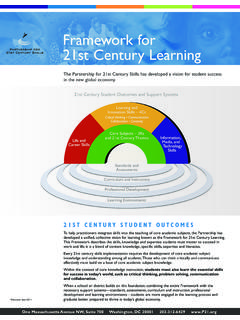
2 The key elements of 21st century Learning 8 Emphasize core subjects8 Emphasize Learning skills9 Use 21st century tools to develop Learning skills10 Teach and learn in a 21st century context12 Teach and learn 21st century content12 Use 21st century assessments that measure 21st century skills14 PartIII: Implementing 21st century skills : nine steps to build momentum 20 Making a difference: How key stakeholders can support the effort24 MILE Guide for 21st century skillscenter insertAppendix A: outreach efforts 26 Appendix B: References 29 Appendix C: Endnotes 31 Appendix D.
3 Acknowledgments 332 Learning for the 21st r r y Crane, President for Education,AOL, behalf of AOLTWF oundationChair, Partnership for 21st Century SkillsJohn WilsonExecutive Director,National Education AssociationVice-Chair, Partnership for 21st Century SkillsAmelia Maurizio, , Educational Alliances ProgramSAPT reasurer, Partnership for 21st Century SkillsSherri BealkowskiGeneral Manager,Education Solutions GroupMicrosoft CorporationKaren BruettDirector of Marketing,Public Sector DivisionDell Computer CorporationJohn CouchVice President for EducationApple Computer, JeanneroSenior Manager, MarketingCisco Systems, O Brien, DirectorCable in the Classroom/NCTAE ducation Foundation Letter to America s education leadersFrom the Board of the Partnership for 21st Century SkillsHow can we best prepare students to succeed in the 21st century?
4 This is a question of paramount importance to America seducators, employers, parents and the public. Our communityvibrancy, personal quality of life, economic viability and businesscompetitiveness depend on a well-prepared citizenry and education provides the bedrock from which our national andindividual prosperity rise No Child Left Behind Act of 2001, which reauthorizesthe Elementary and Secondary Education Act of 1965, emphasizesstudent achievement and requires assessments in core subjects,which are the foundation for Learning .
5 This federal law is focusingthe attention of schools and educators on fundamental knowledgeand is an excellent start. We can do even more. The nationneeds a compelling vision for education that will inspire educationleaders, teachers, parents and students alike. Clearly, we must worktogether to fully prepare people for the challenges of work and lifein the 21st Partnership for 21st Century skills , a unique public-private organization of leaders and educators in business and educa-tion, has come together to help schools fully address the educationalneeds of the 21st century.
6 With this, our first report, we articulate aunified, collective vision for education and a framework for also provide a companion guide for getting started, ourMilestones for Improving Learning and Education (MILE) Guidefor 21st century skills . We developed both the report and the MILEG uide through a comprehensive process involving hundreds ofeducators, researchers and employers across the recognize that we are calling on schools to change dramati-cally even as they face difficult economic challenges and a vigorousdiscussion of student achievement and assessments.
7 However, whilecurrent budget constraints eventually will subside, the long-termneed for 21st century Learning will not: Accelerating technologicalchange, rapidly accumulating knowledge, increasing global com-petition and rising workforce capabilities around the world make21st century skills are committed to promoting a national dialogue about 21st century skills and to resolving issues about teaching eitherbasic skills or21st century skills . Both are essential and, when doneconcurrently, each reinforces the other.
8 We urge you to join thisdiscussion and help us build consensus and momentum for educa-tion that integrates knowledge and skills that are relevant to the 21stcentury. To that end, we are launching a public awareness campaignto engage people in this national dialogue. We are exhilarated by theprogress educators, employers and public leaders have made in pro-moting 21st century skills and contributing to this vision. As youread this report, we hope you will share the Partnership s excitementabout the educational opportunities made possible by the prospectof communities using and adapting this vision to make real progressfor children in the 21st recent years, educators at the local, state and national levelshave focused on improving student achievement the peren-nial top priority of public and school districts have estab-lished rigorous academic standards.
9 Assessments and accountability meas-ures a concerted effort that hasinvolved thousands of educators, employers and community mem-bers nationwide. Schools have responded with strategies to improveteaching and remains, however, a profound gap between the knowl-edge and skills most students learn in school and the knowledge andskills they need in typical 21st century communities and work-places. The Partnership for 21st Century skills , a group of majorbusiness and education organizations, formed in 2002 to work onclosing this gap.
10 The Partnership is committed to promoting anational dialogue about 21st century skills , integrating them intoK 12 schools and encouraging the development of curriculum andassessments that reflect 21st century Partnership s work builds on the significant progress ofrecent years. In fact, the recommendations in this report comple-ment No Child Left Behind and provide a vision for capturing thefull range of 21st century skills in the assessments the law initiative is a broad-based public-private partnership in the finest Partnership is contributing to improving education in severaldistinct ways.