Transcription of “Learning to read Afrikaans”
1 Article from Learning to read Afrikaans by Willemien Kr ger December 2012 To follow up on the previous article on preparing for reading including all ages before 7years, this article will discuss in more depth the specific details on how to learn to read Afrikaans from about 5 or 6 years old (if Afrikaans is the home language). If Afrikaans is the second language, this may wait until first language reading fluency is established. It is not a reading program though, as it describes my own experience with all of my children who all learnt to read. I must admit that I did not have children with specific learning problems such as dyslexia, ADHD, perceptual problems etc. who may require additional attention and care in the process.
2 This article also assumes that a lot of perceptual preparation for reading has been done. For more info on this, read the article Preparing for reading From this quote from Ruth Strang Reading is more than seeing words clearly, more than pronouncing printed words correctly, more than recognising the meaning of isolated word. Reading requires you to think, feel and imagine it is clear that the reading process includes seeing, pronouncing and recognizing skills. What follows is an approach I have followed using some help, but mostly using my own logic. I will try and summarize for easy understanding. Remember also that the phases will overlap quickly eg. when only 3 letters have been learnt, a number of words can be formed.
3 I have personally benefited most by Ruth Beechick s book called A home start in reading (Part of book The 3 R s) where the steps to teach a child to read is explained in detail. In this way one can understand the logic behind the process, and therefore adapt it as well. Following the logic as found in the book, adding my own ideas, the following phases and concepts describe the learning to read Afrikaans process : Phase 1 : Learning to recognize the pictures (how does it look) and sounds (how does it sound ) of the letters of the alphabet = phonics. This phase is relatively easy as only 23 of the 26 available alphabet letters are used in the Afrikaans language. (x, c and q are not used). If a letter a day is taught, this will take only a few weeks, but do not hurry.
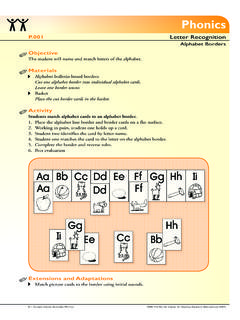
4 The goal is for the child to memorize sound related pictures , and sounds may even represent more than one letter/letter combinations eg. the sound k can be found as the letters k as well as tj or even dj . Start by teaching only the simple one letter sounds before the combinations. Do not follow the alphabet order in learning the letters rather teach letters which are easy to make a word with for example m,a,k,t (with these 4 letters multiple Afr words can be formed eg. ma, mat, mak, kam, tam, tak, kat) Recognizing sounds depends heavily on the vocabulary heard in this language else how will child know how to sound out word like engel where the 2 e letters are sounded out differently. (Afrikaans for angel) sound charts for the specific language (see end of this article for Afrikaans sound charts) are most useful to know all the letters/sounds in the specific language When a new letter has been taught, use simple word books (as shown) to practice recognition of letters let the child find the letter learnt in a word and then you say out the word aloud, accentuating the letter learnt.
5 Search for different words with this letter in, so the child can see that sometimes a letter is at the beginning, or the middle or end of a word. Review until all sounds/letters are recognized/memorized. Read aloud to the child often and include a variety of books. It is useful to practice writing in combination with learning the sounds/letters, then practice of the letters will aid recognition of them. Letters as practiced by my one child is is shown in his notebook. Start teaching small letters first then capital letters. Practice writing letters in different formats and styles eg. large in sand, on blackboard, stickers, colors etc. Phase 2 (overlap phase 1 as soon as words can be formed with letters learnt) : Learning to put a few letters (actually sounds) together to form/say a word = blending.
6 As stated above, as soon as there are 3 or more letters, forming words can start eg. m,a,k,t (with these 4 letters multiple Afr words can be formed eg. ma, mat, mak, kam, tam, tak, kat) Form the words and sound out the letter sounds and help the child see / hear that putting together the sounds makes a recognisable word eg. k a t makes the word (Afr) kat (Eng cat) Practice with the board game Scrabble s little letters to make short words (as shown) Review, review, review and pause the learning of the letters in phase 1 awhile if the child struggles to remember. Keep on reading together word and picture books, and encourage the child to read some of the easy words Phase 3 : Learning to recognize/say words correctly = decoding This phase is similar to the first phase, adding more sound combinations.
7 Here the variety of spelling sounds can become the goal with different vowel and consonant pairs available in the language. Teach each new item in a variety of ways and review until child recognizes the sound and spelling eg. eu , ou , ng This is also where whole words can be taught which are difficult to sound out eg. n (Afr for a) and die (Afr for the) Be patient as this phase may take longer than expected. Phase 4 : Learning to read fluently with comprehension = fluency This phase takes the longest (can even take years), and will become better with practice as the child reads. This phase is what I believe Gr1-3 should be about to read and write fluently in chosen languages. The purpose is to let the decoding skills become automatic (fluent) such that the child is actually reading whole words and not sounding out anymore.
8 Little and often is best (5-10 minutes per day) - every day a little bit works better than trying to do a lot one day and other days nothing. One thing that I have found to be very valuable to assist fluency in reading is to expand my children s vocabulary by letting us read non-fiction books about a variety of topics. The main purpose in these Foundation phase years, was therefore not to learn all the facts but to expand vocabulary by hearing different words . Reading complex words was therefore never an issue, as the children would have just sounded out the letters because they have heard enough vocabulary to be able to guess the sounds. We took turns in reading paragraphs, depending on their skill and mood of the day.
9 Putting in effort to choose good books for their own reading, as well as reading to me, has also been worthwhile. This meant that we did not just read anything for the sake of reading, the choice of books is still important for us. There is a saying to learn to read one must read so keep on reading to your child. Don't quit when they start reading well by themselves, because the brain needs a few hours per day of hearing sophisticated linguistic patterns to develop a good basis for using those language patterns either verbally or in written form. In the market currently there are only a few Afrikaans reading programs, and they will differ in whether it suits your taste or not. The important thing to know is that it should be something you are comfortable with and it should be something you can understand and execute.
10 Remember that the curriculum can be adapted, added to and even changes to better suit your style. From a need for a comprehensive and literature rich program for my own children, in partnership with a language consultant, we developed the Omvattend Afrikaans series for the Foundation phase. The learning to read and write program is: Omvattend Afrikaans Gr1 : Remember that your example and lifestyle will also influence how eager a child wants to learn to read. If reading is a hobby with both parents and a way of relaxing, then children will want to be together doing the reading-thing. But do not compare and do not panic about this basic skill. On the following pages the variety of letters (what is seen with the eye) associated with different sounds (what is heard by the ear) are shown.