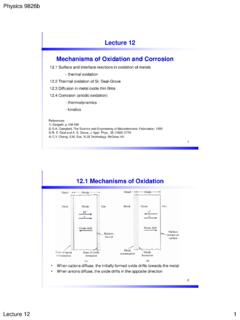
Transcription of Lecture: Diffusion in Metals and Alloys
1 Textbook: Phase transformations in Metals and Alloys (Third Edition), By: Porter, Easterling, and Sherif(CRC Press, 2009). Diffusion and KineticsLecture: Diffusion in Metals and AlloysNikolai V. PriezjevDiffusion in Metals and Alloys Diffusion mechanisms(1) Vacancy Diffusion (2) Interstitial Diffusion (3) Impurities The mathematics of Diffusion (1) Steady-state Diffusion (Fick s first law)(2) Nonsteady-State Diffusion (Fick s second law) Factors that influence diffusionDiffusing species, Host solid, Temperature, MicrostructureReading: Chapter 2of Porter, Easterling, is Diffusion ? Diffusion is material transport by atomic , energy and chemical potential changes during diffusionOil/waterMiscible Why Diffusion ?Interdiffusion and Self-diffusionInterdiffusion (or impurity Diffusion ) occurs in response to aconcentration is Diffusion in one-component material, when all atoms that exchange positions are of the same Mechanisms (I)To jump from lattice site to lattice site, atoms need energy to break bonds with neighbors, and to cause the necessary lattice distortions during jump.
2 This energy comes from the thermal energy of atomic vibrations (Eav~ kBT)The direction of flow of atoms is opposite the vacancy flow Mechanisms (II) small impurity atoms ( C, H, O) to fit into interstices in FluxThefluxofdiffusingatoms,J, (atoms/m2-second)orthemassofatomsdiffusi ngthroughunitareaperunittime,(kg/m2-seco nd).For example, for the mass flux we can writewhere M is the mass of atoms diffusing through the area A during time Diffusion : Fick s first lawSteady-state Diffusion : the Diffusion flux does not change with profile: concentration of atoms/molecules of interest as function of position in the jumps ofnumber B261 BBD 1n2nxCDJBBB 422matoms,smatomsJ ,smxCDBFe/C example:Co1000at Fe ;~ lattice CDjumps/s102 9 Bmpattemps/ju10 :10~ freqvibr 413 Dilute solution!Random walk of a single atomn isnt displacemenet the ,length of stepsn After tr :atoman ofnt displaceme average the t,After time 261 BBD Fe/C example:Co1000at Fe m10~only isnt displacemenet but ~ moves C second 1 Every Einstein relationMean square displacementRandom walk of a single atomn isnt displacemenet the ,length of stepsn After tr :atoman ofnt displaceme average the t,After time 261 BBD Anomalous diffusionFe/C example.
3 Co1000at Fe m10~only isnt displacemenet but ~ moves C second 1 Every effect of temperature thermal activation (I)Interstitial atom, (a) in equilibrium position, (b) at the position of maximum lattice distortion, (c) Variation of the free energy of the lattice as a function of the position of activation m G261 BBD RTGvzBmexp frequency lvibrationa vnumberon coordinati zsecondper jumps ofnumber BEffect of temperature thermal activation (II)261 BBD RTGvzBmexp frequency lvibrationa vRTQDDBB exp0 plots are called Arrhenius activation QRTQRSzvDmB expexp612 of temperature thermal activation (III)261 BBD RTGvzBmexp frequency lvibrationa vRTQDDBB exp0 activation QLow THigh TEffect of temperature thermal activation (IV) of interstitials is typically faster as compared to the vacancy Diffusion mechanism (self- Diffusion ordiffusion of substitutional atoms).Low THigh TEffect of temperature thermal activation (V) Diffusion of a cluster of 10 atoms on a : Temperature dependence of DExample: Temperature dependence of D50C = 2x Diffusion !
4 Nonsteady-State Diffusion : Fick s second ,Fick of this equation is concentration profile as function of time, C(x,t):Nonsteady-State Diffusion : Fick s second Diffusion : HomogenizationThe effect of Diffusion on a sinusoidal variation of sin tlxCCo expsinBDl22 Relaxation time to expInitial concentration profile: increasestion homegeniza of rate decreases, AsllengthBBNonsteady-State Diffusion : Carburization of Diffusion : Carburization of SteelConcentration profiles at successive times for Diffusion into a semi-infinite bar when the surface concentration is maintained constant. DtxCCCCoss2erf)(sCoC1C2C dyyzz 02)exp(2erf C1000at min 17in mm DtxCCCCC2erf222121s/m104D2-11 Nonsteady-State Diffusion : Analytical solution for plane sourceAnalytical solution for plane solution for plane sourceNonsteady-State Diffusion : Analytical solution for plane sourceAnalytical solution for plane sourceNonsteady-State Diffusion : Analytical solution for plane sourceDtx~ Diffusion : Role of the microstructure (I) grainboundaries,dislocationcores, external : Role of the microstructure (II) , , , square Substitutional Diffusion : Self-DiffusionRTGvzvmexp frequency lvibrationa vRTHRS vvev expexpionconcentratvacancy ev261 D RTHHRSSzvDvmvmexpexp612 RTQDDSD exp0vmSDHHQ Metals fccin 12z evvDD /Note:(111) Substitutional Diffusion : DtxDtMC4exp22 Substitutional Diffusion .
5 Self-DiffusionSubstitutional and interstitial alloysDifferent atomic mechanisms of alloy formation, showing pure metal, substitutional, interstitial, and a combination of the Diffusion in Binary Substitutional Alloys (I)xCDJBBB xCDJAAA :lattice the torelativeDiffusion BACCC 0xCxCBA xCDJABB xCDJAAA :RewriteInterdiffusion and vacancy flow. (a) Composition profile after interdiffusion of A and B. (b) The corresponding fluxes of atoms and vacancies as a function of position x. (c) The rate at which the vacancy concentration created or destroyed by dislocation ||||BAJJ BvAJJJ The jumping of atoms in one direction can be considered as the jumping of vacancies in the other direction.(a) before, (b) after: a vacancy is absorbed at a jog on an edge dislocation (positive climb), (b) before, (a) after: a vacancy is created by negative climb of an edge dislocation, (c) Perspective drawing of a jogged edge Diffusion in Binary Substitutional Alloys (II) jumping of atoms in one direction can be considered as the jumping of vacancies in the other direction.
6 :fluxnet Vacancy BAvJJJ xCDDJABAv )(A flux of vacancies causes the atomic planes to move through the keep Cvconstant, vacancies should be createdon B-rich side and destroyed on A-rich side. xJtCvv new Diffusion in Binary Substitutional Alloys (III)BvAJJJ : vplanes lattice ofmovement ofVelocity 0v CtAtAJv # atoms is removed by vacancies crossing plane A# atoms in the volume, which is swept by plane A during time dt0v CJv xCDDJABAv )(0/CCAA xDDABA )(vnew planeA flux of vacancies causes the atomic planes to move through the Diffusion in Binary Substitutional Alloys (IV)But is does not tell us how fast A and B actually Fick s first law for interdiffusionThe total flux of atoms A:AAAACxCDJv Flux due to lattice velocityStandard diffusive flux xDDABA )(vxCDDJABAABA )(BAABDDD ~xCDJAA ~xCDJBB ~BAJJ Diffusion in Binary Substitutional Alloys (V)0/CCAA Interdiffusion coefficient:* Diffusion in Binary Substitutional Alloys (VI)Fick s second law for interdiffusionxJtCAA xCDJAA ~+= xCDxtCAA~BAABDDD ~RTQDD exp~~0 RTQDDBBB exp0 RTQDDAAA exp0 Darken s Diffusion in Binary Substitutional Alloys (VII)An experimental arrangement to show the Kirkendall effect .
7 1947. inert ~ Zn30wt%Cu Diffusion coefficients in the Cu-Ni system at 1000 CCuZnDD W Atomic MobilityDrift velocity is related to the diffusive flux:BBBCvJ 32matoms sm smatoms JCvReasonable to guess that:xMvBBB Some constant Mobility Chemical force per atomAtoms drift down gradientCombine both equations:xCMJBBBB xCDJBBB High Diffusivity PathsRTQDDlll exp0 RTQDDbbb exp0 RTQDDSSS exp0lbSDDD Found experimentally that:The effect of grain boundary Diffusion combined with volume generalBut the size of the highway matters! High Diffusivity PathsCombined lattice and boundary fluxes during steady-state Diffusion through a thin slab of xCDJbb The total flux: xCddDDddJJJlblb w/)ww( xC The apparent Diffusion coefficient: dDDDblapp/ High Diffusivity PathsCombined lattice and boundary fluxes during steady-state Diffusion through a thin slab of The apparent Diffusion coefficient: dDDDD lblapp 1 Grain boundary Diffusion is important: dDDlb dDDDblapp/ nm ~ m 10001~ dGrain boundary Grain size High Diffusivity Paths: Temperature effectsDiffusion in a polycrystalline metalRTQDDlll exp0 RTQDDbbb exp0 Note that: T allat lbDD dDDDblapp/ Metals fccin Low THigh High Diffusivity Paths: Along DislocationsDislocations act as a high conductivity path through the 1710 gIn a well annealed material: -25mmper nsdislocatio 10atoms 10-213mm atoms 10 High T: small lpDDgLow T: only dislocations