Transcription of LECTURES in COMPUTATIONAL FLUID DYNAMICS of …
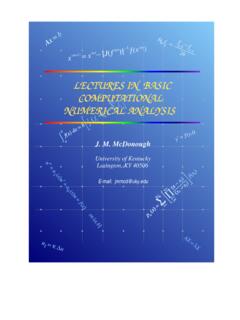
1 LECTURESinCOMPUTATIONAL FLUID DYNAMICSofINCOMPRESSIBLE FLOW:Mathematics, Algorithms and ImplementationsJ. M. McDonoughDepartments of Mechanical Engineering and MathematicsUniversity of Kentuckyc 1991, 2003, 2007 PROLOGUEC omputational FLUID DYNAMICS (CFD) can be traced to the earlyattempts to numerically solve theEuler equations in order to predict effects of bomb blast waves following WW II at the beginning of theCold War. In fact, such efforts were prime drivers in the development of digital computers, and whatwould ultimately come to be termedsupercomputers. Such work was motivated further by the SpaceRace with the (former) Soviet Union, beginning in the late 1950s. The terminology COMPUTATIONAL fluiddynamics, however, was seldom, if ever, used during this early period; moreover, COMPUTATIONAL facilitieswere so inadequate that it was not until the late 1960s that anything even remotely resembling a modernCFD problem could be first book devoted to CFD was written by Patrick Roache during a year-long visit to the MechanicalEngineering Department of the University of Kentucky during 1970 71, and was published the followingyear [1].
2 Computing power at that time was still grossly inadequate for what we today would consideruseful calculations, but significant efforts in algorithm development and analysis were underway in manyleading research universities and national laboratories within the , in Europe (especially France, GreatBritain and Sweden) and in the (former) Soviet , at the beginning of the 21stCentury, CFD can be viewed as a mature discipline, at least inthesense that it has been universally recognized as essential for engineering analyses associated with transportphenomena, and with regard to the fact that numerous commercial computer codes are now available. Suchcodes can be executed even on PCs for fairly complex FLUID flow problems. Despite this, CFD is not alwaysa part of university curricula and, indeed, it is almost never arequiredcomponent for a degree primarilybecause faculty whose backgrounds do not include CFD have yet to retire, and consequently badly-neededcurriculum renovations have not been have offered elective courses on CFD at both graduate and undergraduate levels for the past 12 yearsat the University of Kentucky.
3 But like most universities wedo not have a formal CFD Program in a program should consist of at least one requiredundergraduate course in which students would learnto employ a well-known commercial CFD package in solving real-world engineering problems involvingfluid flow and heat and mass transfer (just has been required infinite-element analysis of structures formany years). Then at least one (but preferably two) graduateclasses in COMPUTATIONAL numerical analysisshould be available possibly through an applied mathematics program. The CFD graduate curriculum,per se, should consist of at leastthe following four one-semester courses:i) CFD of incompressible flow,ii) CFD of compressible flow,iii) turbulence modeling and simulation andiv) grid generation.
4 Clearly,a fifth course on COMPUTATIONAL transport processes and combustion would be very desirable. The twocomputational numerical analysis courses and the first two CFD classes have been taught at the Universityof Kentucky since 1990 with an introduction to grid generation provided in the second of the numericalanalysis classes, an advanced graduate numerical partial differential equations (PDEs) present lecture notes correspond to the first item of the above list. They are written to emphasizethe mathematics of the Navier Stokes (N. S.) equations of incompressible flow and the algorithms thathave been developed over the past 30 years for solving them. This author is thoroughly convinced thatsome background in the mathematics of the N. S. equations isessential to avoid conducting exhaustivestudies (and expending considerable effort in doing so) whenthe mathematics of the problem shows thatthe direction being pursued cannot possibly succeed.
5 (We will provide specific examples of this in Chap. 2of these LECTURES .) Thus, Chap. 1 is devoted to a fairly advanced presentation of the known theory of theN. S. equations. The main theorems regarding existence, uniqueness and regularity of solutions will bepresented, and put into a COMPUTATIONAL context, but without proofs. Omission of these (which tend to beextremely technical, mathematically) is for the sake of engineering students, and we will provide essentialreferences from which mathematicians can obtain proofs andother details of the 2 will be devoted to presentation of a number of basically elementary topics that are specificallyrelated to CFD but yet impact details of the numerical analysis ultimately required to solve the equationsof motion (the N.)
6 S. equations). They are often crucial to the successful implementation of CFD codes,but at the same time they are not actually a part of the mathematical aspects of numerical analysis. Thesetopics include the different forms into which the N. S. equations might be cast prior to discretization,the various possible griddings of the physical domain of the problem that can be used in the contextof finite-difference, finite-element and finite-volume methods, treatment of the so-called cell Reynoldsnumber problem and introduction to checkerboarding associated with velocity-pressure decoupling. Anunderstanding of these subjects, along with competence in the numerical analysis of PDEs (a prerequisitefor this course) will serve as adequate preparation for analysis and implementation of the algorithms to beintroduced in Chap.
7 3. Unlike what is done in most treatmentsof CFD, we will view numerical analysisas an essential tool for doing CFD, but not,per se, part of CFD itself so it will notbe included in Chap. 3 we present a (nearly) chronological historical development of the main algorithms employedthrough the years for solving the incompressible N. S. equations, starting with themarker-and-cellmethodand continuing through theSIMPLE algorithms and modernprojectionmethods. We remark that this isone of the main features of the current LECTURES that is not present in usual treatments. In particular, mostCFD courses tend to focus on a single algorithm and proceed todemonstrate its use in various physicalproblems. But at the level of graduate instruction being targeted by this course we feel it is essential toprovide alternative methods.
8 It is said that those who do not know history are doomed to repeat it, andone can see from the CFD literature that, repeatedly, approaches that long ago were shown to be ineffectivecontinue to resurface and they still are ineffective but mayappear less so because of tremendous increasesin computing power since the time of their last introduction. This happens because researchers simply arenot aware of earlier attempts with these very natural methods. It is this author s opinion that the placeto prevent such wasted effort is in the classroom by presenting both good and bad (and maybe even ugly ) algorithms so they can be analyzed and compared, leading the student to a comprehensive andfundamental understanding of what will and will not work forsolving the incompressible N.
9 S. equations and note at the outset that all details of algorithms will be presented in the context of finite-difference/finite-volume discretizations, and in essentially all cases they will be restricted to two space dimensions. Butthe algorithms,per se, could easily be implemented in a finite-element setting (and in some cases, even forspectral methods). Furthermore, all details and analyses are conceptually easy to transfer to three spacedimensions. The actual construction of working codes, however, is much more tedious in 3D, and studentsare expected to write and debug codes corresponding to various of the algorithms to be presented. So webelieve the 2-D treatment is to be hinted above, this set of LECTURES is intended to be delivered during a (three-unit) one-semester course(or, essentially equivalently, during a four-unit quartercourse) to fairly advanced graduate students whoare expected to have had at least a first course in general graduate numerical analysis, and should also havehad a second course emphasizing numerical PDEs.
10 It is desired to spend as much time as possible focusingon topics that are specific to solution of the incompressibleNavier Stokes equations without having toexpend lecture time on more elementary topics, so these are considered to be prerequisites. LECTURES onthese elements of numerical analysis can be obtained over the Internet as pdf files that can be downloadedby visiting the website acfd and following the links to lecture notes..Contents1 The Navier Stokes Equations: a mathematical Introductory Remarks .. The Navier Stokes equations .. Brief history of mathematical analyses of the N. S. equations .. Why study mathematics of the N. S. equations? .. Some Basic Functional Analysis .. Fourier series and Hilbert spaces.