Transcription of LEGISLATIVE COUNCIL BRIEF - csb.gov.hk
1 File Ref.: CSBCR/PG/4-085-001/80 LEGISLATIVE COUNCIL BRIEF 2018-19 CIVIL SERVICE PAY ADJUSTMENT INTRODUCTION At the meeting of the Executive COUNCIL on 5 June 2018, the COUNCIL ADVISED and the Chief Executive (CE) ORDERED that the following pay adjustment offers for the 2018-19 civil service pay adjustment, to be effected retrospectively from 1 April 2018, should be made to the staff side of the four central consultative councils1 (a) a pay increase of (equals to the net pay trend indicator (PTI) for the upper salary band) for civil servants in the upper salary band and the directorate, subject to the pay points referred to in (i) and (ii) below the dollar values of which should be as specified (i) Master Pay Scale (MPS) 34 at $70,590; and (ii) General Disciplined Services (Officer) Pay Scale (GDS(O)) 20 and Police Pay Scale (PPS) 36 at $70,470, and GDS(O) 21 and PPS 37 at $70,970; (b) a pay increase of (equals to the net PTI for the middle salary band) for civil servants in the middle salary band.
2 And (c) a pay increase of (equals to the net PTI for the middle salary band) for civil servants in the lower salary band, by invoking the bring-up arrangement2. _____ 1 The four central consultative councils are the Senior Civil Service COUNCIL (SCSC), the Police Force COUNCIL (PFC), the Disciplined Services Consultative COUNCIL (DSCC) and the Model Scale 1 Staff Consultative COUNCIL (MOD 1 COUNCIL ). 2 The bring-up arrangement refers to the arrangement to align the pay adjustment for civil servants in the lower salary band with the net PTI for the middle salary band if the latter is higher than the net PTI for the lower salary band.
3 This arrangement was introduced in 1989 upon the recommendation of the Committee of Inquiry into the 1988 Civil Service Pay Adjustment and Related Matters (1988 Committee of Inquiry) (please see paragraph 16 below for details). 2 JUSTIFICATIONS Civil Service Pay Policy 2. The Government s civil service pay policy is to offer sufficient remuneration to attract, retain and motivate staff of suitable calibre to provide the public with an effective and efficient service; and to ensure that civil service remuneration is regarded as fair by both civil servants and the public whom they serve by maintaining broad comparability between civil service pay and private sector pay.
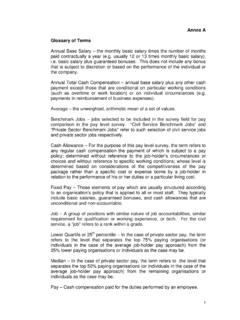
4 To implement this policy, civil service pay is compared with market pay on a regular basis through three different types of survey3 under the Improved Civil Service Pay Adjustment Mechanism endorsed by the Executive COUNCIL in 2007. The PTS is conducted annually, relevant details of which are at Annex A. The 2018 PTS 3. The 2018 PTS has been completed. It covers the 12-month period from 2 April 2017 to 1 April 2018. In the survey, the basic pay and additional pay adjustment data of 157 504 employees in 112 companies, consisting of 155 863 employees in 86 larger companies and 1 641 employees in 26 smaller companies, were collected.
5 The findings of the 2018 PTS are set out below Salary Band4 Basic Pay Indicator [A] Additional Pay Indicator [B] Gross PTI5 [A] + [B] Upper Middle Lower _____ 3 These surveys are (a) the annual Pay Trend Survey (PTS) to ascertain the year-on-year pay adjustment movements in the private sector; (b) the triennial Starting Salaries Survey to compare the starting salaries of civil service civilian grades with the entry pay of jobs in the private sector requiring similar qualifications; and (c) the six-yearly Pay Level Survey to ascertain whether civil service pay is broadly comparable with private sector pay.
6 4 The pay ranges of the three salary bands for the 2018 PTS are (a) Upper: Above MPS 33 to GDS(O) 39 or equivalent, viz. $67,066 to $135,075; (b) Middle: From MPS 10 to 33 or equivalent, viz. $21,880 to $67,065; and (c) Lower: Below MPS 10 or equivalent, viz. below $21,880. 5 The gross PTI is the sum of the basic pay indicator and the additional pay indicator. Basic pay indicators cover salary adjustments awarded to employees on account of: (a) cost of living; (b) general prosperity and company performance; (c) general changes in market rates; and (d) in-scale increment and merit. Additional pay indicators cover adjustments to pay in addition to basic salary, such as the 13th month salary , year-end bonuses, commissions and other non-guaranteed/discretionary/one-off bonuses, etc.
7 Both indicators do not cover changes in fringe benefits and allowances ( housing allowance, stock options and education allowance, etc.). A 3 4. The PTS Committee met and considered the 2018 PTS findings on 24 May 2018. Amongst the ten members who attended the meeting, all validated the findings except one staff side representative of the SCSC who validated the findings with reservation . The two members representing the staff side of the PFC and the other two members representing the staff side of the DSCC had not taken part in the 2018 PTS and hence did not validate the findings6. 5. The PTS Committee submitted its report on the 2018 PTS to the Government on 24 May 2018.
8 The net PTIs, which are calculated by deducting from the gross PTIs the payroll cost of increments7 (PCIs) for the respective salary bands, are as follows Salary Band Gross PTI [C] PCIs in 2017-18 [D] Net PTI [C] [D] Upper Middle Lower The State of Hong Kong s Economy 6. The Hong Kong economy expanded notably by year-on-year in the first quarter of 2018, following an annual growth of in 2017. For 2018 as a whole, the economy is projected to grow by 3% to 4%.
9 The labour market tightened progressively amid the favourable economic conditions, with the seasonally adjusted unemployment rate falling to in February April 2018. Backed by the sturdy labour demand, labour wages and earnings went up steadily throughout 2017. The nominal wage index, which covers regular payment to employees up to the supervisory level, increased by for 2017 as a whole. _____ 6 The staff side representatives of the DSCC and three of the four constituent associations (except for the Superintendents Association which stays in the PTS Committee as an observer) of the PFC have withdrawn from the PTS Committee since 2013.
10 However, the PTS Committee Secretariat has continued to send invitations to meetings, papers and minutes of meeting to them. 7 Payroll cost of increments is the increment payments made to civil servants who have not yet reached the maximum pay point of their rank, expressed as a percentage of total salary payment. 4 Changes in the Cost of Living 7. For the 12-month period ending March 2018, the headline Composite Consumer Price Index (CPI), which reflects the impact of the changes in consumer prices on approximately 90% of households (as compared with CPI(A), CPI(B) and CPI(C) which relate only to approximately 50%, 30% and 10% of households respectively), increased by as compared to the previous 12-month period ending March 2017.