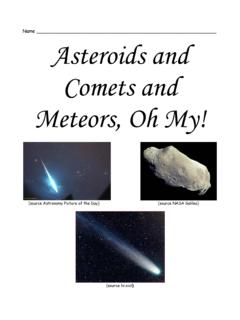
Transcription of Lesson 1: Asteroids, Comets, Meteoroids - …
1 1 Overview:This Lesson examines three types of small bodies found in the solar system: Asteroids, comets, and Meteoroids . Students learn important terminology and examine factors such as thesize, origin, and composition of each. They also study the part these objects play in the formation ofcraters on larger bodies in the solar system. Students apply their knowledge in a hands-on activity thatillustrates differences in size and structure among the three types of small bodies. Follow-up questionsand Lesson extensions are : Upon completion of the Lesson , students will state that asteroids , comets, and meteoroidsare allexamples of small bodies found within the solar system.
2 Following class discussion, students will describe the size of asteroids , comets, and meteoroidsassmaller than planets and moons, and less than 1,000 km in diameter. After being introduced to the similarities and differences among asteroids , comets, and Meteoroids ,students will create a simple scale model showing that the average asteroid is far larger than eithermeteoroids or even the largest Required: Approximately two 45-minute class 1: Topic Introduction Give students copies of Backgroundreproducible. Discuss important terminology and give brief overview of upcoming 2: Lab Activity Students construct a scale model comparing selected physical properties of asteroids , comets, andmeteoroids.
3 Assign Follow-Upreproducible as homework. Use portion of following class period to discuss results and summarize Needed (for each student): metric ruler glue stick or white school glue scissors 2 paper clips unlined paperOptional Materials: colored pencils sand cotton balls variety of seeds and spices for creating models (see next section for details)Steps for Conducting Lab:Day 1: Setup and Topic Introduction Carefully review student Lab Activitysheet to gauge amount of material each student will use;determine amount needed for all classes. Obtain a variety of inexpensive products that students can use to illustrate the three objects (things that represent rocks, ice, iron, dust, ammonia gas, carbon, comet tails, comets, etc.)
4 Select items that will easily stick to paper when affixed with glue stick or white school glue. Most can be found as generics or in bulk at PAGESL esson 1: asteroids , Comets, MeteoroidsSpace Day is sponsored by Lockheed Martin. Photos, clockwise from top left: Jupiterimages; Atlas Photo Bank/Photo Researchers, 1 Determine setup of supplies (for example, in baskets at various lab stations, to be shared by three to four students). Decide where to locate optional lab items. Before lab, give students copies of Backgroundreproducible, discussimportant terminology, and give brief overview of upcoming lab. Copy all required 2: Lab Activity Before class, place required sheets in central location; set up lab supplies.
5 As students enter, have them pick up required reproducibles. Tell class Backgroundreproducible may be used as a reference. Review purpose of activity: to use information about Asteroids, comets, and meteoroidsto create models of each. Review important safety guidelines (for example, no tastingallowed in the laboratory). Point out supplies and discuss the maximum number of items and amount of each that can be used in creating each model. Instruct students to form teams that will share supplies, and 1: asteroids , Comets, Meteoroids (continued)TEACHER PAGESI mages of asteroidsand resources on comets: beliefs about information about Resources powdered drink mix ( comet tail, dust) salt crystals, sugar (ice of comet ) whole oats (ice of comet ) cotton balls (gas around comet ) rice vermicelli noodles ( comet tail) brown or red colored spices such aspaprika and cinnamon (red iron) poppy seeds, tea leaves (carbon) sand, cinnamon (dust, rock) seasoned salts in different types and colors(variety of uses)Below are a few examples of items and how the students might choose to use them.
6 Space Day is sponsored by Lockheed Martin. Photos, clockwise from top left: Jupiterimages; Phil Banko/Stone/Getty 1 Lesson 1: asteroids , Comets, Meteoroids (continued)TEACHER PAGESC onnections to National Science Education StandardsUnifying Concepts and Processes Evidence, models, and explanation Change, constancy, and measurementPhysical Science Properties and changes of properties in matter Motions and forces Transfer of energyEarth and Space Science Earth s history Earth in the solar systemScience in Personal and Social Perspectives Natural hazardsSource:National Research CouncilReproducible Answers: Follow-Up: 1. comets and Meteoroids ; 2. all three can haverock and iron as part of their makeup; 3.
7 Answers will vary;most will probably suggest that larger craters are caused by asteroids , smaller ones by Day is sponsored by Lockheed Martin. Photos, clockwise from top left: Jupiterimages; Larry Landolfi/Photo Researchers, today s Lesson , you will be studying some very important parts of our solar system: asteroids , comets, and Meteoroids . Even though today s scientists consider the three to be small bodies, you will soon see how very big and important they actually are. So, let s find out more about all three!What is considered a small body? Any object in the sky that is smaller than a planet or a moon, such as an asteroid, a comet , or a meteoroidWhat are some things scientists want to know about small bodies?
8 Their size and shape Their composition(what substances they contain) Their origin(where and how they were formed) Their location(where to find them)Asteroid:Size and Shape:Irregular, rocklike fragment; from a few meters up to 1,000 kilometers in diameterComposition:Rock containing carbon; a few have iron and other metalsOrigin:Leftover material from formation of solar systemLocation:Most found between orbit of Mars and Jupiter (asteroid belt)Famous Example:An asteroid s crashing to Earth formed Chicxulub crater inMexico s Yucatan Peninsula; it is thought to be responsible forextinction of dinosaursComet:Size and Shape:Nucleus(center) up to 20 kilometers in diameter; surrounded by gas (two tails, one gasand one dust, which are millions ofkilometers long)Composition:Ice, rock, ammonia and other gasesOrigin:Leftover material from formation of solar systemLocation:They enter the solar system from deep space, orbit near sun,then move far out into space againFamous Examples: comet Halley, comet Hale-BoppMeteoroid:Size and Shape:Irregular, rocklike fragment; a few centimeters up to a few metersin diameterComposition:Rock, iron, or a combination of bothOrigin:Most are broken pieces of asteroids .
9 A few are comet dust (called meteorsif they enter Earth s atmosphere)Location:If they enter Earth s atmosphere and hit the ground, they are meteoritesFamous Example:Iron meteorite found by Mars Exploration Rover Opportunity(first ever found on another planet)REPRODUCIBLEASTEROIDS, COMETS, METEOROIDSB ackgroundSpace Day is sponsored by Lockheed Martin. Photos, clockwise from top left: Alloy Photography/Veer; Phil Banko/Stone/Getty :Astronomers consider asteroids , comets, and meteoroidsto be examples ofsmall bodiesin our solar system. In many ways they are similar: They move atgreat speeds, they have helped scientists learn more about how our universe and solarsystem formed, and they have created fear and wonder in human beings through , however, you will be examining several differencesin these groups.
10 The Backgroundsheet will be a useful reference for this Assignment:Today, you will create a simple scale model that will demonstrate the average relative size,shape, and makeup of the three types of small compare sizes, you will measure and cutstrips of paper so each length represents thediameter of one of the small compare shapes, you will create a sketch ofone of the objects on each of the paper compare makeup, you will select items toglue onto your drawings representing thesubstances in (Creating Scale Model Strips) a plain sheet of whitepaper and turn it four equal stripsof paper, each 5 cm strips (see diagram). one of the paper strips; starting atend of strip, use metric ruler to cm along length of line on strip at cm and cut offthe cm section; this represents thescaled size of a meteoroid; glue the stripto the Data Sheetin the space at the end of strip where the cut was made, repeat the process, but thistime measure 2 cm; again, draw a line at2 cm and cut off the 2 cm section; thissection represents the scaled size of a comet ; glue it to the Data the process, except this timemeasure a line that is 100 cm in length(you will need to measure more than onestrip and add distances together)!