Transcription of Lesson Plan 10: Using In-text Citations - …
1 Lesson Plan 10: Using In-text Citations TEACHER: _____ Date: _____ TOPIC/SUBJECT: Parenthetical Citations , End Notes, and Title Page STANDARDS/CURRICULUM OUTCOME(s): - Grade Level: 4-12 - Content Area: English - Standards Met: , , , , , ELA 5 H3, H4, H5 - Source of Curriculum Standards: OBJECTIVE (s): This set of activities is intended to familiarize students with the importance of identifying the elements of Citations . Furthermore, students practice recognizing and Using different forms of In-text Citations , while recognizing the instance of such within textual examples.
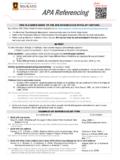
2 Activity (Set, presentation, application, and closure): Using In-text Citations 1. Ask students what they know or understand about when it is important to give credit for a source within the body of the text of a paper, blog post, or web page. 2. Discuss what purpose In-text Citations may serve, making a list on a whiteboard or other commonly visible location. 3. Pass out a copy of the Purdue Online Writing Lab (OWL) Handout: Using In-text Citations , beginning with either the MLA or APA examples. 4. Ask students to read to themselves the first paragraph on the handout from Ashley Montagu s book The American Way of Life.
3 5. Ask one or two volunteers to verbally paraphrase the meaning of the paragraph to test students understanding of both the meaning of the paragraph and how to put it into their own words. If they use the exact words of the author, prompt with the question, Can you think of another way to say that? or Are there some other words that would mean the same thing as _____ ? 6. Read through each sample In-text citation from the OWL worksheet with students, asking them a. comment on the differences among the examples b. identify the essential information that all the examples have in common 7.
4 Ask students to comment on when and why they might use one form of In-text citation versus another. 8. Pass out an article excerpt at an appropriate reading level for the class, preferably one on a topic related to students research interests. 9. Ask students to read the excerpt to themselves and then write a short paraphrase that exemplifies their understanding of the text. Review a few of their paraphrases orally to make sure students understand the main points of the text. 10. Next have students choose three to four different styles of In-text Citations and have them write Citations for the article (on a transparency, if available) as exemplified in the previous handout.
5 11. Either at the end of class or in the following class, anonymously project the student citation examples containing errors on an overhead projector. Have students try to identify the errors. Sample errors may include the following: a. Students have not referenced all of the authors. b. Students have attributed ideas to the wrong source. c. Students have "over cited" by referring to the author within text as well as within the parenthetical citation . d. Students have used single and double quotation marks incorrectly. MATERIALS / RESOURCES: 1.
6 Chalkboard/whiteboard 2. Paper 3. Writing utensils 4. Smart board/digital overhead display 5. Computer with internet access 6. Handout: Using In-text Citations . Purdue Online Writing Lab, The Writing Lab & The OWL at Purdue and Purdue University, 2012. < > ASSESSMENT: Students will be evaluated on the following criteria: - Overall attentiveness - Responsiveness during discussion sessions - Student paraphrasing of articles in steps 8-10 OUTCOMES: _____