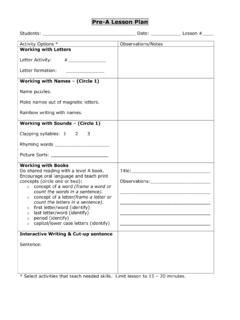
Transcription of LESSON PLAN TEMPLATE CLARIFYING DETAILS
1 Differentiated LESSON plan : Section 4 Part A: Objectives Definition: the intended learning outcomes of the LESSON - What is now known? What can now be done? How have the attitudes changed? Must be described in performance terms. 1. Provides a basis for instructional planning 2. Objectives should not Be stated in terms of teacher performance ( Teach students scientific concepts ) Be stated in terms of the learning process ( TSW learn scientific concepts ) Be context dependent ( TSW read and summarize the main scientific concepts found in chapter 6 ) Focus on the subject-matter topics ( TSW learn the meaning of osmosis, photosynthesis, etc. ) Contain two or more objectives in one statement 3. Exemplary objectives TSW describe the function of each part of the circulatory system TSW distinguish between a square and a rectangle TSW list the major battles of World War II in chronological order TSW explain the importance of neatness Part B: State/District Standards/Learning Targets Definition: statements about what students should know/be able to do, what they might be asked to do to give evidence of learning, and how well they should be expected to know/do it.
2 Content standards refer to what students should know and be able to do Performance standards tell how students will show they are meeting a standard Proficiency standards indicate how well students must perform 1. The WMAS /Common Core Standards serve as the general framework upon which instructional planning occurs. There must be a clear, unambiguous link between the general standard and the LESSON s learner objectives Limiting the number of standards grounding a given LESSON is highly recommended 2. Examples of this linkage between Standards and Learning Targets: Common Core: Eng/LA-A - Write narratives to develop real or imagined experiences or events using effective technique, descriptive DETAILS , and clear event sequences. Objective: TSW organize an event sequence that unfolds naturally.
3 WMAS: Science Understand the structure and function of cells, organs, tissues, organ systems, and whole organisms. Objective: TSW name the elements of a plant cell and describe the function of each. Part C: Definitions of Targeted Terms Definition: The section of the plan where you identify the key vocabulary are noted, including expected definitions at the formal (content related) and grade-level appropriate levels. Appropriate for all lessons, not just those focusing on teaching key vocabulary Recording expected definitions ensures multiple sections come away with the same conceptual understanding. Part D: Pre-Assessment Definition: The section of the LESSON plan where any appropriate assessment is conducted to determine learner readiness May consist of formal or informal assessment activities Focus is on assessing depth and accuracy of background knowledge critical to mastering the LESSON s objective(s).
4 Part E: Pre-requisite Skills Definition: The section of the plan where you identify all of the skills students need in order to participate in the day s LESSON Provide a plan for supporting learners who may not have these skills Consider how you intend to teach the skills or modify the LESSON to accommodate learners lacking these requisite skills Part F: Impact on Planning Definition: The section of the plan where you describe how the information gained from Part D (pre-assessment) and Part E (Pre-requisite Skills) impacts your LESSON . Part G: Advanced Preparation Reminders Definition: The section of the plan where you note all of the preparatory items needed for the LESSON . Serves to organize your preparations Note the agenda for the day to ensure you review it with the students If using technology, indicate what needs to be set up and practiced prior to the LESSON Part H: Materials and Assistive Technology Definition: The section of the plan where you indicate the types and quantities of materials necessary for the LESSON Include all materials and resources as well as the numbers of each Describe any unique material considerations for specific students Identify any types of assistive technology (high or low tech) that may be useful for any student to help them to do a particular step in the LESSON Part I: Duration of the LESSON Definition.
5 The section of the plan where you indicate the anticipated length of the LESSON Ensure that the total time listed here matches the accumulated time indicated in Part M of the plan . Anticipated timing helps assess the LESSON when completing the post- LESSON reflection by comparing actual time spent to the anticipated time allotted Part J: Student & Room Arrangement Definition: The section of the plan where you indicate any student grouping or room arrangement necessary for the LESSON . Indicate what physical arrangements may be necessary to ensure student success Describe the grouping method if applicable Part K: Teaching Strategies Definition: The section of the plan where you list the strategies chosen to help the students meet the learning objectives of the LESSON Indicating the strategies available to the teacher that are consistent with the stated objectives provides support during the LESSON if the primary strategy proves ineffective Listing of selected strategies proves useful when completing the post- LESSON reflection as it allows quick access to your strategy tendencies Allows additional support for a substitute as they review the plan in preparation of the LESSON , allowing them the opportunity to determine their familiarity with the planned approach and modify it if necessary Part L: Behavioral Considerations Definition.
6 The section of the plan where you indicate the behavioral strategies employed to keep all students engaged Indicating the strategies available to the teacher that are consistent with the stated objectives allows the teacher to anticipate interventions for students who may exhibit challenging behaviors during the LESSON Indicating positive supports you have in place provides additional support for a substitute who may be called upon to teach this LESSON in your absence LESSON plan TEMPLATE CLARIFYING DETAILS Part M: Detailed Outline Definition: The section of the plan where you provide, in detail, each step that leads to student mastery of the stated learner objective during the LESSON 1. Creative Introduction Definition: A mental set that causes students to focus on what will be learned.
7 It may also give practice in helping students achieve the learning and yield diagnostic data for the teacher. Example: Look at the paragraph on the board. What do you think might be the most important part to remember? There must be a clear and obvious link between the LESSON s opening and the stated objective(s) An effective anticipatory set serves to hook the students and establishes the learning climate. Get the students excited about your LESSON and their learning! Key Questions and Anticipated Student Responses - Located between all steps in Part M Definition: An opportunity to assess students understanding of the current step. By indicating anticipated responses, you can plan how to revisit a key point if acceptable responses are not received or how to know when to move ahead to the next step.
8 Planning such questions ensures they are asked and prevents teachers from assuming understanding and moving ahead before the learners are ready. Notes - Located between all steps in Part M Definition: Points between each step of Part M where the teacher can make anecdotal comments during delivery of the LESSON . Eliminates the need to remember thoughts regarding the effectiveness of a particular LESSON part or for noting improvements or modifications for the future These sections remain blank during the planning process. Entries are made as the LESSON unfolds. 2. Explaining Behavioral Objectives Definition: The point in the Introduction where you review the items indicated in Part L. Especially helpful for a substitute should they need to teach this LESSON Demonstrates the importance of reinforcement as key to deep learning 3.
9 Sharing Agenda & Objectives Definition: The point in the Introduction where you share an overview of the LESSON and the specific learner objectives you expect the students to achieve by LESSON s end Provides students with a known purpose for what they are about to do Assists a substitute in communicating what was accomplished during the LESSON . Transition - Located between Steps 3/4, 4/5, 5/6, and 6/7 Definition: an explicit statement indicating how you will move from one phase of the LESSON to another physically and/or verbally. Keep the learners actively engaged during transitions Helps learners recognize that they are switching gears . Transitions help LESSON flow from one part to the next. Example: As you move into your groups to begin working on the sample problem, identify three key pieces of information necessary for coming up with a solution.
10 4. LESSON : Steps of Instruction - Not meant to be a script Definition: The phase of the LESSON where students acquire new information about the knowledge, process, or skill they are to achieve. Explicitness is critical Exactly how will you teach them what they need to know? A clear and explicit link to the LESSON s standards and objectives is obvious Demonstrate good questioning skills. Write out many of the main questions you will ask. Use recall as well as various types of critical thinking questions-Bloom s Taxonomy Include sufficient detail to allow a substitute teacher to deliver the instruction in the manner you planned 5. Guided Practice Definition: Students practice using their new knowledge or skill under direct teacher guidance.