Transcription of Lesson Skill: Differentiate between formal and informal ...
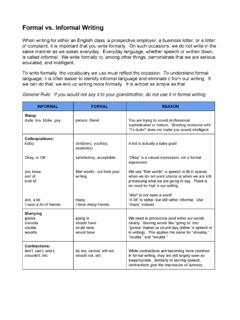
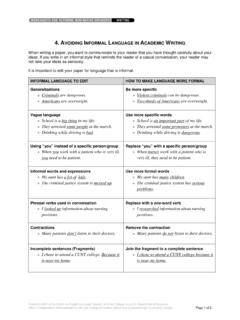
1 English Enhanced Scope and Sequence Lesson Skill: Differentiate between formal and informal language Strand Communication SOL Materials Copies of the words to three formally written speeches, songs, or documents that students are familiar with ( , The Pledge of Allegiance, The Gettysburg Address, The National Anthem, The Preamble). Provide 10 copies of each document, or enough copies so that when students work in groups of three, each student in the group is working with a different document. Note to a Friend/Text Message sheet Standard English formal and informal language Evaluation Lesson 1. Review characteristics of formal language and informal language . Ask students to discuss when to use formal language . Remind them to consider audience and purpose. 2. Tell students they are going to be rewriting history by changing formal text into informal language they would use with friends.
2 3. Give each student a copy of The Preamble. Project a copy onto a screen. Display a copy of the note to a friend. Model through a think aloud, revising the formal language in The Preamble to informal language as you compose a note to a friend. Point out the similarities and differences. 4. Project a copy of the text message form. Repeat the modeling process by simplifying the note to a friend as you compose a text message or blog post. Point out similarities and differences. 5. Organize students in groups of three. Have them work with their backs to each other so they are not able to see what others in the group are writing. Give each student in the group a different document. 6. Students use the original document they receive to write a note to a friend (template attached), conveying the message using informal language . They should not directly reveal the document by using the title.
3 Specify that the note may not use any text message abbreviations. After about ten minutes, have students pass notes to their right. 7. Each student should have an informal document based on a formal document. Challenge each student to take the note to a friend and condense it to a text message or post they would consider making on a social media network (template provided). 8. Have students pass the text message to the right. When the students receive their text message, they should try to guess the formal basis for the text, and write their guess on the message. 9. Have students reposition their desks so they can now face each other and discuss their findings. Review and discuss the original documents, notes to a friend, and text messages. 10. Students fill out the Standard and informal English Evaluation Form. English Enhanced Scope and Sequence Strategies for Differentiation Allow for groups of six instead of three so students may partner read and collaborate to create the note to a friend and text message.
4 Allow students to use available technology to type a note to a friend and a text message. For selected students, model the completion of the Standard and informal English Evaluation Form using the versions that were modeled for the class. For selected students use available technology to allow them to access audio and/or video recordings of the historical documents. English Enhanced Scope and Sequence Note to a Friend Transpose the original document into language you would use to retell the information to a friend. Do not reveal the title of the document when you transpose the contents. _____ English Enhanced Scope and Sequence Text Message Rewrite the information from the letter to a friend into a text message or blog post. When you receive this message, guess what the original document is. I think this message is based on _____. English Enhanced Scope and Sequence Standard English and informal language Evaluation Name _____ The message was based on _____ I was able to correctly guess the origin when I received my message __ yes __ no How many members of your group correctly identified the original source of their message?
5 _____ Review the original documents, notes to a friend, and text messages/blog posts with your group members. Fill in a chart for the three works you evaluated: Check which version you like the best In the three lines below, list specific reasons why you prefer the version you chose. The Pledge of Allegiance Note to a friend Text Message Check which version you like the best In the three lines below, list specific reasons why you prefer the version you chose. The Gettysburg Address Note to a friend Message Check which version you like the best In the three lines below, list specific reasons why you prefer the version you chose. The National Anthem Note to a friend Message English Enhanced Scope and Sequence Reflection There are strengths and benefits of formal and informal language . Use formal language to write a paragraph reflecting on what you learned.
6


![Formal and Informal Essays[1] - OpenStudy](/cache/preview/5/2/f/9/6/a/b/d/thumb-52f96abd94d259826824a181c6312ef5.jpg)