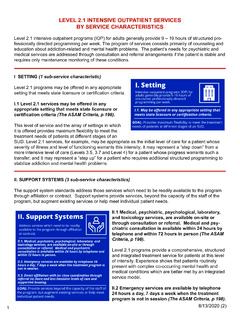
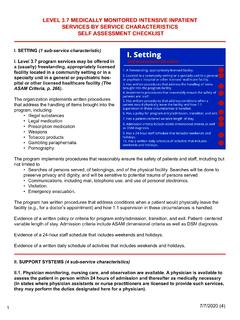
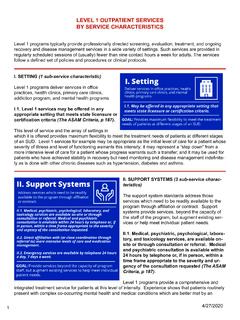
Transcription of Level 3.1 by Service Characteristics
1 Level clinically MANAGED LOW-INTENSITY RESIDENTIAL SERVICES BY Service CHARACTERISTICSL evel programs typically combine clinical services with recovery residential services. This LoC is ap-propriate for patients who require additional time in a structured residential setting in order to 1) improve essential skills and 2) prepare for successful transition to a lesser LoC. (The ASAM Criteria, p. 222) (1 sub- Service characteristic)A 24-hour supervised residence provides a safe, secure environment where patients can develop/practice early recovery skills such as resilience and refusal; experience the support of others in a recovery-oriented setting; and prepare for a successful transition to the Level program services may beoffered in a (usually) freestanding,appropriately licensed facility located in acommunity setting (The ASAM Criteria, ).
2 Experience teaches that many SUD/COD pa-tients require the support and structure of aresidential environment to fully stabilize in recov-ery, with the goal of successfully transitioning toa lower (outpatient) LoC. The extended stays atthis Level may facilitate this transition, assist withengagement in the community, and result in improved treatment SYSTEMS (4 sub-servicecharacteristics)Support services enhance the treatment experience and should be readily available to program staff in response to patient need, and may be provided through affiliation or agreement with other providers. Support services are ordinarily beyond the scope or capacity of the program, but may augment existing services or help meet individual patient Telephone or in-person consultation with aphysician and emergency services are available24 hours a day, 7 days a week(The ASAM ).
3 Patients are medically stable and the role of medicalstaff is as-needed rather than through direct serviceprovision. Affiliations with qualified providers providetelephone consultation, and policies and proceduresare established for emergency (2) Level programs have direct affiliations with other levels of care, or close coordinationthrough referral to more and less intensive levels of care and other clinical or support services(The ASAM Criteria P 224). Level should be viewed in the context of a large network of LoCs that can meet the needs ofpatients at varying stages of treatment. The program should establish relationships with providers topermit smooth, ideally seamless transition between levels, according to patient status as determined byASAM The program has the ability to arrange for needed procedures (including indicated labora-tory and toxicology tests) as appropriate to the severity of the patient s condition (The ASAMC riteria p 224).
4 Level patients may require services such as dental care, laboratory testing or toxicology that can beaccessed through affiliation or arrangement with qualified providers in the The program has the ability to arrange for pharmacotherapy for psychiatric or anti-addictionmedications (The ASAM Criteria, p 224).Research indicates that appropriate use of pharmacotherapy can benefit patients and improve treatmentoutcomes at Level These services can be assured through relationships or affiliations with commu-nity providers, with facilitated access via transport assistance. (The ASAM Criteria, pp 439 441).III. STAFF (3 sub- Service Characteristics )Staffing at Level shall be sufficient in number and appropriately qualified to meet the needs of patients.
5 Regular training shall be conducted in order to maintain a standard of best Allied health professional staff, such ascounselor aides or group living workers, areavailable on-site 24 hours a day or as requiredby the licensing regulations (The ASAM Crite-ria, p. 224).Allied direct care are an integral part of treat-ment at many Level programs. They provide24-hour support for and monitoring of patients andpatient Clinical staff who are knowledgeableabout the biological and psychologicaldimensions of substance use disorders and their treatment, and are able to identify the signsand symptoms of acute psychiatric conditions, including psychiatric decompensation (TheASAM Criteria, p 224).
6 In order to deliver quality services, clinical staff must possess an understanding of the biological andpsychosocial dimensions of SUDs and the skills to recognize and respond to signs of acute The Level program has a team comprised of appropriately trained and credentialed med-ical, addiction, and mental health professionals (The ASAM Criteria, p. 224).A treatment plan is at its most effective when implemented by a multidisciplinary team of qualifiedprofessionals, representing medical, addictions, and mental health (2)2IV. THERAPIES (10 sub- Service Characteristics ) Level programs shall include a range of therapies and therapeutic modalities useful to the patient.
7 Evidence-based approaches are preferred. The program should maintain capacity to provide various types of therapy in response to patient need. Each treatment day shall be designed to meet patient needs. Some services are typically offered through affiliation with community providers, rather than directly, and may be offsite. Policies and procedures ensure successful communication and informa-tion-sharing among Therapies are designed to improve thepatient s ability to structure and organize thetasks of daily living and recovery (The ASAMC riteria, p. 225).The structure and support of Level programsprovides a unique opportunity to assist patientsin building skills to facilitate successful transitionto autonomous function in the activities that foster a sense of per-sonal responsibility, respect and regard for others, and that reinforce prosocial attitudes are a key to success at this Planned clinical program activities(constituting at least 5 hours per week ofprofessionally directed treatment) to stabi-lize and maintain the stability of the patient ssubstance use disorder symptoms, and tohelp him or her develop and apply recoveryskills.
8 Activities may include relapse preven-tion, exploring interpersonal choices, anddevelopment of a social network supportiveof recovery (The ASAM Criteria, p. 225).Regular involvement in evidence-based thera-peutic activity has demonstrated value at thisLoC. Topics should focus on practical aspects ofrecovery such as relapse prevention, effectivedecision-making, and making use of peer sup-port and community-based services in recovery.(The ASAM Criteria, pp 222- 224). Addiction pharmacotherapy (The ASAMC riteria ).Programs can substantially improve outcomesby supporting patients who decide to make useof Medication Assisted Treatment for opioid, alcohol, and tobacco use disorders.
9 The program can provide helpful information as well as facilitate Random drug screening to monitor and reinforce treatment gains as appropriate to thepatient s individual treatment plan (The ASAM Criteria, P. 225).Studies have shown that appropriate use of random unannounced drug screens can substantially3/9/2020 (2)3increase treatment compliance. Testing is individualized and coordinated with the treatment plan. (ASAM Appropriate Use of Drug Testing in Clinical Addiction Medicine Document). Motivational enhancement and engagement strategies appropriate to the patient s stage ofreadiness to change are used in preference to confrontational strategies (The ASAM Criteria, p225).
10 According to research findings, the use of motivational enhancement strategies can positively impactreadiness for change as well as promote positive engagement in treatment. (The ASAM Criteria, pp222 224). Counseling and clinical monitoring to support successful initial involvement or re- involve-ment in regular, productive daily activity (such as work or school) and, as indicated, successfulreintegration into family living. Health education services are provided (The ASAM Criteria, p225).The Level therapeutic program is an appropriate setting in which to address patient needs with re-gard to employment or education; reintegration into the family; and better health and nutrition that educate, inform, and build skills in these areas directly benefit the Regular monitoring of the patient s medication adherence (The ASAM Criteria, ).