Transcription of Level 3.7 by Service Characteristic
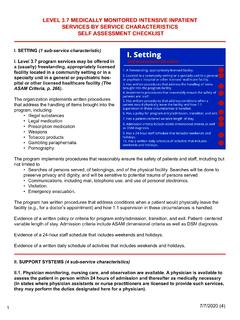
1 Level MEDICALLY MONITORED INTENSIVE INPATIENT SERVICES BY Service CHARACTERISTICSL evel programs are appropriate for patients whose subacute biomedical and emotional, behavioral, or cognitive problems are so severe that they require inpatient treatment, but who do not need the full resources of an acute care general hospital or a medically managed inpatient treatment program. (The ASAM Criteria, p. 265)I. SETTING (1 Sub- Service Characteristic ) Level programs provide a planned and structured regimen of 24-hour professionally directed evaluation, observation, medical monitoring, and addiction treatment in an inpatient Level program services may be offered in a (usually) freestanding, appropriately licensed facility located in a community setting or in a specialty unit in a general or psychiatric hospital or other licensed healthcare facility (The ASAM Criteria, p. 266).This Level , characterized as subacute, provides services and supervision not available at lower levels.
2 Patient needs ordinarily involve enhanced medical and/or psychiatric care and are met through access to a specialized unit with services that comply with standards presented in this SUPPORT SYSTEMS (4 sub- Service characteristics)The support system standards address those services which need to be readily available to the program through affiliation or contract. Support systems provide services, beyond the capacity of the staff of the program, which will not be needed by patients on a routine basis or services to augment those provided by Physician monitoring, nursing care , and observation are available. A physician is available to assess the patient in person within 24 hours of admission and thereafter as medically necessary (In states where physician assistants or nurse practitioners are licensed to provide such services, they may perform the duties designated here for a physician).A registered nurse conducts an alcohol or other drug-focused nursing assessment at the time of admission.
3 An appropriately credentialed and licensed nurse is responsible for monitoring the patient s progress and for medication administration (The ASAM Criteria, p. 266).Higher acuity in some patients dictates the need for 24 hour nursing care and direct involvement by the physician or other qualified Additional medical specialty consultation, and psychological, laboratory, and toxicology ser-vices, are available on-site, through consultation or referral (The ASAM Criteria, p. 267).13/9/2020 (2)Key services must be readily available in order to meet patient needs with respect to medical and mental health care . This includes specialty consultation, laboratory and toxicology, pharmacy and drug testing, among other services. Where not available onsite, these needs may be met through affiliation and agreement, in accordance with established policies and ASAM Level programs have the ability to provide coordination of necessary services, or other levels of care are available through direct affiliation or referral processes (such as step-down services for continuing care and/or medical follow-up services) (The ASAM Criteria, p.)
4 267).Although separate, the Level unit is an integral part of a larger network involving multiple LoC and providers who work together to meet complex and changing patient needs. The involvement of multi-ple levels of care requires coordination and smooth communication to ensure quality and continuity of Psychiatric services are available on-site, through consultation or referral, when a presenting issue could be attended to at a later time. Such services are available within eight (8) hours by telephone or 24 hours in person (The ASAM Criteria, p. 267).Psychiatric services are a frequent requirement at Level Prompt access is essential, both to meet patient needs and to prevent crises. Services may be provided directly, through affiliation or agreement, or through consultation and referral, so long as care is appropriately matched to STAFF (3 sub- Service characteristics)ASAM staff standards address the composition and competencies of professionals on the staff of the An interdisciplinary staff (including physicians, nurses, addiction counselors, and behavioral health specialists) who are able to assess and treat the patient and to obtain and interpret infor-mation regarding the patient s psychiatric and substance use or addictive disorders (The ASAM Criteria, p.
5 268). Level services are best provided by a multidisciplinary team that includes medical, addictions, and behavioral health professionals. Core competencies shall reflect each member s role in patient care . A qualified Program Director shall provide administrative Clinical staff knowledgeable about the biological and psychosocial dimensions of addiction and other behavioral health disorders, and with specialized training techniques and evidence-based practices. The staff is able to provide a planned regimen of 24-hour, professionally 23/9/2020 (2)directed evaluation, care , and treatment services (including administration of prescribed medications) (The ASAM Criteria, p. 268).To provide quality services, clinicians at Level must be knowledgeable re SUDs, CODs, their treatment and recovery. This includes EBPs and medical/nursing care of the subacute A licensed physician to oversee the treatment process and assure the quality of care . Physicians perform physical examinations for all patients admitted to this Level of care .
6 Many states require that the physician serving as medical director for a Level treatment program be a certified addiction medicine physician or addiction psychiatrist. These physicians have specialty training and/or experience in addiction medicine or addiction psychiatry and, if treating adolescents, experience with adolescent patients in this Level of care receive ad-diction pharmacotherapy, integrated with psychosocial therapies. The provider of such care can be a physician assistant or other licensed independent practitioner with prescribing authority who is knowledgeable about addiction treatment, especially pharmacotherapies (The ASAM Criteria, p. 268).A qualified physician / addiction specialist serves as Medical Director, with responsibilities that include oversight of care as well as supervision of other physicians or licensed THERAPIES (10 sub- Service characteristics)ASAM therapies standards cover the range of therapies that programs need to be capable of offering to ensure they meet the personalized biopsychosocial needs of the patients they treat.
7 Not all listed thera-pies must be provided to each person served, but the program should have the capacity to provide each of these as needed, and each day should include activities designed to meet the needs of the patients as defined in their individual treatment Daily clinical services (provided by an interdisciplinary treatment team) to assess and ad-dress the patient s individual needs. Clinical services may involve appropriate medical and nurs-ing services and individual, group, family, and activity services (The ASAM Criteria, p. 269).The patient at Level can benefit from daily programming by professional staff, which may include medical and nursing care as well as activities to improve motivation, enhance readiness for change, build recovery skills, and prepare for transition to a lower Planned clinical program activities to stabilize the acute addictive and/or psychiatric symptoms. Activities may include pharmacological, cognitive-behavioral, and other therapies administered to the patient on an individual and/or group basis.
8 Such activities are adapted to the patient s Level of comprehension (The ASAM Criteria, p. 269).33/9/2020 (2)Research has demonstrated that the use of evidence-based cognitive and behavioral therapies in both group and individual formats can improve outcomes for SUD / COD patients. Level also presents a unique opportunity for education, counseling, and involvement in MAT. Programs may provide these services directly or through affiliation/ Counseling and clinical monitoring to promote successful initial involvement or re-in-volvement in, and skill building for, regular, productive daily activity ( , work or school) and, as indicated, successful reintegration into family living (The ASAM Criteria, p. 269).As at other residential LoC, the patient at may benefit from assistance in planning and implement-ing lifestyle changes that center on productive daily activity rather than substance use. Likewise, family and significant others can be encouraged to partic-ipate and develop their own skills for meeting the challenges of early Random drug screening to shape behavior and reinforce treatment gains, as appropriate to the patient s individual treatment plan (ASAM Criteria, ).
9 Studies have shown the value of random drug screens in monitoring and maintaining compliance with treatment regimens, particularly with respect to lapse and relapse. Monitoring works best when integrated with the treatment plan and adjusted in response to changes in patient Regular monitoring of the patient s adher-ence in taking any prescribed medications (The ASAM Criteria, p. 269).Medications used by patients may include drugs for addiction or mental health disorders; meds prescribed for various health needs; and OTC preparations. Predictably, non-adherence to medication regimens is a common problem. To improve outcomes, programs should establish procedures for monitoring compliance, both during treatment and to prepare for transition to a lower Planned clinical program activities de-signed to enhance the patient s understanding of his or her substance use and/or mental disor-ders (The ASAM Criteria, p. 269).Patients in treatment often have significant gaps in knowledge and understanding of SUDs and CODs, including their own.
10 Left unaddressed, misconceptions contribute to poor treatment response and even-43/9/2020 (2)tually to relapse. Accordingly, the program provides accurate, current, evidence-based information about causes, consequences, and treatment of these health education services associated with the course of addiction and, as appropriate, oth-er potential health -related risk factors ( , HIV, hepatitis C, sexually transmitted diseases) (The ASAM Criteria, p. 269).Substance use increases risk for a host of health conditions, acute and chronic. To lower risk, promote health , and teach disease management, the curriculum should include patient education on related Evidence-based practices, such as motivational enhancement strategies and interventions appropriate to the patient s stage of readiness to change, designed to facilitate the patient s under-standing of the relationship between his or her substance use disorder and attendant life issues (The ASAM Criteria, p. 269).Lack of motivation, along with ambivalence towards change, are common barriers to success in treat-ment.