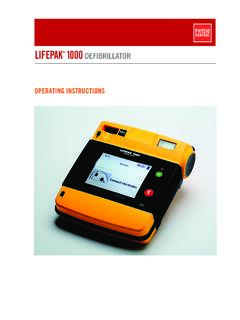
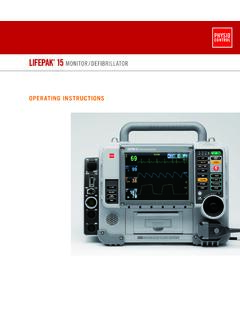
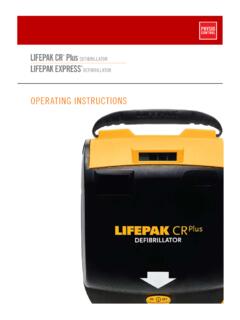
Transcription of LIFEPAK1000 DEFIBRILLATOR - Stryker
1 LIFEPAK1000 DEFIBRILLATOR OPERATING INSTRUCTIONSLIFEPAK1000 DEFIBRILLATOR OPERATING INSTRUCTIONSI mportantThis instrument is to be used by authorized personnel only. Rx Only Device TrackingThe Food and Drug Administration requires DEFIBRILLATOR manufacturers and distributors to track the location of their defibrillators. If the device is located somewhere other than the shipping address or the device has been sold, donated, lost, stolen, exported, destroyed, permanently retired from use, or if the device was not obtained directly from Physio-Control, please do one of the following: register the device at , call the device tracking coordinator at , or use one of the postage-paid address change cards located in the back of this manual to update this vital tracking informationResponsibility for InformationIt is the responsibility of our customers to ensure that the appropriate person(s) within their organization have access to this information, including cautions and warnings provided throughout this manual.
2 !USA!USALIFEPAK, LIFENET, and QUIK-COMBO are registered trademarks of Physio-Control, Inc. ADAPTIV, CODE-STAT, cprMAX, REDI-PAK, and Shock Advisory System are trademarks of Physio-Control, Inc. Microsoft and Windows are registered trademarks of Microsoft Corporation. Ambu is a registered trademark of the Ambu Corporation. Specifications are subject to change without notice. 2002 2008 Physio-Control, Inc. All rights Date: 10/2008 MIN 3205213-005 LIFEPAK 1000 DEFIBRILLATOR Operating Instructionsiii 2008 Physio-Control, OF CONTENTS1 PrefaceAbout Defibrillation .. viIndications for Use .. viDefibrillation .. viECG viOperator Considerations .. viiAbout the LIFEPAK 1000 DEFIBRILLATOR .. viiDefibrillator Features .. viiText Conventions .. viii1 SafetyTerms .. 1-2 General Warnings and Cautions ..1-2 Symbols .. 1-32 Controls and IndicatorsControls and Indicators .. 2-23 How to Use the LIFEPAK 1000 DefibrillatorModes of Operation .. 3-2 Defibrillation Warnings and Cautions.
3 3-2 Defibrillation in AED Mode .. 3-3 Basic Steps for Using the LIFEPAK 1000 DEFIBRILLATOR .. 3-3 Special Situations for Electrode Placement .. 3-4 Defibrillation in Manual Mode .. 3-5 Analysis .. 3-6 Troubleshooting Tips for Defibrillation .. 3-6ivLIFEPAK 1000 DEFIBRILLATOR Operating InstructionsECG Monitoring (ECG Mode) ..3-8 Troubleshooting Tips for ECG Data ManagementManaging DEFIBRILLATOR Data .. 4-2 Overview of Data Storage .. 4-2 Data Stored by the LIFEPAK 1000 DEFIBRILLATOR .. 4-2 Overview of Connections for Transmitting Reports ..4-35 Caring for the LIFEPAK 1000 DefibrillatorMaintenance and Testing Schedule ..5-2 Self-Test Performance .. Tests ..5-2 Inspection .. 5-3 Cleaning ..5-4 Battery Maintenance ..5-4 Electrode Storage .. 5-5 Service ..5-6 Product Recycling Information ..5-6 Supplies, Accessories, and Training Tools .. 5-7 Warranty Information .. 5-7A SpecificationsB Shock Advisory SystemC cprMAX TechnologyD Changing Setup OptionsE user s ChecklistIndexLIFEPAK 1000 DEFIBRILLATOR Operating Instructionsv 2008 Physio-Control, section provides information about defibrillation and an overview of the LIFEPAK 1000 DEFIBRILLATOR .
4 About Defibrillationpage viIndications for UseviOperator ConsiderationsviiAbout the LIFEPAK 1000 DefibrillatorviiTex t Co n ve n t i o n sviiiPrefaceviLIFEPAK 1000 DEFIBRILLATOR Operating InstructionsABOUT DEFIBRILLATIOND efibrillation is a recognized means of terminating certain potentially fatal arrhythmias. A direct current DEFIBRILLATOR applies a brief, high-energy pulse of electricity to the heart muscle. The Physio-Control LIFEPAK 1000 DEFIBRILLATOR is an automated external DEFIBRILLATOR (AED) that delivers this energy through disposable defibrillation electrodes applied to the patient's is only one aspect of the medical care required to resuscitate a patient with a shockable ECG rhythm. Depending on the situation, other measures may include: cardiopulmonary resuscitation (CPR) Supplemental oxygen Drug therapyIt is recognized that successful resuscitation is related to the length of time between the onset of a heart rhythm that does not circulate blood (ventricular fibrillation, pulseless ventricular tachycardia) and defibrillation.
5 The American Heart Association has identified the following as critical links in the chain of survival from sudden cardiac arrest (SCA). Early access Early CPR by first responders or bystanders Early defibrillation Early advanced life supportThe physiological state of the patient may affect the likelihood of successful defibrillation. Thus, failure to resuscitate a patient is not a reliable indicator of DEFIBRILLATOR performance. Often, patients will exhibit a muscular response (such as jumping or twitching) during energy transfer. The absence of such a response is not a reliable indicator of actual energy delivered or DEFIBRILLATOR FOR USED efibrillationDefibrillation is a recognized means of terminating certain potentially fatal arrhythmias, such as ventricular fibrillation and symptomatic ventricular DEFIBRILLATOR is to be used in AED mode only on patients who are in cardiopulmonary arrest. The patient must be unresponsive, not breathing normally, and showing no signs of DEFIBRILLATOR may be used with standard defibrillation pads only on adults and children who are 8 years old or more or who weigh more than 25 kg (55 lbs).
6 The DEFIBRILLATOR may be used on children who are less than 8 years old or weigh less than 25 kg (55 lbs) with Infant/Child Reduced Energy Defibrillation MonitoringECG monitoring is for use on conscious and unconscious patients of all ages for the purpose of ECG rhythm recognition and heart rate 1000 DEFIBRILLATOR Operating Instructionsvii 2008 Physio-Control, CONSIDERATIONSThe LIFEPAK 1000 DEFIBRILLATOR requires operator interaction to defibrillate the DEFIBRILLATOR is intended for use by personnel who are authorized by a physician or medical director and have, at a minimum, the following skills and training. CPR training DEFIBRILLATOR training equivalent to that recommended by the American Heart Association Training in the use of the LIFEPAK 1000 DEFIBRILLATOR The LIFEPAK 1000 DEFIBRILLATOR is intended for use in hospital and out-of-hospital mode is intended for use by personnel trained in ECG recognition who want to use the DEFIBRILLATOR to deliver a shock independent of AED mode.
7 The operator has control over the charging and delivery of mode provides a nondiagnostic ECG display and is intended for use by personnel trained in ECG recognition to allow for rhythm and heart rate monitoring using standard ECG electrodes. When in ECG mode, the DEFIBRILLATOR s shock capability is disabled; however, the LIFEPAK 1000 DEFIBRILLATOR continues to analyze the patient s ECG for a potentially shockable THE LIFEPAK 1000 DEFIBRILLATORThe LIFEPAK 1000 DEFIBRILLATOR is a semiautomatic model that can be operated in either of three modes: AED mode, Manual mode, and ECG mode. The DEFIBRILLATOR uses the patented Physio-Control Shock Advisory System (SAS) to analyze the patient's electrocardiographic (ECG) rhythm and prompts you when it detects a shockable rhythm and when it does not detect a shockable rhythm. Responder interaction is required to provide therapy (defibrillation) to the FeaturesThe following paragraphs introduce the LIFEPAK 1000 DEFIBRILLATOR Rhythm AnalysisThe patented Physio-Control Shock Advisory System evaluates the patient s heart Display (optional)This feature allows display of the ECG using the 3-wire (Lead II) cable and when using the DEFIBRILLATOR in AED mode.
8 This feature is also necessary to use the DEFIBRILLATOR in Manual WaveformThe defibrillation shock, using ADAPTIV Biphasic technology, is delivered in the form of a biphasic truncated exponential (BTE) defibrillation waveform. LIFEPAK biphasic defibrillators measure the patient s transthoracic impedance and automatically adjust the defibrillation waveform current, duration, and voltage to meet the needs of the individual patient. Patient impedance is measured whenever defibrillation electrodes are in contact with the 1000 DEFIBRILLATOR Operating InstructionscprMAX TechnologyThe cprMAX technology is designed to allow resuscitation protocols to maximize the amount of CPR administered during treatment using the LIFEPAK 1000 DEFIBRILLATOR . When used with the factory default settings enabled, the DEFIBRILLATOR allows AED protocols to be consistent with the 2005 American Heart Association guidelines for cardiopulmonary resuscitation and Emergency Cardiovascular Care and European resuscitation Council guidelines for ManagementThe LIFEPAK 1000 DEFIBRILLATOR digitally records patient data, including ECG rhythm and delivered shocks.
9 Recorded data may be transferred from the DEFIBRILLATOR to a PC using an infrared connection. The PC must have one of our LIFENET products installed to collect and review the recorded patient OptionsA nonrechargeable lithium manganese dioxide (Li/MnO2) battery provides power to the DEFIBRILLATOR . The battery has indicators that approximate the remaining state of charge. To save battery life if the DEFIBRILLATOR is accidentally turned on or left on, the DEFIBRILLATOR automatically turns off if it is not connected to a patient and no buttons are pressed for 5 Self-TestThe DEFIBRILLATOR performs a daily self-test every 24 hours and every time you turn on the DEFIBRILLATOR . This feature tests the most important circuitry in the DEFIBRILLATOR to give the responder a high degree of confidence that it is ready for DisplayThe LIFEPAK 1000 DEFIBRILLATOR includes a readiness display. The OK symbol appears in the display if the daily self-test is completed successfully. A battery symbol that approximates the remaining state of charge is also visible.
10 If the self-test detects that service is required, the OK symbol disappears and the service symbol T CO N VE N T I O N SThroughout this manual, special text characters are used to indicate labels, screen messages, and voice control labels:CAPITAL LETTERS such as ON/OFF and messages, and voice prompts:CAPITAL ITALICIZED LETTERS such as PUSH ANALYZE and CONNECT 1000 DEFIBRILLATOR Operating Instructions1-1 2008 Physio-Control, section provides important information to help you operate the LIFEPAK 1000 DEFIBRILLATOR . Familiarize yourself with all of these terms, warnings, and 1-2 General Warnings and Cautions1-2 Symbols1-3 Safety1-2 LIFEPAK 1000 DEFIBRILLATOR Operating InstructionsTE R M SThe following terms are used either in this manual or on the LIFEPAK 1000 : Immediate hazards that will result in serious personal injury or r n i ng :Hazards or unsafe practices that could result in serious personal injury or : Hazards or unsafe practices that could result in minor personal injury, product damage, or property WARNINGS AND CAUTIONSThe following section provides general warning and caution statements.