Transcription of Light - Geometric Optics
1 1 Light - Geometric OpticsA. KarlePhysics 202 Nov. 20, 2007 Chapter 35 Nature of Light Reflection refraction Dispersion Total internal reflectionlecture notes and demonstrations Demonstrations: Speed of Light through optical fiber Dispersion: Rainbow colors by prism Whiteboard: Details on Roemer method (speed of Light withJupiter moon Io) Other2 Nature of Light : particles? Until the end of the 19th century, Light wasconsidered to be a stream of particles. The particles were either emitted by the object beingviewed or emanated from the eyes of the viewer Isaac Newton (1642-1727) was the chief architect ofthe particle theory of Light He believed the particles left the object and stimulated thesense of sight upon entering the eyes This was the view at the end of the 18th centuryNature of Light : waves? Christian Huygens (1629-1695) argued that Light might besome sort of a wave motion Thomas Young (1801) provided the first clear demonstrationof the wave nature of Light He showed that Light rays interfere with each other Such behavior could not be explained by particles During the nineteenth century, other developments led to thegeneral acceptance of the wave theory of Light Maxwell asserted that Light was a form of high-frequencyelectromagnetic wave Hertz confirmed Maxwell s predictions This was the view at the end of 19th century!
2 But: new problems arose just as everything seemed fine!3 Nature of Light : particle or wave?- or both? Some experiments could not be explained bythe wave nature of Light The photoelectric effect was a majorphenomenon not explained by waves When Light strikes a metal surface, electrons aresometimes ejected from the surface The kinetic energy of the ejected electron isindependent of the frequency of the lightMeasurement of the Speed of Light Roemer s Method Ole Roemer (1675) measuredthe periods of revolution of Io, amoon of Jupiter, as Jupiterrevolved around the sun The periods of revolution were longer when the Earthwas receding from Jupiter and shorter when the Earthwas approaching Using Roemer s data,Huygens estimated the lowerlimit of the speed of Light to x 108 m/s Finite speed! Reasonably close!4 Measurement of the Speed of Light Demonstration: Measure time delay of an optical pulse through anoptical fiber of 30 m length.
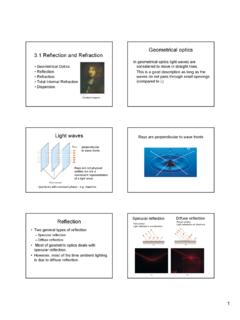
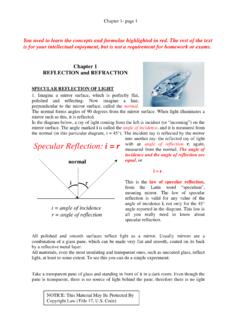
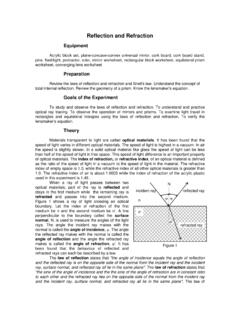
3 Observed delay: ~ 100 nsec Approximately the speed of Light . C = 30 m / 100 nsec = ..Ray Approximation The rays are straightlines perpendicular tothe wave fronts If a wave meets a barrier, wewill assume that <<d d is the diameter of theopening This approximation is good forthe study of mirrors, lenses,prisms, Reflection Specular reflection isreflection from a smoothsurfaceLaw of Reflection 1 = 1 The incident ray, the reflectedray and the normal are all inthe same planeLaw of ReflectionLight in a Medium The Light enters from the left The Light may encounter anelectron The electron may absorb the Light ,oscillate, and reradiate the Light The absorption and radiationcause the average speed of thelight moving through the materialto decrease6 The Index of refraction The speed of Light in any material is less than its speed invacuum The index of refraction , n, of a medium can be defined as For a vacuum, n = 1 For other media, n > 1 For air.
4 N= 1 Frequency Between Media As Light travels from onemedium to another, itsfrequency does notchange Both the wave speed andthe wavelength do change The wavefronts do not pileup, nor are created ordestroyed at the boundary,so must stay the same v = on both sides7 Index of refraction - Snell s Law The frequency stays the same as the wave travels from one medium tothe other v = 1 = 2 but v1 v2 so 1 2 The ratio of the indices of refraction : 1n1 = 2n2 Snell s law of refraction :n1 sin 1 = n2 sin 2 Huygens s Principle Huygens assumed that Light is aform of wave motion rather thana stream of particles Huygens s Principle is ageometric construction fordetermining the position of a newwave at some point based on theknowledge of the wave front thatpreceded it8 Huygens s Construction for a Plane WaveHuygens s Principle and the Law ofRefraction Ray 1 strikes the surface andat a time interval t later, ray2 strikes the surface During this time interval, thewave at A sends out awavelet, centered at A,toward DBC=sin 1=v1 tAD=sin 2=v2 tSnell s Law9 Variation of Index of refraction withWavelength = Dispersion The index of refraction for amaterial generally decreaseswith increasing wavelength Violet Light bends more thanred Light when passing into arefracting materialRefraction in a Prism Since all the colorshave different angles ofdeviation.
5 White lightwill spread out into aspectrum Violet deviates the most Red deviates the least The remaining colorsare in between10 The Rainbow At the back surface the Light isreflected It is refracted again as it returnsto the front surface and movesinto the air The rays leave the drop atvarious angles The angle between the white lightand the most intense violet ray is40 The angle between the white lightand the most intense red ray is42 Observing the Rainbow If a raindrop high in the sky is observed, the red ray is seen A drop lower in the sky would direct violet Light to the observer The other colors of the spectra lie in between the red and theviolet11 Total Internal Reflection A phenomenon called total internalreflection can occur when Light is directedfrom a medium having a given index ofrefraction toward one having a lower index ofrefractionPossible Beam Directions Possible directions of thebeam are indicated by raysnumbered 1 through 5 The refracted rays are bentaway from the normalsince n1 > n212 Critical Angle There is a particular angleof incidence that will resultin an angle of refraction of90 This angle of incidence iscalled the critical angle, CFiber Optics An application of internalreflection Plastic or glass rods are used to pipe Light from one place toanother Applications include.
6 Medical use of fiber opticcables for diagnosis andcorrection of medicalproblems Telecommunications13 Construction of an Optical Fiber The transparent core issurrounded by cladding The cladding has a lower nthan the core This allows the Light in thecore to experience totalinternal reflection The combination issurrounded by thejacketFermat s principleThe path a beam of Light takes between two points is the onewhich is traversed in the least medium: time: minimumpath does the lightknow which is thefastest way?14 Example: Propagation of sound wavesin ice at the South PoleUnderstand refraction in order to understand Measurable refraction in firn:Little refraction below firn:Fermat s principle Fermat s principle offers a fascinating view. How do the photons know which is the fastestway? It reminds of other principles in Physics: Principle of least Light A small underwater pool Light is mbelow the surface.
7 The Light emerging fromthe water forms a circle on the water is the diameter of this circle?