Transcription of lighting against crime - SBD
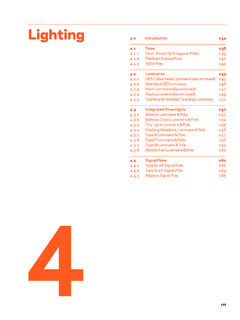
1 lighting against crime A Guide for crime Reduction Professionals 1. contents INTRODUCTION 4. GOOD lighting 6. How much light Exterior Domestic lighting Commercial lighting Industrial lighting Public Spaces Road lighting Closed Circuit Television Variable lighting LIGHT DISTRIBUTION 20. Uniformity IsoLux Diagram (Lux Plans). COLOUR OF LIGHT 22. Colour Appearance Colour Rendering (Ra). LIGHT POLLUTION 24. What is Light Pollution? How to reduce Light Pollution Environmental Zones ENERGY EFFICIENCY 26. LAMP TYPES AND THEIR LUMENS. PER WATT. GLOSSARY 27. APPENDIX 30. 2 3. introduction foreword This guide will provide the reader with a basic We all like to feel safe, most of us would particularly understanding of some of the terminology used like to be able to see that we are safe; in order to when discussing external lighting systems and the give us this opportunity at night it is important that recommended levels of illumination used to combat those responsible for designing and specifying our crime , the fear of crime and antisocial behaviour.
2 Built environment provide the most appropriate lighting conditions for where we live, work and play. It will not replace the expertise of a qualified lighting Engineer but it will help in the sensible appraisal of an This guide is for use by architects, builders, planners, existing or proposed lighting system. police officers or any other member of design teams who may not necessarily want to know about lighting Throughout the guide the term Good lighting will but do need a basic knowledge of the subject and be used to encompass all the requirements of a high some technical terms so as to deliver successful quality lighting installation that is effective, efficient developments for people to use at night. Targeted and has appropriate values of illuminance, uniformity lighting improvements have been proven to reduce and maintenance.
3 crime and the fear of crime and if design partners can discuss lighting values using a common language, they Secured by Design Secured by Design is a police will find it easier to provide a higher quality of night initiative to encourage the building industry to time environment. adopt crime prevention measures in the design of developments to assist in reducing the opportunity for Designing out criminal opportunities and thereby crime and the fear of crime , creating a safer and more making people safer is not the preserve of any single secure environment. Secured by Design is owned discipline and this guide can be used to establish by the Association of Chief Police Officers and has common ground and language between those who are the support of the Home Office crime Reduction and using light to make the public safer.
4 Community Safety Group and the Department for Communities and Local Government . This Guide was compiled and written by Peter Kane, crime Prevention Design Advisor, Metropolitan Police. ACPO Secured by Design would like to acknowledge with grateful thanks John Brewis of The Institute of lighting Professionals who provided the technical detail for this publication and supported the initiative Peter Kane throughout. crime Prevention Design Advisor Metropolitan Police 4 5. good lighting Good lighting is an amalgam of qualities and the following is a definition of the term. A good lighting system is one designed to distribute an appropriate amount of light evenly with Uniformity Values of between and using lamps with a rating of at least 60 on the Colour Rendering Index.
5 Good lighting will use energy efficient lamps in suitable luminaries. These luminaries will be positioned to minimise any light pollution so as to provide a high quality system only when and where required. The definition explained: 1. An Appropriate Amount of Light Where the level of illumination provided is A good illustration of uniformity, colour rendering and energy efficient lamps appropriate for the visual task to be undertaken and is suitable for the environmental conditions for the system. 2. Uniformity (Uo). The even distribution of light across the area being illuminated. 3. Colour Rendering The ability of lighting to show the colours of objects as close to their true tint, hue and tone as possible. 4. Colour Rendering Index (CRI). The method used to indicate the colour rendering properties of a lamp with values ranging from CRI.
6 0 CRI 100 (where CRI 100 represents the colour This example shows the application of an appropriate amount of light rendering qualities of condition close to natural daylight). 5. Light Pollution Where the lighting installation causes nuisance to others not directly involved. 6. Energy Efficiency The lighting equipment specified making efficient use of the electrical energy used. The following sections will provide details of the good lighting components shown above and the methods used to meet the relevant criteria. Good light levels with furniture appropriate to the use that the space is put to An environment where lighting promotes feeling of safety, security and a desire to return 6 7. How much light Exterior domestic The lighting of our external environment, the environs Do light levels need to be adjusted?
7 lighting of buildings and the spaces between them, our public The way the environment is used may produce Design specification and values parks, leisure complexes, advertising signs, roads circumstances where high levels of light are only and pathways must be achieved in the most energy required at specific times. Outside these times, when efficient way possible. lower values of light can be used, a system of lamp GOOD A form of lighting found in many domestic locations dimming should be considered. Low wattage lamps is a tungsten halogen flood light controlled by a Poor design and specification are the most common Dusk to dawn lighting movement sensor (PIR). There are a number of causes of an inefficient or polluting lighting system In order to set lighting in some context the following Vandal resistant luminaires problems associated with this type of lighting : and therefore the following questions are to be taken are approximate lighting levels, or values to be found Appropriate lighting values They only illuminate once a criminal has selected a into consideration at the earliest possible stage of the in everyday situations.
8 Twin level illuminance luminaires target premises and has crossed the boundary. design. Minimum mounting height (Lux is the measurement of light reaching a surface They emit a harsh light which can be intrusive and Do we need to light at all? where 1 Lux is the amount of light from one candle BAD causes a serious nuisance to neighbours. When safety and security are factors, it is often one metre distant from a surface of 1 square metre) High wattage lamps necessary to provide light but there may be Passive Infra Red detection (PIR) They instantly switch on a powerful light source circumstances, such as the lighting of remote foot Average levels of illuminance in Lux Low mounting heights which, if poorly directed, can be hazardous for paths across open spaces for instance, where lighting Sunny June day 80000 Lux Incorrect alignment of luminaires motorists using nearby roads.
9 May encourage the undesirable use of the path. Bad light stopped play at Lords 1000 Lux Poor maintenance regime They can increase the fear of crime by repeatedly A well-lit office 500 Lux activating for no apparent reason. How much light? Main road lighting 15 Lux The current Building Control Regulations and The If lighting is necessary, then the values detailed in A residential side street 5 Lux Clean Neighbourhood and Environment Act 2005 They are energy inefficient and require regular lamp this guide for differing circumstances, from residential A clear moonlit night Lux must be considered when designing lighting systems replacement. developments to public spaces, are acceptable under for residential and other types of development and current standards. part of the relevant sections are quoted in appendix 1.
10 For these reasons they are not acceptable in Secured of this guide. Whilst mainly applying to new building by Design approved schemes except as additional projects, the principles spoken of in the regulations courtesy lighting , near to bin stores for instance. are also relevant to lighting improvements for existing dwellings. For individual dwellings, low energy lamps in vandal resistant luminaires positioned out of easy reach Whilst obviously applying to new build, the principles and switched by a photo electric cell (dusk to dawn are sound when considering lighting for existing lighting ) are recommended. dwellings. However, the regulations do not apply to common areas blocks of flats and other access In domestic situations it is possibly better to think of way lighting provided for communal use.