Transcription of Linear Algebra and Its Applications
1 Linear Algebra and Its Applications Fourth Edition Gilbert Strang x y z Ax b y Ay b b 0. z Az 0. 0. Contents Preface iv 1 Matrices and Gaussian Elimination 1. Introduction .. 1. The Geometry of Linear Equations .. 4. An Example of Gaussian Elimination .. 13. Matrix Notation and Matrix Multiplication .. 21. Triangular Factors and Row Exchanges .. 36. Inverses and Transposes .. 50. Special Matrices and Applications .. 66. Review Exercises .. 72. 2 Vector Spaces 77. Vector Spaces and Subspaces .. 77. Solving Ax = 0 and Ax = b .. 86. Linear Independence, Basis, and Dimension .. 103. The Four Fundamental Subspaces .. 115. Graphs and Networks .. 129. Linear Transformations .. 140. Review Exercises .. 154. 3 Orthogonality 159. Orthogonal Vectors and Subspaces .. 159. Cosines and Projections onto Lines .. 171. Projections and Least Squares.
2 180. Orthogonal Bases and Gram-Schmidt .. 195. The Fast Fourier Transform .. 211. Review Exercises .. 221. i ii CONTENTS. 4 Determinants 225. Introduction .. 225. Properties of the Determinant .. 227. Formulas for the Determinant .. 236. Applications of Determinants .. 247. Review Exercises .. 258. 5 Eigenvalues and Eigenvectors 260. Introduction .. 260. Diagonalization of a Matrix .. 273. Difference Equations and Powers Ak .. 283. Differential Equations and eAt .. 296. Complex Matrices .. 312. Similarity Transformations .. 325. Review Exercises .. 341. 6 Positive Definite Matrices 345. Minima, Maxima, and Saddle Points .. 345. Tests for Positive Definiteness .. 352. Singular Value Decomposition .. 367. Minimum Principles .. 376. The Finite Element Method .. 384. 7 Computations with Matrices 390. Introduction .. 390.
3 Matrix Norm and Condition Number .. 391. Computation of Eigenvalues .. 399. Iterative Methods for Ax = b .. 407. 8 Linear Programming and Game Theory 417. Linear Inequalities .. 417. The Simplex Method .. 422. The Dual Problem .. 434. Network Models .. 444. Game Theory .. 451. A Intersection, Sum, and Product of Spaces 459. The Intersection of Two Vector Spaces .. 459. The Sum of Two Vector Spaces .. 460. The Cartesian Product of Two Vector Spaces .. 461. The Tensor Product of Two Vector Spaces .. 461. The Kronecker Product A B of Two Matrices .. 462. CONTENTS iii B The Jordan Form 466. C Matrix Factorizations 473. D Glossary: A Dictionary for Linear Algebra 475. E MATLAB Teaching Codes 484. F Linear Algebra in a Nutshell 486. A~x = ~b C(AT ) C(A). dim r AT ~y = ~c dim r Row Space Column Space all AT ~y all A~x Rn Rm AT ~y = ~0.
4 ~0. ~0. A~x = ~0. Null N (A) Space Left N (AT ). Null Space dim n r dim m r .. Preface Revising this textbook has been a special challenge, for a very nice reason. So many people have read this book, and taught from it, and even loved it. The spirit of the book could never change. This text was written to help our teaching of Linear Algebra keep up with the enormous importance of this subject which just continues to grow. One step was certainly possible and desirable to add new problems. Teaching for all these years required hundreds of new exam questions (especially with quizzes going onto the web). I think you will approve of the extended choice of problems. The questions are still a mixture of explain and compute the two complementary approaches to learning this beautiful subject. I personally believe that many more people need Linear Algebra than calculus.
5 Isaac Newton might not agree! But he isn't teaching mathematics in the 21st century (and maybe he wasn't a great teacher, but we will give him the benefit of the doubt). Cer- tainly the laws of physics are well expressed by differential equations. Newton needed calculus quite right. But the scope of science and engineering and management (and life) is now so much wider, and Linear Algebra has moved into a central place. May I say a little more, because many universities have not yet adjusted the balance toward Linear Algebra . Working with curved lines and curved surfaces, the first step is always to linearize. Replace the curve by its tangent line, fit the surface by a plane, and the problem becomes Linear . The power of this subject comes when you have ten variables, or 1000 variables, instead of two. You might think I am exaggerating to use the word beautiful for a basic course in mathematics.
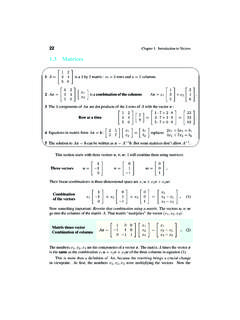
6 Not at all. This subject begins with two vectors v and w, pointing in different directions. The key step is to take their Linear combinations. We multiply to get 3v and 4w, and we add to get the particular combination 3v + 4w. That new vector is in the same plane as v and w. When we take all combinations, we are filling in the whole plane. If I draw v and w on this page, their combinations cv + dw fill the page (and beyond), but they don't go up from the page. In the language of Linear equations, I can solve cv + dw = b exactly when the vector b lies in the same plane as v and w. iv v Matrices I will keep going a little more to convert combinations of three-dimensional vectors into Linear Algebra . If the vectors are v = (1, 2, 3) and w = (1, 3, 4), put them into the columns of a matrix: . 1 1.. matrix = 2 3 . 3 4. To find combinations of those columns, multiply the matrix by a vector (c, d).
7 1 1 " # 1 1. c . Linear combinations cv + dw 2 3 = c 2 + d 3 . d 3 4 3 4. Those combinations fill a vector space. We call it the column space of the matrix. (For these two columns, that space is a plane.) To decide if b = (2, 5, 7) is on that plane, we have three components to get right. So we have three equations to solve: . 1 1 " # 2 c+ d = 2. c . 2 3 = 5 means 2c + 3d = 5 . d 3 4 7 3c + 4d = 7. I leave the solution to you. The vector b = (2, 5, 7) does lie in the plane of v and w. If the 7 changes to any other number, then b won't lie in the plane it will not be a combination of v and w, and the three equations will have no solution. Now I can describe the first part of the book, about Linear equations Ax = b. The matrix A has n columns and m rows. Linear Algebra moves steadily to n vectors in m- dimensional space.
8 We still want combinations of the columns (in the column space). We still get m equations to produce b (one for each row). Those equations may or may not have a solution. They always have a least-squares solution. The interplay of columns and rows is the heart of Linear Algebra . It's not totally easy, but it's not too hard. Here are four of the central ideas: 1. The column space (all combinations of the columns). 2. The row space (all combinations of the rows). 3. The rank (the number of independent columns) (or rows). 4. Elimination (the good way to find the rank of a matrix). I will stop here, so you can start the course. vi PREFACE. Web Pages It may be helpful to mention the web pages connected to this book. So many messages come back with suggestions and encouragement, and I hope you will make free use of everything.
9 You can directly access , which is continually updated for the course that is taught every semester. Linear Algebra is also on MIT's OpenCourseWare site , where became exceptional by including videos of the lectures (which you definitely don't have to ). Here is a part of what is available on the web: 1. Lecture schedule and current homeworks and exams with solutions. 2. The goals of the course, and conceptual questions. 3. Interactive Java demos (audio is now included for eigenvalues). 4. Linear Algebra Teaching Codes and MATLAB problems. 5. Videos of the complete course (taught in a real classroom). The course page has become a valuable link to the class, and a resource for the students. I am very optimistic about the potential for graphics with sound. The bandwidth for voiceover is low, and FlashPlayer is freely available.
10 This offers a quick review (with active experiment), and the full lectures can be downloaded. I hope professors and students worldwide will find these web pages helpful. My goal is to make this book as useful as possible with all the course material I can provide. Other Supporting Materials Student Solutions Manual 0-495-01325-0 The Student Solutions Manual provides solutions to the odd-numbered problems in the text. Instructor's Solutions Manual 0-030-10588-4 The Instructor's Solutions Man- ual has teaching notes for each chapter and solutions to all of the problems in the text. Structure of the Course The two fundamental problems are Ax = b and Ax = x for square matrices A. The first problem Ax = b has a solution when A has independent columns. The second problem Ax = x looks for independent eigenvectors. A crucial part of this course is to learn what independence means.