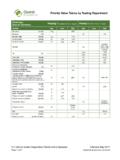
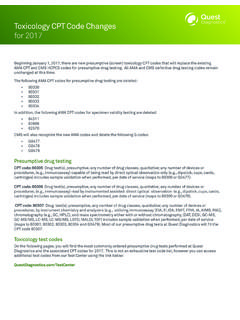
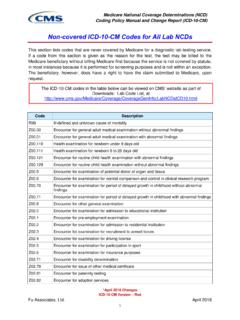
Transcription of Lipid Testing - Quest Diagnostics
1 CPT: Medicare National Coverage Determination Policy CMS National Coverage Policy Medically Supportive ICD Codes are listed on subsequent page(s) of this document Visit to view current limited coverage tests, reference guides, and policy information. To view the complete policy and the full list of medically supportive codes, please refer to the CMS website reference Right Click Hyperlink to Add CMS URL Add full policy information Template structure: First level is for headers such as limitations, indications and usage guidelines Second level is for main body copy Third level is for bullet (if needed) To apply styles to copy, select copy and use the promote and demote under the home tab Helpful hint: be sure to hit Reset button to apply master once all copy is in template to apply styles 80061, 82465, 83700, 83701, 83704, 83718, 83721, 84478 Lipid Testing Coverage Indications, Limitations, and/or Medical Necessity Lipoproteins are a class of heterogeneous particles of varying sizes and densities containing Lipid and protein.
2 These lipoproteins include cholesterol esters and free cholesterol, triglycerides, phospholipids and A, C, and E apoproteins. Total cholesterol comprises all the cholesterol found in various lipoproteins. Factors that affect blood cholesterol levels include age, sex, body weight, diet, alcohol and tobacco use, exercise, genetic factors, family history, medications, menopausal status, the use of hormone replacement therapy, and chronic disorders such as hypothyroidism, obstructive liver disease, pancreatic disease (including diabetes), and kidney disease. In many individuals, an elevated blood cholesterol level constitutes an increased risk of developing coronary artery disease. Blood levels of total cholesterol and various fractions of cholesterol, especially low density lipoprotein cholesterol (LDL -C) and high density lipoprotein cholesterol (HDL-C) are useful in assessing and monitoring treatment for that risk in patients with cardiovascular and related diseases.
3 Blood levels of the above cholesterol components including triglyceride have been separated into desirable, borderline and high-risk categories by the National Heart, Lung, and Blood Institute in their report in 1993. These categories form a useful basis for evaluation and treatment of patients with hyperlipidemia. Therapy to reduce these risk parameters includes diet, exercise and medication, and fat weight loss, which is particularly powerful when combined with diet and exercise. Indications The medical community recognizes Lipid Testing as appropriate for evaluating atherosclerotic cardiovascular disease. Conditions in which Lipid Testing may be indicated include: Assessment of patients with atherosclerotic cardiovascular disease Evaluation of primary dyslipidemia Any form of atherosclerotic disease, or any disease leading to the formation of atherosclerotic disease Diagnostic evaluation of diseases associated with altered Lipid metabolism, such as.
4 Nephrotic syndrome, pancreatitis, hepatic disease, and hypo and hyperthyroidism Secondary dyslipidemia, including diabetes mellitus, disorders of gastrointestinal absorption, chronic renal failure Signs or symptoms of dyslipidemias, such as skin lesions As follow-up to the initial screen for coronary heart disease (total cholesterol + HDL cholesterol) when total cholesterol is determined to be high (>240 mg/dL), or borderline-high (200-240 mg/dL) plus two or more coronary heart disease risk factors, or an HDL cholesterol <35 mg/dL. To monitor the progress of patients on anti- Lipid dietary management and pharmacologic therapy for the treatment of elevated blood Lipid disorders, total cholesterol, HDL cholesterol and LDL cholesterol may be used. Triglycerides may be obtained if this Lipid fraction is also elevated or if the patient is put on drugs (for example, thiazide diuretics, beta blockers, estrogens, glucocorticoids, and tamoxifen) which may raise the triglyceride level.
5 When monitoring long-term anti- Lipid dietary or pharmacologic therapy and when following patients with borderline high total or LDL cholesterol levels, it may be reasonable to perform the Lipid panel annually. A Lipid panel at a yearly interval will usually be adequate while measurement of the serum total cholesterol or a measured LDL should suffice for interim visits if the patient does not have hypertriglyceridemia. CPT: Medicare National Coverage Determination Policy Visit to view current limited coverage tests, reference guides, and policy information. To view the complete policy and the full list of medically supportive codes, please refer to the CMS website reference Right Click Hyperlink to Add CMS URL Add full policy information Template structure: First level is for headers such as limitations, indications and usage guidelines Second level is for main body copy Third level is for bullet (if needed) To apply styles to copy, select copy and use the promote and demote under the home tab Helpful hint.
6 Be sure to hit Reset button to apply master once all copy is in template to apply styles CMS National Coverage Policy (continued) 80061, 82465, 83700, 83701, 83704, 83718, 83721, 84478 Lipid Testing Any one component of the panel or a measured LDL may be reasonable and necessary up to six times the first year for monitoring dietary or pharmacologic therapy. More frequent total cholesterol HDL cholesterol, LDL cholesterol and triglyceride Testing may be indicated for marked elevations or for changes to anti- Lipid therapy due to inadequate initial patient response to dietary or pharmacologic therapy. The LDL cholesterol or total cholesterol may be measured three times yearly after treatment goals have been achieved. Electrophoretic or other quantitation of lipoproteins may be indicated if the patient has a primary disorder of lipoid metabolism.
7 Effective January 1, 2005, the Medicare law expanded coverage to cardiovascular screening services. Several of the procedures included in this NCD may be covered for screening purposes subject to specified frequencies. See 42 CFR and section 100, chapter 18, of the Claims Processing Manual, for a full description of this benefit. Limitations Lipid panel and hepatic panel Testing may be used for patients with severe psoriasis which has not responded to conventional therapy and for which the retinoid etretinate has been prescribed and who have developed hyperlipidemia or hepatic toxicity. Specific examples include erythrodermia and generalized pustular type and psoriasis associated with arthritis. Routine screening and prophylactic Testing for Lipid disorder are not covered by Medicare. While Lipid screening may be medically appropriate, Medicare by statute does not pay for it.
8 Lipid Testing in asymptomatic individuals is considered to be screening regardless of the presence of other risk factors such as family history, tobacco use, etc. Once a diagnosis is established, one or several specific tests are usually adequate for monitoring the course of the disease. Less specific diagnoses (for example, other chest pain) alone do not support medical necessity of these tests. When monitoring long-term anti- Lipid dietary or pharmacologic therapy and when following patients with borderline high total or LDL cholesterol levels, it is reasonable to perform the Lipid panel annually. A Lipid panel at a yearly interval will usually be adequate while measurement of the serum total cholesterol or a measured LDL should suffice for interim visits if the patient does not have hypertriglyceridemia. Any one component of the panel or a measured LDL may be medically necessary up to six times the first year for monitoring dietary or pharmacologic therapy.
9 More frequent total cholesterol HDL cholesterol, LDL cholesterol and triglyceride Testing may be indicated for marked elevations or for changes to anti- Lipid therapy due to inadequate initial patient response to dietary or pharmacologic therapy. The LDL cholesterol or total cholesterol may be measured three times yearly after treatment goals have been achieved. If no dietary or pharmacological therapy is advised, monitoring is not necessary. When evaluating non-specific chronic abnormalities of the liver (for example, elevations of transaminase, alkaline phosphatase, abnormal imaging studies, etc.), a Lipid panel would generally not be indicated more than twice per year. CPT: Code Description Medicare National Coverage Determination Policy The ICD10 codes listed below are the top diagnosis codes currently utilized by ordering physicians for the limited coverage test highlighted above that are also listed as medically supportive under Medicare s limited coverage policy.
10 If you are ordering this test for diagnostic reasons that are not covered under Medicare policy, an Advance Beneficiary Notice form is required. *Note Bolded diagnoses below have the highest utilization Disclaimer: This diagnosis code reference guide is provided as an aid to physicians and office staff in determining when an ABN (Advance Beneficiary Notice) is necessary. Diagnosis codes must be applicable to the patient s symptoms or conditions and must be consistent with documentation in the patient s medical record. Quest Diagnostics does not recommend any diagnosis codes and will only submit diagnosis information provided to us by the ordering physician or his/her designated staff. The CPT codes provided are based on AMA guidelines and are for informational purposes only. CPT coding is the sole responsibility of the billing party.