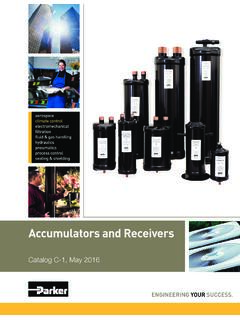
Transcription of Liquid & Suction Line Filter-Driers
1 Catch-All Liquid & Suction Line Filter-Driers June 2015 / BULLETIN 40-10 filter -DRIERSIt s the core that counts!Page 2 Bulletin 40-10 Table of ContentsQuick Selection Guide .. 3 Technical Information System Chemistry .. 4 The Catch- all filter -Drier .. 5 Application .. 8 Sealed Model Catch-All Filter-Driers Specifications .. 10 Ratings and Selection .. 12 Reversible Heat Pump Filter-Driers .. 19 replaceable core Catch-All Filter-Driers Features .. 23 Specifications .. 24 Cores and filter Elements .. 26 Ratings and Selection .. 28HH Style Catch-Alls For Wax Removal .. 33 Suction Line Filter-Driers Application .. 34 Specifications .. 36 Compact Style Suction Line Filter-Driers .
2 40 Acid Test Kit .. 42 Accessories .. 43 ATEX Compliance .. 44 Terms of Sale With Warranty Limitations .. 45 The Sporlan Catch-All Liquid and Suction Line Filter-Driers are the choice for today s systems with R-410A WARNING USER RESPONSIBILITYF ailure or improper selection or improper use of the products described herein or related items can cause death, personal injury and property document and other information from Parker Hannifin Corporation, its subsidiaries and authorized distributors provide product or system options for further investigation by users having technical user, through its own analysis and testing, is solely responsible for making the final selection of the system and components and assuring that all performance, endurance.
3 Maintenance, safety and warning requirements of the application are met. The user must analyze all aspects of the application, follow applicable industry standards, and follow the information concerning the product in the current product catalog and in any other materials provided from Parker or its subsidiaries or authorized the extent that Parker or its subsidiaries or authorized distributors provide component or system options based upon data or specifications provided by the user, the user is responsible for determining that such data and specifications are suitable and sufficient for all applications and reasonably foreseeable uses of the components or OF SALEThe items described in this document are hereby offered for sale by Parker Hannifin Corporation, its subsidiaries or its authorized distributors.
4 This offer and its acceptance are governed by the provisions stated in the detailed Offer of Sale available at USE ON REFRIGERATION and/or AIR CONDITIONING SYSTEMS ONLYB ulletin 40-10, February 2015, supersedes Bulletin 40-10, January 2011, and all prior publications. Liquid LineQuick Selection RecommendationsBulletin 40-10 Page 3*C-30000 and C-40000 Series shells are not approved for SIZEFIELD REPLACEMENTTONSLINE SIZEI nches ODAIR CONDITIONINGREFRIGERATIONR-12 & R-134aR-22, R-407C & R-410A*R-12, R-134a, R-404A, R-502 & R-507R-22 SEALED TYPES - SPECIFY FLARE OR SOLDER 1/4 - 1/3 CAP TUBE1/4C-032-CAPC-032(-S)C-032-CAPC-032( -S)C-032-CAPC-032(-S)C-032-CAPC-032(-S)1 /2 - 11/45/163/8C-052(-S)C-0525-SC-053(-S)C-0 52(-S)C-0525-SC-053(-S)C-082(-S)C-0825(- S)C-083(-S)C-082(-S)C-0825-SC-083(-S)1-1 /2 - 2-1/25/163/81/2C-0825-SC-083(-S)C-084(-S )C-0825-SC-083(-S)C-084(-S)C-1625-SC-163 (-S)C-164(-S)C-1625-SC-163(-S)C-164(-S)
5 3 - 65/163/81/25/8C-1625-SC-163(-S)C-164(-S) C-165(-S)C-1625-SC-163(-S)C-164(-S)C-165 (-S) C-303(-S)C-304(-S)C-305(-S) C-303(-S)C-304(-S)C-305(-S)7 - 91/25/87/8C-304(-S)C-305(-S)C-307-SC-304 (-S)C-305(-S)C-307-SC-414(-S)C-415(-S)C- 417-SC-414(-S)C-415(-S)C-417-S10 - 121/25/87/81-1/8 C-415(-S)C-417-SC-419SC-414(-S)C-415(-S) C-417-SC-419S C-415(-S)C-417-SC-419-SC-414(-S)C-415(-S )C-417-SC-419-S13 - 185/87/81-1/8 C-607-SC-609-SC-415(-S)C-607-SC-609-S C-607-SC-609-SC-415(-S)C-607-SC-609-SREV ERSIBLE HEAT PUMP filter -DRIER1-53/81/25/8 HPC-103-S / HPC-163-S-HHHPC-104-S / HPC-164-S-HHHPC-165-S-HH 5-163/81/25/87/8 HPC-303-S-HH / HPC-304-S-HHHPC-305-S-HH / HPC-307-S-HH replaceable core TYPES4 - 95/87/8C-485-GC-487-GC-485-GC-487-GC-485 -GC-487-GC-485-GC-487-G10 - 155/87/81-1/8 C-487-GC-489-GC-485-GC-487-GC-489-G C-487-GC-489-GC-485-GC-487-GC-489-G16 - 297/81-1/81-3/8C-967-GC-969-GC-9611-GC-9 67-GC-969-GC-9611-GC-967-GC-969-GC-9611- GC-967-GC-969-GC-9611-G30 - 397/81-1/81-3/8 C-1449-GC-14411-GC-967-GC-969-GC-9611-G C-1449-GC-14411-GC-967-GC-969-GC-9611-G4 0.
6 591-1/81-3/81-5/8C-1449-GC-19211-GC-1921 3-GC-1449-GC-14411-GC-14413-G C-19211-GC-19213-GC-1449-GC-14411-GC-144 13-G60 - 751-1/81-3/81-5/8 C-19211-GC-19213-GC-1449-GC-19211-GC-192 13-G C-19211-GC-19213-G C-19211-GC-19213-G76 - 991-3/81-5/82-1/8 C-30013-GC-40017-GC-19211-GC-19213-GC-19 217-G C-30013-GC-40017-GC-19211-GC-19213-GC-19 217-G100 - 1301-5/82-1/8 C-40017-GC-30013-GC-40017-G C-40017-GC-30013-GC-40017-G131 - 1502-1/8(2) C-30017-GC-40017-G(2) C-30017-GC-40017-GCATCH-ALL SIZENO. OF CORESSECONDARY FILTERCORE TYPEC-R420 Series Shell1 RCW-42C-480 Series Shell1FS-480 RCW-48, RC-4864,or RC-4864-HHC-960 Series Shell2FS-960C-14400 Series Shell3FS-1440C-19200 Series Shell4FS-19200C-30000 Series Shell3 RCW-100, RC-10098,or RC-10098-HHC-40000 Series Shell4 MOISTUREW ater or moisture is always present in refrigeration sys-tems, especially with the use of hygroscopic polyolester (POE) lubricants.
7 Acceptable limits vary from one unit to another and from one refrigerant to another. Moisture is harm-ful even if freeze-ups do not occur. Moisture is an important factor in the formation of acids, sludge, copper plat-ing, and corrosion. To be safe and sure, keep the moisture level as low as , oxide, scale, sludges, f lux, and metallic particles are frequently found in refrigeration systems. Numerous metallic contaminants cast iron dust, rust, scale, steel, copper, and brass chips can damage cylinder walls, bearings, and plug capillary tubes or thermostatic expansion valve screens. In addition to mechanical damage and plug-ups, these contaminants catalyze chemical reactions that contribute to decomposition of the refrigerant-lubricant mixture at elevated by themselves are very stable, even when heated to a high temperature.
8 However under some conditions, reactions do occur which can result in the formation of acids. For example, Refrigerant 22 will decompose at high temperatures to form hydrochlo-ric acid where an acid acceptor such as electrical insulation paper is present. The reaction of refrigerants with water may cause hydrolysis and the formation of hydrochloric and hydrof luoric acids. These acids are usually present as a gas in the system and are highly corrosive. In ordinary usage this reaction is negli-gible, but in a very wet system operating at abnormally high temperatures, some hydrolysis may of these reactions are increased by elevated temperature and are catalytic in effect, resulting in the formation of corrosive significant source of acidity in refrigeration systems is organic acid formed from lubricant breakdown.
9 Acid is formed when POE lubricant reacts with moisture. Appreciable amounts of organic acid are found in lubricant sam-ples analyzed in our laboratory. Since acids corrode metals in a system, they must be AND VARNISHA lthough the utmost pre-caution may be taken in the design and fabrica tion of a system, once in operation, unusually high discharge temperatures will cause the lubricant to breakdown. By-products of mineral/alkylbenzene lubricant decomposition are varnish, sludge, and possibly carbonaceous may vary in different makes of compressors and under dif-ferent operating conditions. While tem-peratures of 265 F/129 C are not unusual at the discharge valve under normal operation, temperatures well above 300 F/149 C frequently occur under unusual conditions.
10 Common sources of high temperatures in refrigeration systems are dirty condensers, non-condensible gases in the condenser, high compression ratio, high superheat of Suction gas returned to compressor, fan failure on forced convection condensers, and addition to high discharge tempera-tures, there are certain catalytic metals that contribute to the lubricant-refriger-ant mixture breakdown. The most noted of these in a refrigeration system is iron. It is used in one form or another in all systems and is an active catalyst. Copper is in the same category as iron, but its action is slower. However, the end result is the same. This reaction causes sludge formation and other corrosive materials that will hinder the normal operation of compressor valves and control devices.