Transcription of Literacy learning continuum - ACARA
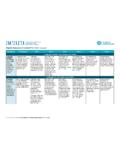
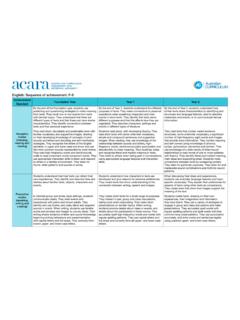
1 Literacy learning continuum Sub-elementLevel 1aStudents:Level 1bStudents:Level 1cStudents:Level 1dStudents:Comprehending texts through listening, reading and viewing elementComprehend textsuse behaviours that are not intentionally directed at another person to: attend to, respond to or show interest in familiar people, texts, events and activitiesuse informal behaviours that show consistent anticipation of events in regular routines to: attend consistently to familiar texts respond consistently to social interactions with familiar people demonstrate anticipation of predictable events respond to questions respond to requestsuse conventional behaviours and/or concrete symbols consistently in an increasing range of environments and with familiar and unfamiliar people to: respond to a sequence of gestures, objects, photographs and/or pictographs, for example follow a visual schedule to complete a task respond to texts with familiar structures, for example by responding to a question respond to requestsuse conventional behaviours and/or abstract symbols consistently in different contexts and with different people to: work out the meaning of texts with familiar structures, such as illustrated books, printed words, Braille texts and pictographs , using knowledge of context and vocabulary respond to questions, sequence events and identify information from texts with familiar structures use information in texts to explore a topicSub-elementLevel 1eTypically, by the end of Foundation Year, students:Level 2 Typically, by the end of Year 2, students:Level 4 Typically, by the end of Year 4, students:Level 4 Typically, by the end of Year 6, students.
2 Level 5 Typically, by the end of Year 8, students:Level 6 Typically, by the end of Year 10, students:Navigate, read and view learning area textsnavigate, read and view simple texts with familiar vocabulary and supportive illustrations navigate, read and view texts with illustrations and simple graphics navigate, read and view different types of texts with illustrations and more detailed graphicsnavigate, read and view subject-specific texts with some challenging features and a range of graphic representationsnavigate, read and view a variety of challenging subject-specific texts with a wide range of graphic representationsnavigate, read and view a wide range of more demanding subject-specific texts with an extensive range of graphic representations Listen and respond to learning area textslisten and respond to brief questions and one and two step instructions, listen for information in simple spoken texts and respond to audio texts and texts read aloud listen to two or more step instructions for undertaking learning tasks, listen for information about topics being learned in spoken and audio texts and respond to texts read aloudlisten to spoken instructions with some detail for undertaking learning area tasks, listen to identify key information in spoken and multi-modal texts and respond to texts read aloudlisten to detailed spoken instructions for undertaking learning tasks, listen to spoken and audio texts, and respond to and interpret information and opinions presented listen to extended spoken and audio texts, respond to and interpret stated and implied meanings, and evaluate information and ideaslisten to a range of extended spoken and audio texts and respond to, interpret and evaluate ideas.
3 Information and opinions Interpret and analyse learning area textsinterpret simple texts using comprehension strategies interpret and use texts to explore topics, gather information and make some obvious inferences using comprehension strategies interpret literal information and make inferences to expand topic knowledge using comprehension strategies interpret and analyse information and ideas, comparing texts on similar topics or themes using comprehension strategies interpret and evaluate information, identify main ideas and supporting evidence, and analyse different perspectives using comprehension strategies interpret and evaluate information within and between texts, comparing and contrasting information using comprehension strategies Literacy learning continuum Sub-elementLevel 1aStudents:Level 1bStudents:Level 1cStudents:Level 1dStudents:Composing texts through speaking, writing and creating elementCompose textsuse behaviours that are not intentionally directed at another person to: refuse or reject reflect a preference or desire reflect state of wellbeing, for example contentment, joy, worry, pain reflect a physical state, for example hot, cold, nauseause informal behaviours to intentionally communicate a single message consistently in familiar environments with familiar people, such as to: refuse or reject express a preference request the continuation of an activity request something new request more request attentionuse conventional behaviours and/or concrete symbols to intentionally communicate more than one idea at a time consistently across an increasing range of environments with familiar and unfamiliar people, such as to.
4 Refuse or reject request items, people or events present at the time create texts, for example to comment on a recent event, story or shared experienceuse conventional behaviours and/or abstract symbols consistently in different contexts and with different people to communicate intentionally and consistently in different contexts and with different people to: create texts with familiar structures such as speech, simple print texts, keyboard texts, illustrations, pictographs comment on people, events and objects in the past, present and future and to ask questions convey knowledge about learning area topicsLiteracy learning continuum Sub-elementLevel 1eTypically, by the end of Foundation Year, students:Level 2 Typically, by the end of Year 2, students:Level 4 Typically, by the end of Year 4, students:Level 4 Typically, by the end of Year 6, students:Level 5 Typically, by the end of Year 8, students:Level 6 Typically, by the end of Year 10, students.
5 Composing texts through speaking, writing and creating elementCompose spoken, written, visual and multimodal learning area textscompose short learning area texts, with support, to record and report ideas and eventscompose and edit a small range of learning area texts compose and edit a range of learning area texts compose and edit learning area texts compose and edit longer sustained learning area texts compose and edit longer and more complex learning area texts Use language to interact with othersuse short pair, group and class conversations and discussions as learning tools to explore learning area topics and to prepare for creating texts use pair, group and class discussions as learning tools to explore learning area topics, to represent ideas and relationships, and to prepare for creating texts use pair, group and class discussions about learning area topics as learning tools to explore and represent ideas and relationships, test possibilities and to prepare for creating texts use pair, group and class discussions and informal debates as learning tools to explore ideas and relationships, test possibilities, compare solutions and to prepare for creating texts use pair, group and class discussions and formal and informal debates as learning tools to explore ideas, test possibilities, compare solutions, rehearse ideas and arguments in preparation for creating textsuse pair, group and class discussions and formal and informal debates as learning tools to explore ideas, compare solutions, evaluate information and ideas, refine opinions and arguments in preparation for creating textsDeliver presentationsplan and deliver short presentations related to learning area topics plan.
6 Rehearse and deliver short presentations on learning area topics, incorporating some visual and multimodal elements plan, rehearse and deliver presentations on learning area topics, incorporating some learned content and appropriate visual and multimodal elements plan, research, rehearse and deliver presentations on learning area topics, selecting appropriate content and visual and multimodal elements to suit different audiences plan, research, rehearse and deliver presentations on learning area topics, sequencing selected content and multimodal elements for accuracy and their impact on the audience plan, research, rehearse and deliver presentations on more complex issues and learning area topics, combining visual and multimodal elements creatively to present ideas and information and support opinions and engage and persuade an audience Literacy learning continuum Sub-elementLevel 1eTypically, by the end of Foundation Year, students:Level 2 Typically, by the end of Year 2, students:Level 4 Typically, by the end of Year 4, students:Level 4 Typically, by the end of Year 6, students:Level 5 Typically, by the end of Year 8, students:Level 6 Typically, by the end of Year 10, students.
7 Text knowledge elementUse knowledge of text structuresuse knowledge of some basic differences between imaginative and informative texts to select and use texts and compose simple learning area texts with teacher support use knowledge of the structure and features of learning area texts to comprehend and compose a growing range of texts with some teacher support use growing knowledge of the structure and features of learning area texts to comprehend and compose an increasing number and range of texts use developing knowledge of the structure and features of learning area texts to comprehend and compose a range of more complex texts for identified purposesuse wide knowledge of the structure and features of learning area texts to comprehend and compose texts, using creative adaptations of text structures and conventions for citing others use comprehensive knowledge of the structure and features of learning area texts to comprehend and compose complex texts in innovative ways, using conventions for citing others Use knowledge of text cohesionuse beginning knowledge of how language is used to comprehend and compose written texts with support use knowledge of how texts are made cohesive through word repetitions and associations, synonyms and antonyms to comprehend and compose texts use knowledge of how texts are made cohesive through linking words and phrases, for example so , therefore , then , in addition.
8 And the correct use of pronouns to comprehend and compose texts use knowledge of how cohesive links can be made in texts through omitting and replacing words use knowledge of word functions to make connections in texts use knowledge of how the cohesion in texts is improved by strengthening the internal structure Literacy learning continuum Sub-elementLevel 1eTypically, by the end of Foundation Year, students:Level 2 Typically, by the end of Year 2, students:Level 4 Typically, by the end of Year 4, students:Level 4 Typically, by the end of Year 6, students:Level 5 Typically, by the end of Year 8, students:Level 6 Typically, by the end of Year 10, students:Grammar knowledge elementUse knowledge of sentence structuresuse simple sentences to record ideas and events with emerging knowledge of word order use simple and compound sentences to record observations, and make connections between ideasuse simple, compound and complex sentence structures to describe, explain, report and make connections between ideas and eventsuse simple, compound and complex sentence structures to record, explain, question, describe and elaborate ideas and events control a range of simple, compound and complex sentence structures to record, explain, question, argue, describe and link ideas, evidence and conclusions control a range of simple, compound and complex sentence structures to convey complex ideas, build and support arguments.
9 And change emphasis Use knowledge of words and word groupsrecognise that texts are made up of words and groups of words that make meaning recognise and use nouns that represent people, places, things and ideas in the learning area and expand nouns to achieve greater precision recognise and use adverbs and prepositional phrases that provide detailed descriptions in the learning areasexpand and sharpen ideas through careful choice of verbs and phrases and elaborated tenses recognise and use aspects of language to suggest possibility, probability, obligation and conditionality develop higher order concepts in academic texts through language features that compact and generalise ideasExpress opinion and point of viewuse speaking, visual elements (including drawing) and beginning writing to express likes and dislikes identify and use language that expresses feelings and opinions, and compares and evaluates people and thingsdifferentiate between the language of opinion and feeling and the language of factual reporting or recording use subjective, objective and evaluative language, and identify bias use language to evaluate an object, action or text, and language that is designed to persuade the reader/viewer use language that indirectly expresses opinions and constructs representations of people and events, and consider expressed and implied judgmentsLiteracy learning continuum Sub-elementLevel 1eTypically, by the end of Foundation Year, students:Level 2 Typically, by the end of Year 2, students:Level 4 Typically, by the end of Year 4, students:Level 4 Typically, by the end of Year 6, students:Level 5 Typically, by the end of Year 8, students.
10 Level 6 Typically, by the end of Year 10, students:Word knowledge elementUnderstand learning area vocabularyuse familiar vocabulary contexts related to everyday experiences, personal interests and topics taught at school and used in other contextsuse mostly familiar vocabulary, with a steady introduction of new vocabulary in learning area contexts u