Transcription of LOS ANGELES COUNTY SOLID WASTE MANAGEMENT …
1 LOS ANGELES COUNTY SOLID WASTE MANAGEMENT COMMITTEE/ INTEGRATED WASTE MANAGEMENT TASK FORCE 900 SOUTH FREMONT AVENUE, ALHAMBRA, CALIFORNIA 91803-1331 BOX 1460, ALHAMBRA, CALIFORNIA 91802-1460 December 28, 2015 Ms. Karen Ross, Secretary, California Department of Food and Agriculture (CDFA) 1220 N Street Sacramento, CA 95814 Mr. Scott Smithline, Director California Department of Resources Recycling and Recovery (CalRecycle) Box 4025 Sacramento, CA 95812-4025 Dear Ms. Ross and Mr. Smithline: BIOSECURITY OF PROCESSED AND UNPROCESSED GREEN WASTE /MATERIAL The Los ANGELES COUNTY SOLID WASTE MANAGEMENT Committee/Integrated WASTE MANAGEMENT Task Force (Task Force) appreciates the opportunity to express our concern regarding processed and unprocessed green WASTE /materials originating from quarantined areas as designated by the (emphasis added). Currently thirty-three of California s fifty-eight counties are quarantined in all or part of their jurisdictions.
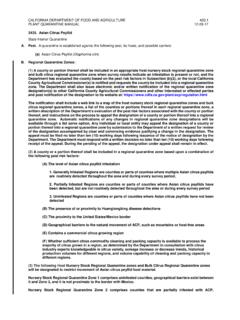
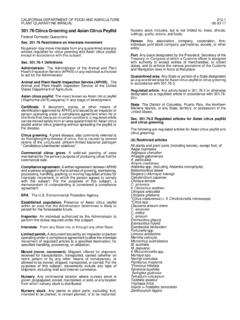
2 According to the CDFA and the Department of Agriculture (USDA) there are five major plant pests and plant pathogens which are currently under quarantine or regulated in California. Los ANGELES COUNTY is known to host at least three of the major quarantined pests as identified in Title 3 of the California Code of Regulations(CCR), asian citrus psyllid Diaphorina citri (Section 3435), Huanglongbing (Section 3439), and Light Brown Apple Moth Epiphyas postvittana (Section 3434). Jurisdictions in Los ANGELES COUNTY also have been experiencing problems resulting from Oak Mortality Disease Phytophthora Ramorum (3 CCR, Section 3700) Regulations recently set forth by CalRecycle in Title 14 of the CCR, Division 7, Chapter , including, but not limited to, Section 17852 (a)(21) Green Material and Green Material and Vegetative Food Material Processing Requirements ; and Title 3 of the CCR, Division 4, Chapter 3, Subchapter 4, Article 2: - General Provisions of Quarantine Regulations being implemented by CDFA, should be updated/coordinated by the said two agencies to address elevated hazards of pest and pathogen transport.
3 GAIL FARBER, CHAIR MARGARET CLARK, VICE -CHAIR Ms. Ross and Mr. Smithline December 28, 2015 Page 2 of 3 The Task Force would like to offer the following comments on these regulations for the protection of biosecurity and preservation of native Californian plant species. The approval or cancelling of permitting, licensing, and certification of green WASTE /material receivers (including biomass/cogeneration facilities, composting operations, landfills, WASTE processors or transfer stations) and green WASTE /material hauler/transporters by the CDFA should be mandatory regulatory actions. This review needs to take precedence over any other appropriate/applicable state or local permitting processes in Plant Pest/Pathogen Quarantine areas throughout the state (emphasis added). Wherever CalRecycle green WASTE /material or composting regulations mention consulting with or referencing to the state or local regulatory agencies, such as the Air Resources Board, Water Resources Control Board, or California Department of Public Health, the list needs to be specifically expanded to include California Department of Food and Agriculture.
4 Any new set of permitting regulations involving green WASTE /materials and/or vegetative food material/ WASTE that neglects the extremely severe environmental impacts of aggressive, invasive plant pests and/or pathogens should prepare an appropriate California Environmental Quality Act (CEQA) document and complete the required process. Special attention should be given to potentially sensitive operations such as all nurseries, landscape businesses, agricultural enterprises, urban landscaping (street trees), wildland ecosystems, parkland, and residential gardens. Dead and deceased plant material exhibiting symptoms of contamination should be properly disposed of in a SOLID WASTE permitted landfill or other disposal facilities designated by CDFA/CalRecycle. Further, considering the requirements of AB 939 (1989), AB 341 (2011), and AB 1826 (2014), the tonnages reported of such material should not be considered as disposal against the affected jurisdictions (emphasis added).
5 Considering the urgency of the subject matter, it is recommended that as a part of the AB 1045 (Chapter 596 0f the 2015 State Statute) implementation the involved agencies should take an immediate action upon effective date of AB 1045 to adopt an emergency regulation to address the subject matter on an interim basis pending complete study and evaluation of the situation leading to the adoption of an appropriate regulation. Pursuant to the California Integrated WASTE MANAGEMENT Act of 1989 (Assembly Bill 939 [AB 939], as amended) and Chapter of the Los ANGELES COUNTY Code, the Task Force is responsible for coordinating the development of all major SOLID WASTE planning documents prepared for the COUNTY of Los ANGELES and the 88 cities in Ms. Ross and Mr. Smithline December 28, 2015 Page 3 of 3 Los ANGELES COUNTY with a combined population in excess of ten million.
6 Consistent with these responsibilities and to ensure a coordinated, cost-effective, and environmentally sound SOLID WASTE MANAGEMENT system in Los ANGELES COUNTY , the Task Force also addresses issues impacting the system on a countywide basis. The Task Force membership includes representatives of the League of California Cities-Los ANGELES COUNTY Division, COUNTY of Los ANGELES Board of Supervisors, City of Los ANGELES , WASTE MANAGEMENT industry, environmental groups, the public, and a number of other governmental agencies. The Task Force respectfully requests that CalRecycle and CDFA consider the above comments and to make appropriate changes for the protection of the environment, especially in light of current state regulations for the diversion of green and vegetative food material/ WASTE from landfills and other disposal facilities.
7 If you have any questions, please contact Mr. Mike Mohajer of the Task Force at or (909) 592-1147. Sincerely, Margaret Clark, Vice-Chair Los ANGELES COUNTY SOLID WASTE MANAGEMENT Committee/ Integrated WASTE MANAGEMENT Task Force and Mayor, City of Rosemead MH:fm P:\..\TF\TF\letters\2015\CalRecycleBiose curityltr Enc. cc: Governor Brown s Deputy Legislative Secretary Martha Guzman-Aceves CalEPA (Matt Rodriguez) California Department of Food and Agriculture (Craig McNamara and Annette Whiteford) CalRecycle (Ken DaRosa, Mark De Bie, Howard Levenson, Brenda Smyth, Robert Holmes, Georgjan Turner, Ken Decio, and Cara Morgan) California Air Resources Board (Mary Nichols) State Water Resources Control Board (Felicia Marcus, Thomas Howard, and Leslie Graves) California Department of Public Health (Dr. Karen Smith) California State Association of Counties (Cara Martinson) League of California Cities (Jason Rhine) Los ANGELES COUNTY Department of Public Health (Angelo Bellomo, Maurice Pantoja, and Gerardo Villalobos) Los ANGELES COUNTY Agricultural Commissioner/Weight and Measures (Kurt Floren) City of Los ANGELES Local Enforcement Agency (David Thompson) Each Member of the Los ANGELES COUNTY Integrated WASTE MANAGEMENT Task Force General facts about the current quarantines in the state: 1.
8 Los ANGELES COUNTY is host to three quarantined pests, though only asian citrus psyllid quarantine covers the whole COUNTY . The other two are Huanglongbing and Light Brown Apple Moth. 2. California has 58 counties. Thirty-three of those counties are quarantined in all or part of their jurisdictions. 3. Licenses for composting/processing operations and compliance agreement certificates for all transporting of green WASTE and other plant material within or out of these quarantined areas are required by CDFA. EXHIBIT: GW4 GREEN WASTE RECEIVER COMPOSTING Provisions for the Intrastate Movement of PROCESSED AND UNPROCESSED GREEN WASTE originating within the State Interior Quarantine for (check all that apply): asian citrus psyllid (CCR 3435) European Grapevine Moth (CCR 3437) Huanglongbing (CCR 3439) Light Brown Apple Moth (CCR 3434) Oak Mortality Disease Control Phytophthora ramorum (CCR 3700) A.
9 Green WASTE Definitions and Regulatory Movement Requirements Green WASTE is unprocessed or processed vegetative material which contains any of the following or a mixture thereof: stems, leaves, culls, discarded fruits and vegetables, grass clippings, weeds, yard trimmings, wood/vine/processing/harvesting WASTE , hulls, bark, branches, logs and stumps, home garden/field/vineyard/grove/orchard residues, duff, mulch, compost, and other miscellaneous plant materials. Unprocessed Green WASTE is Green WASTE in the raw state. It has not undergone any mechanical procedure to lessen the pest risk and is therefore a regulated item. All parties involved in selling, transporting, or receiving Unprocessed Green WASTE , from a Quarantine Area, must have a Program issued compliance agreement. The movement of Unprocessed Green WASTE is regulated, and it must remain within the quarantine area. Processed Green WASTE * is Green WASTE that has undergone some mechanical procedure to lessen or eliminate the pest risk.
10 Depending upon the degree of processing, it may or may not be a regulated item. All parties involved in selling, transporting, or receiving Processed Green WASTE , from a Quarantine Area, that is not completely processed into Compost must have a Program issued compliance agreement. The movement of Processed Green WASTE is dependent upon the degree of processing (mulch or compost). Refer to items a and b. a. Mulch* is Processed Green WASTE that has been chipped, ground or shredded. Mulch is not completely processed and still poses a pest risk, and is therefore a regulated item. All parties involved in selling, transporting, or receiving Processed Green WASTE in the form of Mulch , from a Quarantine Area, must have a Program issued compliance agreement. The movement of Mulch is regulated, and it must remain within the quarantine area. b. Compost is Processed Green WASTE composted in accordance with California Code of Regulations, Title 14, Division 7, Chapter Compost is completely processed and no longer poses a pest risk, and is therefore not a regulated item.