Transcription of LOW CARBON ROADMAP - EUROFER
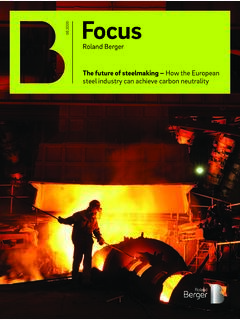
1 EUROFER AISBL Avenue de Cortenbergh, 172 B-1000 Brussels Belgium +32 3 738 79 20 EU Transparency Register: ID 93038071152-83 LOW CARBON ROADMAP PATHWAYS TO A CO2-NEUTRAL EUROPEAN STEEL INDUSTRY FINAL November 2019 OVERVIEW 2 OVERVIEW Making a success of the European steel industry s low- CARBON transformation The European steel industry is the most advanced of its kind in the world. As it is, Europe leads the way in environmental and climate performance. CO2 emissions and energy use in European steel production have been halved since 1960, and the sector has the ambition to further achieve cuts of between 80-95% by 2050, compared to 1990 levels.
2 This transition will require significant investment in new technological development and deployment, in energy infrastructure, consumption and type, and will require access to high quality materials, such as iron ore and scrap. EUROFER has established a clear set of pathway scenarios that will deliver this essential change for the sector, ensuring that Europe will remain on track to fulfil its Paris Climate Accords requirements, whilst also making European steel fit for a clean, low- CARBON future. KEY MESSAGES This ROADMAP sets out several of the key elements that will make the transition to a low or CARBON -neutral European steel industry possible The European steel industry could achieve CARBON emissions cuts of between 80-95% by 2050, under the right conditions.
3 Through new technological pathways Total costs of production will rise by 35-100% per tonne of steel by 2050 as a result of the costs of using new technologies and more energy Additional energy requirements will be about 400 TWh of CO2-free electricity in 2050 about seven times what the sector purchases currently. KEY MESSAGES 3 Contents Pathways to a CO2-neutral European steel industry .. 1 Overview .. 2 Key messages .. 2 Introduction .. 4 Steel innovation: technological pathways .. 4 Necessary conditions .. 5 Scenarios for transformation.
4 5 Energy access and cost .. 6 Other key findings and techno-economic feasibility assessment .. 7 Pathways to a CO2-neutral European steel industry .. 9 Transitioning the European steel industry to its low- CARBON future .. 9 Business as usual .. 9 Ongoing retrofit pathway .. 9 Current projects pathway with low-CO2 energy .. 10 Alternative pathways with low-CO2 energy .. 10 Current projects pathway with CO2-free energy .. 10 Alternative pathways with CO2-free energy ..11 Steel production growth projections for 2050 ..11 Scrap and its role in emissions reduction.
5 13 Inputs into steelmaking and CARBON storage .. 13 Investment requirements and ongoing costs .. 14 Conclusions .. 16 About the European Steel association ( EUROFER ) .. 18 About the European Steel Industry .. 18 INTRODUCTION 4 INTRODUCTION With advanced technologies, and under the right circumstances, the EU steel industry could achieve a revolutionary transformation in the way it makes steel and in its environmental impact The whole European steel industry is being driven to reduce its direct and indirect CO2 emissions and could achieve CO2 emissions cuts of 80-95% in 2050 compared to 1990 levels.
6 However, this change is not an instantaneous shift: it is an iterative process that will require adjustments and a managed transition between phases. The overall transformation would be enabled by hydrogen-based steelmaking, by adapting of fossil fuel-based steelmaking through process integration, and through the capture and use of waste CARBON for the production of chemicals and increased recycling of steel scrap and steel by-products. Steel innovation: technological pathways There are two main technological pathways for CO2 reduction in the steel sector.
7 These are Smart CARBON Usage (SCU) and CARBON Direct Avoidance (CDA). These pathways, shown in Figure 1, seek to substantially reduce the use of the CARBON compared to the current means of steel production or to avoid CARBON emissions entirely. There are overarching circular economy projects, such as enhancing recycling of steel and its by-products and the further improvement of resource efficiency. Within each pathway are groups of technological approaches. Smart CARBON Usage (SCU) includes: Figure 1: The EU steel industry s strategic technological pathways.
8 This identifies both the main pathways to be pursued and a sample of some of the proposed or ongoing projects in each pathway. INTRODUCTION 5 Process integration, which looks at modifications of existing ironmaking /steelmaking processes based on fossil fuels that would help reduce the use of CARBON in, and thus the CO2 emissions of, a state-of-the-art EU plant. CARBON Valorisation or CARBON Capture and Usage, which includes all the options for using the Hydrogen, CO and CO2 in steel plant gases or fumes as raw materials for the production of, or integration into, valuable products.
9 CARBON Direct Avoidance (CDA) includes: Hydrogen-based metallurgy, which uses hydrogen to replace CARBON as the main reduction agent for the iron ore reduction stage. This hydrogen could be produced using renewable energy. Electricity-based metallurgy, which uses electricity instead of CARBON as reduction agent for the iron ore reduction, with greater focus on renewable energy. Necessary conditions Various conditions must be satisfied while the steel industry is transitioning to becoming a low-CO2 sector The necessary conditions need to be in place to make this transformation happen.
10 In particular, all the necessary ingredients for steel making need to be available in both quality and quantity. These include suitable raw materials, such as iron ore and scrap. It also means having access to sufficient low-CO2 energy sources, such as electricity and hydrogen, which must be available at commercially viable rates. The energy infrastructure that goes with it is also indispensable, as even cutting-edge, technologically advanced steelmaking facilities would be stranded without access to clean energy. During the transition, CARBON Capture and Storage (CCS) technology may also be needed in order to support progress along the potential CO2 reduction pathway.