Transcription of LPN SCOPE OF PRACTICE - CLARIFICATION
1 LPN SCOPE OF PRACTICE - CLARIFICATION POSITION STATEMENT for LPN PRACTICE Page 1 of 5 NORTH CAROLINA BOARD OF NURSING PO BOX 2129 Raleigh, NC 27602 (919) 782-3211 FAX (919) 781-9461 nurse Aide II Registry (919) 782-7499 INTRODUCTION The Nursing PRACTICE Act, (8) and North Carolina Administrative Code, 21 NCAC (LPN rules) govern licensed practical nurse (LPN) PRACTICE in North Carolina. Reading this Position Statement and the LPN rules together serves to clarify the LPN SCOPE of PRACTICE /Components of PRACTICE for LPNs, RNs, employers, consumers, and others. Comparison with 21 NCAC (RN Rules) provides distinction from RN SCOPE of PRACTICE . LPN SCOPE of PRACTICE in all steps of the nursing process is limited and focused because, by law, it is a dependent and directed SCOPE of PRACTICE .
2 LPN PRACTICE requires assignment or delegation by and performance under the supervision, orders, or directions of a registered nurse (RN), physician, dentist, or other person authorized by State law to provide the supervision. LPNs implement health care plans developed by the RN and/or by any person authorized by State law to prescribe such a plan. Note: The PRACTICE of nursing is constantly evolving as new and changing technology and therapies are introduced. The North Carolina Board of Nursing defines and interprets scopes of PRACTICE for all levels of providers of nursing care. Each agency/employer is responsible for developing policies/procedures/standards of PRACTICE and ensuring competency of the nursing staff. An agency/employer, including a registered nurse or physician employer, may restrict the nurse s PRACTICE but never expand the PRACTICE beyond the legal SCOPE as defined.
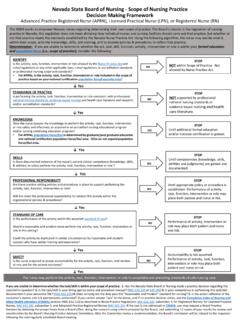
3 LPN PRACTICE is not defined by specific activities or tasks, but rather as a process consisting of a set of legally defined Components of PRACTICE using the steps of the nursing process as outlined in the LPN rules, 21 NCAC For specific questions, the NCBON SCOPE of PRACTICE Decision Tree for the RN and LPN is available at select Nursing PRACTICE on the top banner select Position Statements and Decision Trees select SCOPE of PRACTICE Decision Tree. NCBON PRACTICE Consultants can also be reached for CLARIFICATION at 919-782-3211. Critical Thinking: Critical thinking is used throughout all components of the nursing process. Critical thinking is purposeful and reflective judgment in response to events, observations, experiences, and verbal or written expressions. It involves determining the meaning and significance of what is observed or expressed to determine need for action.
4 Nurses (RNs and LPNs) use critical thinking in clinical problem-solving and decision-making processes relative to SCOPE of PRACTICE , knowledge, competency, and experience. Co-signature of LPN Documentation: North Carolina nursing law and rules do not require LPN documentation to be co-signed by the RN. All nurses are responsible and accountable for their own actions and documentation. Agencies may, however, establish policies requiring RN co-signature of LPN documentation. Agency policy should define what the RN co-signature means. (For example, the co-signature might indicate review , agreement , or that every element has been checked by the RN depending upon the policy requirements.) LPN SCOPE OF PRACTICE - CLARIFICATION POSITION STATEMENT for LPN PRACTICE A Position Statement does not carry the force and effect of law and rules but is adopted by the Board as a means of providing direction to licensees who seek to engage in safe nursing PRACTICE .
5 Board Position Statements address issues of concern to the Board relevant to protection of the public and are reviewed regularly for relevance and accuracy to current PRACTICE , the Nursing PRACTICE Act, and Board Administrative Code Rules. LPN SCOPE OF PRACTICE - CLARIFICATION POSITION STATEMENT for LPN PRACTICE Page 2 of 5 NORTH CAROLINA BOARD OF NURSING PO BOX 2129 Raleigh, NC 27602 (919) 782-3211 FAX (919) 781-9461 nurse Aide II Registry (919) 782-7499 ACCEPTING AN ASSIGNMENT The first decision required by the LPN is whether or not to accept the assignment given by the registered nurse , physician or other person authorized to make the assignment. The LPN shall accept only those assigned nursing activities and responsibilities, as defined in Paragraphs (b) through (j) of the LPN rules. Paragraph (a) of the LPN rules lists the variables in each PRACTICE setting which the LPN must consider in making this decision.
6 Please see Position Statement, Accepting an Assignment, for additional guidance on this important topic at select Nursing PRACTICE on the top banner select Position Statements select Accepting an Assignment. COMPONENTS OF LPN PRACTICE ASSESSMENT, the first step of the nursing process and an essential component of nursing PRACTICE , is an ongoing process. Beginning with the initial encounter and continuing throughout the episode(s) of care, assessment is the basis for nursing judgments, decisions, and interventions. Nursing assessment is the gathering of information about a patient's physiological/biological, psychological, sociological, and spiritual status. Both registered nurses and licensed practical nurses assess clients. Some elements of assessment are identical for both the RN and LPN. These include: The collection of data for a nursing history, psychological, spiritual, and social history, and physical examination (including vital signs, head to toe and/or targeted physical assessment, and other physiological/biological data); Comparison of the data collected to normal values and findings; Ongoing determination of client status for changes in condition, positive and negative.
7 For the LPN, nursing assessment is a focused appraisal of an individual s status and situation at hand, contributing to assessment, analysis, and development of a comprehensive plan of care by the RN. The LPN supports ongoing data collection and decides who to inform of the information and when to inform them. The LPN identifies the need for immediate assessment (beyond that specified in the plan of care) in response to current client status and condition. (National Council of State Boards of Nursing, Model Law and Rules, 2008) The LPN participates in both initial and ongoing nursing assessments of the client s health status, including reaction to illness and treatment regimens while the RN retains overall responsibility for verifying data collected, interpreting data, and formulating nursing diagnoses. Participating in means to have a part in or contribute to the elements of the nursing process.
8 Participation of the LPN in assessment is limited to: Collection of data according to structured written guidelines, policies and forms; Recognition of existing relationships between data gathered and the client s current health status; Determination of the need for immediate nursing interventions. LPN Participation in Initial , Admission , or Event-focused Assessment: These terms used by health care agencies to describe different types of assessments are not defined in nursing law and rules. The components of initial , admission , event-focused ( , post patient fall, pre-transfer, etc.), or other specifically-named assessment processes are defined by agency policy based on the laws and regulations, standards of care, accreditation standards, and reimbursement requirements applicable to specific PRACTICE settings.
9 (For example, if federal Medicare regulations require that an RN perform the initial assessment, then the LPN cannot perform this assessment by proxy for the RN.) The LPN within SCOPE of PRACTICE participates in any assessment process, if permitted by agency policy, using structured written guidelines, policies, and forms that outline the data to be obtained. LPN SCOPE OF PRACTICE - CLARIFICATION POSITION STATEMENT for LPN PRACTICE Page 3 of 5 NORTH CAROLINA BOARD OF NURSING PO BOX 2129 Raleigh, NC 27602 (919) 782-3211 FAX (919) 781-9461 nurse Aide II Registry (919) 782-7499 PLANNING is the second step of the nursing process. For the LPN, planning includes participation in the identification of the client s needs related to the findings of the nursing assessment. Elements of planning are listed in the LPN rules in Paragraph (c) and include: Identification of nursing interventions and goals for review by the RN; Participation in decision-making regarding the implementation of nursing and medical interventions utilizing assessment data; Participation in multidisciplinary planning by providing resource data Therefore, the LPN provides important input in the planning process while the RN has the responsibility for developing the nursing plan of care and modifying the plan as indicated by ongoing assessment and evaluation.
10 IMPLEMENTATION is the third step of the nursing process and consists of delivering nursing care according to an established health care plan and as assigned by the RN or other person(s) authorized by law. Elements of implementation for the LPN are listed in the LPN rules in Paragraph (d)(1) and include the following: Procuring resources needed to implement the care plan; Implementing nursing interventions and medical orders consistent with nursing rules and within an environment conducive to client safety; Prioritizing performance of nursing interventions within assignment; Recognizing responses to nursing interventions; Modifying immediate nursing interventions based on changes in a client s status; Delegating specific nursing tasks as outlined in the plan of care and consistent with nursing rules.