Transcription of LTE Random Access Procedure - EventHelix.com
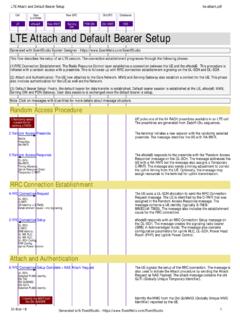
1 UE-AUE-BUE-CeNodeBLTE Random Access Procedure LTE Random Access Procedure is used by the UEs to initiate a data transfer. The UEs also obtain uplink timing information from the initialhandshake. This sequence diagram describes the tale of three UEs (UE-A, UE-B and UE-C) that are powered on at the same time: (1) UEs synchronize with the downlink channel by decoding the PSS and SSS signal. The UEs are synchronized to the downlink frames aftercompleting this Procedure . (2) The three UEs initiate the Random Access Procedure at exactly the same time. Two of them (UE-A and UE-B) happen to pick the samepreamble. This results in a resulting in a collision. UE-C picks a distinct preamble so it succeeds in the Random Access Procedure .
2 (3) Contention between UE-A and UE-B is resolved in UE-A'S favor. UE-A proceeds with the RRC connection. (4) UE-C times out and retries the Random Access Procedure . Inc, 2015. Generated with EventStudio ( ) Primary Synchronization Signal (PSS)PSS is transmitted at the start and middle ofevery 10ms Synchronization Signal (SSS)The SSS is also transmitted every 5ms. Thepattern alternates every 5ms. The UE achievesdownlink frame synchronization once it hasdecoded both SSS synchronize with the eNodeB Master Information Block (MIB)UEs download the MIB from the broadcastchannel. This channel contains informationabout the location of the downlink and uplinkcarrier DCI Format 1 ASI-RNTI The UEs tune to the PDCCH to look for DCI(Downlink Control Information) addressed withthe SI-RNTI.
3 The UL-SCH assigned by thePDCCH contains System Information Block(SIB) Information Block 2 (SIB2)SI-RNTI,Root sequence index for Zadoff Chu codes,Zero correlation zone config,prach frequency,prach frequency offset The UEs download the System InformationBlocks from the DL-SCH. SIB2 downloadcontains parameters needed for initial download the system information Select Preamble 1 The UE-A randomly selects an RA preamblesequence from the set of sequences available inthe cell. The preamble selection is a shift in theZadoff-Chu code for the RA Preamble 1RA-RNTI 1 UE-A transmits the Preamble on an RA transmission carries no data bits. TheRA-RNTI is is implicitly specified by the timingof the preamble Access Procedure UE-AUE-BUE-CeNodeBSelect Preamble 1 UE-B happens to select the same preamble RA Preamble 1RA-RNTI 1 UE-B transmits the preamble at the same UE-B also assumes RA-RNTI 1.
4 Two UEstransmitted using the same preamble. In thisscenario we assume that UE-B's preambletransmission is Preamble 3 UE-C randomly chooses between the availablepreambles. It picks Preamble RA Preamble 3RA-RNTI 1 UE-3 also transmits at the same time as UE-Aand UE-B. So UE-C also assumes the sameRA-RNTI as UE-A and UE-B. Preamble 1 andPreamble 3 Zadoff-Chu sequences areorthogonal to each other so both of them Preamble 1 The eNodeB detects the preamble the Uplink Timing The eNodeB estimates the uplink transmissiontiming of the RA-RNTI 1 The eNodeB derives the RA-RNTI from thetimeslot number in which the preamble Temporary C-RNTI 1 A Temporary C-RNTI is assigned to the address will be used to address the UE insubsequent Preamble 1 Detect Preamble 3 The eNodeB detects the preamble the Uplink Timing The eNodeB estimates the uplink transmissiontiming of the RA-RNTI 1 The eNodeB derives the RA-RNTI from thetimeslot number in which the preamble Temporary C-RNTI 3 Process Preamble 3 PDCCH DCI Format 1 CRA-RNTI 1 The
5 ENode assigns resources via the PDCCH mesage is addressed by 'RA-RNTI1' that is assigned to UE-A, UE-B and RA ResponseMAC Header,- Backoff Indicator,- Preamble 1,- Preamble 3,MAC RAR 1 (for Preamble 1),- Temporary C-RNTI 1,- Timing Advance 1,- Uplink Resource Grant 1,MAC RAR 3 (for Preamble 3),- Temporary C-RNTI 3,- Timing Advance 3,- Uplink Resource Grant 3 The eNodeB transmits the RA Response on theDL-SCH channel. The message carries thetiming and uplink resource allocation forPreamble 1 and Preamble 3. The message alsoincludes the back off indicator MAC header forcontrolling the backoff duration in the event ofa Random Access Procedure three UEs receive the message as they were expecting the message on thesame RA-RNTI.
6 UE-A Processes RA Responsefor Preamble 1 UEs Process the RA Response UE-AUE-BUE-CeNodeBSave Temporary C-RNTI 1 UE-A saves the Temporary C-RNTI from theMAC data for Preamble Timing Advance 1 After applying the correction, the UE issynchronized in the return direction and cantransmits data bursts to the Uplink Resource Grant1 The eNodeB assigned uplink resourceinformation will be used to transmit the data tothe Temporary C-RNTI 1 UE-B mistakenly believes that the RA Responseis meant for it. The RA-RNTI and Preamble inthe message match. UE-B has no way ofknowing that the message was really meant forUE-A Timing Advance 1 Process Uplink Resource Grant 1 UE-B is continuing with the Procedure eventhough had been rejected.
7 This situation will beresolved after the contention resolution Processes RA Response forPreamble 1 Save Temporary C-RNTI 3 UE-C saves the Temporary C-RNTI from theMAC data for Preamble 3 and goes ahead withthe Random Access Procedure normally. Thefurther Procedure for UE-C is not shown in Timing Advance 3 Process Uplink Resource Grant 3 UE-C Processes RA Response forPreamble 3 The randomly selected RA preamble does not enable unique identification of the UE, and itis possible that multiple UEs attempted RA with the same RA preamble sequence on thesame RA channel. The Contention Resolution phase helps uniquely identify the UE that hasbeen selected. In this scenario, contention resolution will resolve the Random Access Procedure betweenUE-A and UE-B.
8 Pick Initial UE Identity as 'RandomNumber A' UE-A does not have a permanent identity, so itpicks a Random number as the UE RRC Connection Requestue-identity = Random Number A The Random UE identity is included in the RRCconnection starts the T300 timer, awaiting the RRCC onnection Setup Initial UE Identity as ' Random Number B' UE-B also picks a Random number as its Resolution UE-AUE-BUE-CeNodeBUL-SCH RRC Connection Requestue-identity = Random Number B,Establishment Cause UE-B transmits on the same assignment andcollides with the transmission of UE-A. It islikely that it's transmission will not be receivedat the eNodeB as it is transmitting with a timingadvance that was not intended for the UE. Inthis scenario, UE-B's message is also starts a timer awaiting the RRCC onnection Setup ACKThe eNodeB accepts the transmission from theUE and acknowledges it with a Hybrid ARQ DCI Format 1 Temporary C-RNTI 1 The eNodeB signals a downlink assignmentusing the Temporary C-RNTI 1.
9 Both UE-A andUE-B assume that the assignment is for themas both UEs think they have been assignedTemporary C-RNTI Contention Resolution + RRC Connection Setupinitial UE Identity = Random Number A UE-A and UE-B receive the RRC ConnectionSetup message, as it is addressed with theTemporary C-RNTI 1. The message alsocontains ' Random Number A' as the UCI HARQ ACKUE-A receives the eNodeB's transmission so itacknowledges the message with a Hybrid received initial UE identitywith ' Random Number A' that wassent in the RRC Connection Requestmessage. The UE, seeing its own identity echoed back,concludes that the RA was successful andproceeds with time-aligned received initial UE identity with 'RandomNumber B' This comparison fails.
10 UE-B realizes that it haslost out to another UE in the UCI SRUE-A now requests uplink resources to sendthe RRC Connection Setup Complete DCI Format 0 Temporary C-RNTI 1 UE-A receives the resource Connection Setup CompleteNAS Message UE-A sends the RRC Connection Setupmessage to initiate further Connection Setup Complete handling UE_B_T300UE-B times for the Random Access Procedure asit did receive their own identity in thecontention Preamble 4 UE-B retries the RA Preamble 1RA-RNTI 4 UE-B retries the Random Access Random Access Procedure Generated with EventStudio ( ) UE-AUE-BUE-CeNodeBEXPLORE MORE LTE IMS