Transcription of Lumbar Fusion Protocol
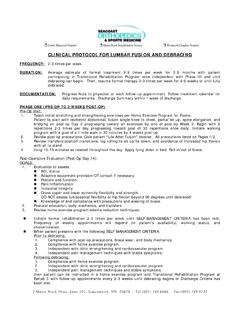
1 Lumbar Fusion Protocol Weeks 2-4 Weeks 4-8 Initial Evaluation Evaluate Screen for signs and symptoms that may indicate a post-operative complication, new pathology, or spinal instability: o New onset urinary or bowel urgency/incontinence o Ascending paresthesia s o New onset weakness o Severe/intractable pain or headache o Abnormal discharge If present discuss with MD or PA. Co-morbidities: Prior level of function: Occupation/return to work plans: Systems Review: o Cardiovascular/Pulmonary: BP, edema, HR, RR, SpO2. o Integument: skin color, incisional integrity, drainage, myofascial pain. o Communication/Affect/Cognition/Language/ Learning style: Learning preferences.
2 O Nueromuscular and musculoskeletal: See detailed exam details below. Tests and Measures: o Pain: Location: Radicular sxs: Iliac crest donor site pain: Sxs prior to surgery compared to now identify any residual sxs: Medication: Cognitive component: assess if they had chronic pain prior, assess psychological factors (cognitive and emotional) including beliefs of pain pre and post. Incorporate as appropriate pending case. 3 o Joint mobility: Thoracic spine and hip o Soft tissue mobility o Neuro Screen: Myotomes, Dermatomes, DTR s, Slump, SLR. o Muscle Performance: TA contraction, multifidus recruitment, trunk stability/control, hip girdle strength.
3 O Muscle Length: Hamstring, hip flexor, hip external rotators, Achilles. o Posture. o Gait/balance assessment: Monitor for residual foot drop or knee buckling/quad weakness. o Occupation/return to work plans Systems Review Tests and Measures: o Pain o Muscle Performance o Muscle Length o Posture o Joint mobility: thoracic spine and hip o Soft tissue mobility o Gait/balance assessment Weeks 2-4 Weeks 4-8 Patient Education Patient Education Precautions: o No lifting > 10# for 6 weeks. o No sustained sitting > 30 minutes for 6 weeks. o No end range BLT (bending, twisting, lifting) for 6 weeks. o Review Bracing schedule (see special considerations) Positioning: o Spine neutral position and application for ADL s, driving, sleeping, ergonomics/work set up Neural tension: review postural irritants HEP: strength, motor control, and interval walking.
4 Body Mechanics: o Bed mobility: log roll o Sit <> stand, functional squat o Lifting Precaution Review Gradual/safe increase in activity level to obtain active lifestyle. Joining gym/fitness center. Goal for aerobic endurance training 30 minutes at least 5 days of week (goal of 150 minutes per week).1 Discuss effect of truncal weight/obesity on back pain. Therapeutic Exercise* Therapeutic Exercise* Education and Core stabilization . TrA activation. Spine neutral stabilization (position of comfort and progress to spine neutral as spine neutral has optimal facilitation of TrA activation) using motor control exercises starting in hooklying.
5 Teaching co-contraction of pelvic floor muscles during abdominal hollowing for TrA to help to increase contraction of ,5 Strengthening: o LE strengthening hip for global stability. o Midback strengthening to improve posture. Practice safe body mechanics with: o Log roll, sit <> stand functional squat, ADL s. Stretching: hip flexors, hamstring, hip rotators, achilles (without causing nerve irritation). Walking program: Interval progress to continuous with goal of 30 minutes continuous daily. Aquatics: if patient unable to tolerate land based exercise. Get surgeon approval first. Spine stabilization progression: Quadruped prone standing.
6 Body mechanics: Lifting techniques with breathing at 6 weeks: partial lunge, squat, hip hinge for reaching. Continued strengthening midback, LE and core. Incorporate intermittent loading in closed chain functional position. Continuous walking program. Manual Techniques Manual Techniques Thoracic mobilizations/manipulation Hip mobilizations Soft Tissue: o STM to thoracic and Lumbar spine o Scar massage Modalities as indicated Thoracic mobilizations/manipulation Hip mobilizations Soft Tissue mobility as indicated Modalities as indicated Goals Goals Understand post-op precautions Understand and demonstrate proper body mechanics Independent with self-management of symptoms Independent with HEP including: o Motor control exercises and good understanding of TA bracing to stabilize the spine incorporating appropriate breathing pattern.
7 O LE strength and conditioning program. o Interval walking program. Independent with HEP including: o Continuous walking program and exercise program at gym. Progressive return to work. * Exercises within each category are to provide the clinician with examples based on evidence based research, but are not all inclusive. References 1. (2018, April 18). Retrieved February 14, 2019, from 2. (2005, March 5). Retrieved February 14, 2019 from 3. O Sullivan PB, Caneiro JP, O Keeffe M, et al. Cognitive functional therapy: An integrated behavioral approach for the targeted management of disabling low back pain. Phys Ther.
8 2018;98:408 423. (2018). Physical Therapy, 98(10), 903-903. 4. Critchley, D. (2002). Instructing pelvic floor contraction facilitates transversus abdominus thickness increase during low-abdominal hollowing. Physiotherapy Research International, 7(2), 65-75. 5. Hodges, P. W., &Richadson, (1996). Inefficient Muscular stabilization of Lumbar Spine Associated with Low Back Pain: A Motor Control Evaluation of Transversus Abdominis. Spine, 21(22), 2640-2650. Special Considerations Scheduled Follow Up Visits with Physician: o 3 week o 6 week o 3 month o Optional 6 month dependent on case or change in status. Brace Schedule: Non-instrumented Fusion o 0 to 6 weeks s/p surgery: wear hard shell and soft shell o 6 to 12 weeks s/p surgery: soft portion of brace only o 12 weeks: wean out of soft brace Brace Schedule: Instrumented Fusion o 0 to 3 weeks s/p surgery: wear hard shell and soft shell o 3 to 6 weeks s/p surgery: wear soft portion of brace only o 6 weeks: wean out of soft brace * Exercises within each category are to provide the clinician with examples based on evidence based research, but are not all inclusive