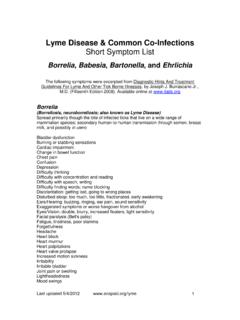
Transcription of Lyme Disease Background Information
1 lyme Disease Background Information lyme Disease (also known as lyme borreliosis ) is a potentially serious bacterial infection transmitted via tick bites. It does occur in the UK, particularly in certain rural areas. Organism Borrelia burgdorferi Incidence and Transmission There are around 900 reported cases of lyme Disease in the UK each year, although estimates suggest there may actually be 2000 3000 cases. Some of these cases are acquired abroad. lyme Disease is spread by tick bites. The ticks feed on birds and mammals that carry the bacterium in their blood and then transmit the bacterium to a human when they have a blood meal. The tick needs to be attached to a person for about 24h before the Disease can be transmitted. In the UK, the risk of tick bites is highest from April to October, when the ticks are most active.
2 Ticks are common in forested areas, heathland, moorland and suburban parks, although infected ticks are more common in certain regions of the UK. lyme Disease is most commonly acquired in the following areas: New Forest; Exmoor; South Downs; Thetford Forest; woodland and heathland in Southern England; Lake District; North York moors; and Scottish Highlands and Islands. lyme Disease is not spread from person to person. Occupations and processes where lyme Disease may present a risk Occupational exposure to Borrelia burgdorferi may occur in those who: work outdoors in high risk areas of the UK; or are in contact with animals in high risk areas of the UK. Occupations where there may be a risk of occupationally acquired lyme Disease include: sheep farmers, particularly hill farmers and from working dogs; deer farmers; game keepers; veterinary surgeons; agricultural workers; forestry workers; nature conservancy workers; and rural outdoor pursuits instructors.
3 Clinical Information Incubation time is 3 30 days. The first symptom is usually a rash, which spreads from the site of the tick bite. It is not generally painful or itchy. There are often accompanying flu-like symptoms. In a small number of more serious cases there is infection of the nervous system (symptoms include viral-like meningitis, facial palsy, nerve damage). Anyone with these symptoms who has been in a high risk area should seek medical attention. Early treatment with antibiotics is generally effective. Control The following control measures reduce the risk of infection: It is important to be tick aware in high risk areas. In areas of long grass, wear long trousers tucked in to socks. Check exposed skin for ticks (they are very small and therefore difficult to see) and remove immediately with tweezers.
4 Check clothing and animals (eg working dogs) for ticks. Use insect repellents. Further Information Public Health England lyme Disease NHS Choices lyme Disease