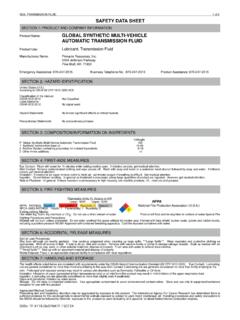
Transcription of (M)SDS: HYDRAULIC FLUID SAFETY DATA SHEET
1 (M)SDS: HYDRAULIC FLUID ! of 2 1 SAFETY DATA Department of Labor Compliance Date of Issue/Revision: 21 Feb. 2015 OSHA's Hazard Communication Standard (29 CFR )According REACH Title IV, Annex II and Format ISO 11014. GHS . SECTION 1 - PRODUCT AND COMPANY INFORMATIONPRODUCT USE & IDENTITY: PREMIUM ANTI-WEAR HD HYDRAULIC OIL Product Use: Lubricant, HYDRAULIC Oil, ISO Grades 22, 32, 46, 68, 100 MANUFACTURER S NAME - Pinnacle Resources, Inc.
2 EMERGENCY ASSISTANCE (870) 247-2315 5504 Jefferson Parkway Bus. Telephone No. (870) 247-2315 Pine Bluff, Arkansas 71602 Product Information (870) 247-2315 SECTION 2 - HAZARDS IDENTIFICATION OSHA Communication Standard: Product assessed in accordance with OSHA 29 CFR and determined not to be hazardous. Effects of overexposure: No significant effects expected. Emergency Response Data: Liquid with varying color and clarity. DOT ERG No. - NA SEC: 0 Health 1 HMIS Applicable GHS Classifications: Category 4-FLAMMABLE LIQUIDS.
3 Category 2- MILD SKIN IRRITATION. Fire Hazard 1(Sec. 5 Definition) Category 2A-EYE DAMAGE/IRRITATION. Category 3-AQUATIC TOXICITY (Sec. 12). Reactivity 0 Hazardous Material Information System ( ) SECTION 3- COMPOSITION/INFORMATION ON INGREDIENTS %WeightP Premium AW HD HYDRAULIC Oils, ISO 22, 32, 46, 68, 1 Solvent refined, hydrotreated paraffinic distillate mineral base oil50-90 2 Refined and hydroprocessed heavy distillate/residual mineral base 3 Additive system containing proprietary formulated ingredients.
4 1-6 4 Other minor additives< 1 SECTION 4 - FIRST AID MEASURESEye Contact - Flush with water for 15 minutes while holding eyelids open. If irritation persists, get medical Contact -Remove contaminated clothing and wipe excess off. Wash with soap and water or a waterless hand cleaner followed by soap and water. If irritation occurs, get medical attention. Inhalation - If overcome by vapor remove victim to fresh air; administer oxygen if breathing is difficult. Get medical - Do not induce vomiting. In general no treatment is necessary unless large quantities of product are ingested. However, get medical to Physician - In general, Emesis Induction is unnecessary in high viscosity, low volatility products, , most oils and 5 - FIRE FIGHTING MEASURES Flammable limits /% Volume in AiR Lower: N/AV Upper: N/AV NFPANFPA RATINGS- Health: 1 Flammability: 1 Reactivity: 0 Special: -- 1 1 National Fire Protection Association ( ) 00 NPCA-HMIS RATINGS- Health: 1 Flammability: 1 Reactivity: 0 1 0 Extinguishing Media.
5 Use water fog, foam, dry chemical or CO2. Do not use a direct stream of water. Product will float and be reignited on surface of Fire Fighting Procedures and Precautions:Material will not burn unless preheated. Do not enter confined fire-space without full bunker gear (Helmet with face shield, bunker coats, gloves and rubber boots), including a positive-pressure NIOSH-Approved self-contained breathing apparatus. Cool fire exposed containers with 6 - ACCIDENTAL RELEASE MEASURESS pill or Leak Procedures:May burn although not readily ignitable. Use cautious judgement when cleaning up large spills. **Large Spills** Wear respirator and protective clothing as appropriate. Shut off source of leak. If safe to do so, dike and contain.
6 Remove with vacuum trucks or pump to storage salvage vessels. Soak up residue with an absorbent such as clay, sand, or other suitable materials; dispose of properly. Flush area with water to remove trace residue.**Small Spills** Take up with an absorbent material and dispose of Disposal:Place in an appropriate disposal facility in compliance with local 7 - HANDLING AND STORAGEThe health effects noted below are consistent with requirements under the OSHA Hazard Communication Standard (29 CFR ).Eye Contact:Lubricating oils are general considered no more than minimally irritating to the Contact:Lubricating oils are generally considered no more than mildly irritating to the skin. Prolonged and repeated contact may result in various skin disorders such as Dermatitis, Folliculitis or Oil :Inhalation of vapor (generated at high temperatures only) or oil mist from this product may result in mild irritation of the upper respiratory :Lubricating oils are generally considered no more than slightly toxic if and symptoms:Irritation as noted : Do not store in unlabeled containers.
7 Use appropriate containment to avoid environmental contamination. Store and use only in equipment/containers designed for use with this product(M)SDSn: (M)SDS: HYDRAULIC FLUID ! of 2 2 Aggravated Medical Conditions:Preexisting skin and respiratory disorders may be aggravated by exposure to this product. The International Agency For Cancer Research has determined there is sufficient evidence for the carcinogenicity in experimental animals exposed by contact to used motor (crankcase) oil. Handling procedures and SAFETY precautions in the MSDS should be followed to minimize exposure to the product as used lubricating oil in gasoline or diesel fueled internal combustion 8 - EXPOSURE CONTROLS/PERSONAL PROTECTIONM inimize skin contact.
8 Wash with soap and water before eating, drinking, smoking or using toilet facilities. Launder contaminated clothing before reuse, properly dispose of contaminated leather articles, including shoes that cannot be decontaminated. Store in a cool, dry place with adequate ventilation. Keep away from open flames and high Protection:If exposure may or does exceed occupational exposure limits (SECTION 2) use a NIOSH-Approved respirator to prevent overexposure. In accord with 29 CFR use either an atmosphere-supplying respirator or an air-purifying respirator for organic vapors and clothing:Wear chemical resistant gloves and other protective clothing as required to minimize skin contact. Wear SAFETY goggles to avoid eye contact. Test data from published literature and/or glove and clothing manufacturers indicate the best protection is provided by nitrile Exposure Limits (estimated 8-hour workday): OSHA Z1 ACGIH OTHERS tandards -> PEL/TWA PEL/CEILING TLV/TWA TLV/STEL Oil Mist - > 5 Mg/M3* None 5Mg/M3* 10 Mg/M3* None (*Oil Mist, Mineral) SECTION 9 - PHYSICAL/CHEMICAL PROPERTIESP hysical State: Liquid Auto Ignition Temperature: > 320 C/608 F Upper/Lower Explosion/Flammability Limits: 1-10 %V (Based on Mineral Oil) Boiling Point: Not AvailableGravity, (H2O= ) API @ 60 F.
9 - Melt Point: N/A Pour Point: -30 F to 0 FFlash Pt., COC: 385 F to 450 F Evaporation Rate: Volatile by Volume: NegligibleVapor Density: (Air= ) > Viscosity@100 C, cSt.: - typ Solubility In Water: Negligible Appearance: Clear-yellow to darker Odor: Mild hydrocarbon Viscosity@ 40 C, cSt.: 22 - 100 typ PH: N/AVapor Pressure: < ( @ 20 C [Est]Electrical Conductivity: Not expected to be a static accumulator. SECTION 10 - REACTIVITY DATAS tability: Stable Hazardous Polymerization: Will Not Occur Conditions and Materials to Avoid: Avoid heat, open flames and oxidizing Decomposition Products:Thermal decomposition products are highly dependent on the combustion conditions.)
10 A complex mixture of airborne solid, liquid, particulate and gases will evolve when this material undergoes pyrolysis or combustion. Carbon monoxide and other unidentified organic compounds may be formed upon 11 - TOXICOLOGICAL INFORMATIOND ermal LD50> g/kg (Rabbit)OSHA - Non ToxicBased on similar material(s) Oral LD50> g/kg (Rat)OSHA - Non ToxicBased on similar material(s) Carcinogenicity Classification (Highly Refined Mineral Oil/IP346<3%):IARC 3=No carcinogenicity to A4=Unclassified as a human carcinogenicity classification. NTP=No IOSHA=No SECTION 12 - ECOLOGICAL INFORMATIONThis product is classified as an oil under section 311 of the Clean Water Act. Spills entering (A) surface waters of (B) any water courses or sewer s-entering/leading to surface waters that cause a sheen must be reported to the nearest local Environmental Protection Agency Office SECTION 13 - DISPOSAL CONSIDERATIONSP roduct is suitable for burning in an enclosed, controlled burner for fuel value or disposal by supervised incineration.