Transcription of MAASTO TPIMS Project Systems Engineering Analysis ...
1 MAASTO TPIMS Project MAASTO TPIMS Systems Engineering Analysis documentation November 18, 2016 Page 1 Date: November 18, 2016 Subject: MAASTO TPIMS Systems Engineering Analysis and Supplementary Project documentation Summary Introduction Systems Engineering is a typical part of any ITS Project and is required on any federal-aid Project that has an ITS work element, per 23 CFR The MAASTO Truck Parking Information Management Systems ( TPIMS ) Project has followed this step by step Systems Engineering Analysis to: Assess the system s needs and relationship to the regional ITS architectures Plan a Project that meets stakeholder needs and expectations Define specific system Requirements for the Project and subsystems Define the operations and maintenance requirements for the system Plan for the performance measurement and refinement of the system The purpose of this memorandum is to detail the contents of the Systems Engineering Analysis and the Phase 1 Preliminary Design (30% design) deliverables for the MAASTO TPIMS Project .
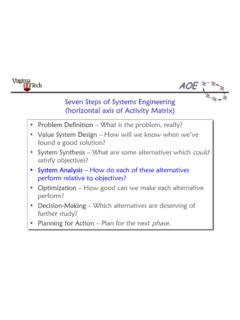
2 Figure 1 provides a graphical representation of the steps of the Systems Engineering Process covered through 30% design as well as supplementary documents. Figure 1: Systems Engineering V Diagram MAASTO TPIMS Project Systems Engineering Analysis documentation November 18, 2016 Page 2 The deliverables consist of state-specific and regional Systems Engineering documents as well as supplemental Project documentation . Each document in the process is described in the following sections and is included on the Phase 1 deliverables flash drive. A. Systems Engineering Documents The final Phase 1 system Engineering deliverables are categorized based on the stage of the Systems Engineering process in which they fall. 1. Concept of Operations The Concept of Operations stage of the Systems Engineering process is a time of discovery and stakeholder engagement. These activities start defining the Project on a high, region-wide level.
3 Each state received the same documents from this stage. Concept of Operations The Concept of Operations document provides a high-level overview of the MAASTO TPIMS system . It covers the following topics: Purpose and Overview Scope Referenced Documents Background User-Oriented Project Development (stakeholder engagement) Operational Needs including the Project vision, needs, goals, and objectives system Overview National and Regional Project Architecture Core Functions Matrix Operation and Maintenance elements Operational Scenarios Summary of Impacts/Outcomes State-specific appendices which include: o State-specific core functions matrix o Statewide proposed Project architecture o Operation, Maintenance, and Ownership responsibilities Core Functions Matrix Early development of the core functions matrix organized each state s intentions for the following Project attributes: Procurement Data Collection Method Data Collection Technology Operations & Maintenance Data Analytics & Sharing Information Dissemination This document is also located in the Concept of Operations.
4 MAASTO TPIMS Project Systems Engineering Analysis documentation November 18, 2016 Page 3 Stakeholder Workshop Summaries The draft Concept of Operations was presented at two stakeholder workshops. Feedback from the stakeholder workshops were used to refine the Concept of Operations. 2. system Requirements The system Requirements stage of this Project focused on a regional level. Therefore, each state received the same documents from this stage. system Requirements Technical Memorandum The system requirements memo is a result of the development of the Concept of Operations document. This memo defines the user needs and requirements of the system from a regional level, but does not contain specifics of what each state is doing. It contains the following tables: User Needs system Requirements Traceability Matrix Project -level ITS Architecture The ITS Architecture for the MAASTO TPIMS Project documents the attributes and associated Systems , service packages, functional areas, and architecture flows.
5 A Turbo architecture file is available along with a memorandum that describes and summarizes the Project s ITS Architecture. ITS Architecture Consistency Review Forms These forms capture any necessary changes or additions to the statewide and regional ITS Architectures that are affected by this Project . A form has been prepared for each individual Architecture review. 3. High-Level Design (30% Design) The High-Level Design stage of the Systems Engineering process is focusing more on state-specific deliverables. While each state still needs to fulfill their applicable system requirements, they can do so in their own state-specific manner. The high-level design has been completed to a 30% level as described below. Design Requirements The Design Requirements are more detailed, state-specific requirements that are necessary to accomplish the regional system requirements. They should reflect design standards for each state based on the type of system they are deploying.
6 For states taking a design-build approach to procurement the design requirements are expressed as Functional Requirements . Typical Site Layout Each state s potential truck parking sites were sorted by site type for the purposes of providing typical site layouts for the 30% design. These do not represent any particular site, but rather the general quantity and layout of each site type. MAASTO TPIMS Project Systems Engineering Analysis documentation November 18, 2016 Page 4 Typical Site Block Diagrams The typical site block diagrams accompany each typical site layout and provide a high-level overview of the communications network and connections required for each respective site type. Cost Estimates Each site in the Project was assigned a site type as described above. Each site type was analyzed to provide a high-level 30% cost estimate, taking into account factors such as the number of driveways to determine the cost.
7 This estimate is not detailed enough to determine individual site considerations, such as foundation depth or potential tree removal. Final Map Geodatabase A geodatabase was created using ArcGIS to catalog TPIMS site and sign information for all eight states. This database is available for viewing online ( ) and contains the following information: Site locations for all sites included in the TIGER grant, visited during the field reviews, and/or currently listed as an active Project site. Sign locations for all signs that are part of the active Project . Geotagged photos at each site visited in the field for power service, potential camera locations, driveways, and other general site photos. Data for each of the sites and signs in the database - including mile marker, direction, public or private, site type, etc. To access this database, click on the link above or copy the link into your web-browser. The displayed map will include a box with a brief description of the data and a note that the map will be updated as the Project progresses.
8 Click ok on the box. You can then either use the zoom tool in the upper right hand corner of the box or use the scroll on your mouse as you would in Google Earth to each site. Site data can be accessed by clicking on each site point. There is a toolbar at the top of the screen that includes the legend, layer list, measurement tool and printer. GIS Data Geographic Information system (GIS) data from the field work and signs (if applicable) for each state. State Block Diagrams The state block diagrams provide an overview of the communications and Systems connections within each state, showing the logical connections for data collection, processing, and dissemination. Each proposed MAASTO TPIMS truck parking site and sign is included. These diagrams distinguish between state and third party operations, depending on the configuration that each state has chosen. Sign Technical Memorandum The sign technical memorandum provides guidance for the placement of Dynamic Truck Parking Signs (DTPS) and Dynamic Message Signs (DMS) that are proposed to disseminate parking availability information.
9 The memo also includes recommendations from the federal MUTCD committee on sign legends and best practices. MAASTO TPIMS Project Systems Engineering Analysis documentation November 18, 2016 Page 5 Technology Alternatives Technical Memorandum The Technology Alternatives Technical Memorandum summarizes several of the most likely technology alternatives. The memo also includes an appendix with specific equipment information from similar projects and the MAASTO RFI responses. Data Feed Technical Memorandum This memorandum summarizes the standard data feed that each state will provide for their public and private truck parking sites. The data elements and formatting were agreed upon by the eight states participating in the MAASTO TPIMS Project , and are intended to set a standard for future projects. 4. system Verification The Systems Verification Plan will be developed in Phase 2 concurrently with Final Design.
10 Verification will be performed before burn-in as a basic check that all parts of the system are built and running, and answers the question does the system meet the design? States are responsible for regular testing and acceptance of their Systems as they would normally proceed for an ITS Project . The state-level testing will culminate with self-evaluation testing. Testing progress will be discussed at Phase 2 Partnership calls (held every other week) and self-evaluation documentation that supports each subsystem being tested (signs, site detection, software feed) will be collected. 5. system Validation The Systems Validation Plan will be developed in Phase 2 concurrently with Final Design. Validation will be tied into performance measures and answers is this system functioning up to the performance standards and addressing user needs? The functionality of the system will be checked daily during a 60-day burn-in, and typical utilization data for each parking facility will be collected over a continuous 7-day period.