Transcription of MACBETH A UNIT PLAN - MsEffie
1 MACBETH . A UNIT PLAN. Second Edition Based on the play by William Shakespeare Written by Mary B. Collins Teacher's Pet Publications, Inc. 11504 Hammock Point Berlin, Maryland 21811. Copyright Teacher's Pet Publications, Inc. 1996, 1999. This LitPlan for William Shakespeare's MACBETH has been brought to you by Teacher's Pet Publications, Inc. Copyright Teacher's Pet Publications 1999. 11504 Hammock Point Berlin MD 21811. Only the student materials in this unit plan may be reproduced. Pages such as worksheets and study guides may be reproduced for use in the purchaser's classroom.
2 For any additional copyright questions, contact Teacher's Pet Publications. TABLE OF CONTENTS - MACBETH Introduction 10. Unit Objectives 12. Reading Assignment Sheet 13. Unit Outline 14. Study Questions (Short Answer) 19. Quiz/Study Questions (Multiple Choice) 28. Pre-reading Vocabulary Worksheets 42. Lesson One (Introductory Lesson) 52. Nonfiction Assignment Sheet 55. Oral Reading Evaluation Form 59. Writing Assignment 1 61. Writing Assignment 2 67. Writing Assignment 3 78. Writing Evaluation Form 68. Vocabulary Review Activities 66.
3 Extra Writing Assignments/Discussion ?s 71. Unit Review Activities 80. Unit Tests 82. Unit Resource Materials 123. Vocabulary Resource Materials 139. 3. ABOUT THE AUTHOR. WILLIAM SHAKESPEARE. SHAKESPEARE, William (1564-1616). For more than 350 years, William Shakespeare has been the world's most popular playwright. On the stage, in the movies, and on television his plays are watched by vast audiences. People read his plays again and again for pleasure. Students reading his plays for the first time are delighted by what they find.
4 Shakespeare's continued popularity is due to many things. His plays are filled with action, his characters are believable, and his language is thrilling to hear or read. Underlying all this is Shakespeare's deep humanity. He was a profound student of people and he understood them. He had a great tolerance, sympathy, and love for all people, good or evil. While watching a Shakespearean tragedy, the audience is moved and shaken. After the show the spectators are calm, washed clean of pity and terror. They are saddened but at peace, repeating the old saying, "There, but for the grace of God, go I.
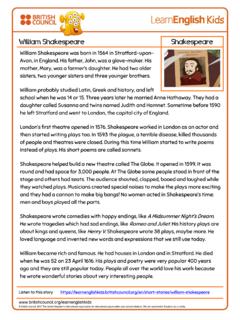
5 ". A Shakespearean comedy is full of fun. The characters are lively; the dialogue is witty. In the end young lovers are wed; old babblers are silenced; wise men are content. The comedies are joyous and romantic. Boyhood in stratford William Shakespeare was born in stratford - upon -Avon, England, in 1564. This was the sixth year of the reign of Queen Elizabeth I. He was christened on April 26 of that year. The day of his birth is unknown. It has long been celebrated on April 23, the feast of St. George. He was the third child and oldest son of John and Mary Arden Shakespeare.
6 Two sisters, Joan and Margaret, died before he was born. The other children were Gilbert, a second Joan, Anne, Richard, and Edmund. Only the second Joan outlived William. Shakespeare's father was a tanner and glovemaker. He was an alderman of stratford for years. He also served a term as high bailiff, or mayor. Toward the end of his life John Shakespeare lost most of his money. When he died in 1601, he left William only a little real estate. Not much is known about Mary Shakespeare, except that she came from a wealthier family than her husband.
7 stratford - upon -Avon is in Warwickshire, called the heart of England. In Shakespeare's day it was well farmed and heavily wooded. The town itself was prosperous and progressive. The town was proud of its grammar school. Young Shakespeare went to it, although when or for how long is not known. He may have been a pupil there between his 7th and 13th years. His studies must have been mainly in Latin. The schooling was good. All four schoolmasters at the school during Shakespeare's boyhood were graduates of Oxford University. Nothing definite is known about his boyhood.
8 From the content of his plays, he must have learned early about the woods and fields, about birds, insects, and small animals, about trades and outdoor sports, and about the country people he later portrayed with such good humor. Then and later he picked up an amazing stock of facts about hunting, hawking, fishing, dances, music, and other arts and sports. Among other subjects, he also learned about alchemy, astrology, folklore, medicine, and law. As good writers do, he collected information both from books and from daily observation of the world around him.
9 4. Marriage and Life in London In 1582, when he was 18, he married Anne Hathaway. She was from Shottery, a village a mile from stratford . Anne was seven or eight years older than Shakespeare. From this difference in their ages, a story arose that they were unhappy together. Their first daughter, Susanna, was born in 1583. In 1585 a twin boy and girl, Hamnet and Judith, were born. What Shakespeare did between 1583 and 1592 is not known. Various stories are told. He may have taught school, worked in a lawyer's office, served on a rich man's estate, or traveled with a company of actors.
10 One famous story says that about 1584 he and some friends were caught poaching on the estate of Sir Thomas Lucy of Carlecote, near Warwick, and were forced to leave town. A less likely story is that he was in London in 1588. There he was supposed to have held horses for theater patrons and later to have worked in the theaters as a callboy. By 1592, however, Shakespeare was definitely in London and was already recognized as an actor and playwright. He was then 28 years old. In that year he was referred to in another man's book for the first time.