Transcription of MANAGING OBSESSIVE-COMPULSIVE DISORDER
1 MANAGINGOBSESSIVE-COMPULSIVEDISORDERDr. Simon Enright. Department of Clinical PsychologyBerkshire Healthcare NHS Trust. Supported by Berkshire Health Promotion Resources01753 638678 OCD_Layout 1 16/09/2014 11:51 Page aDefeating Depression_Layout 1 25/09/2014 11:08 Page bHOW TO USE THIS BOOKLETThe aim of this booklet is to take you on a journey of rediscovery. It willattempt to boil down all the theory and strategy that you ve learnt intherapy or read in books, into some simple but crucial facts about thenature and management of OCD.
2 The most important of these is this:Your problem does not lie in the fact that you have disturbingintrusive thoughts. Rather, it s how you have learnt to deal with theseunwanted thoughts and images that causes your intense distress andprevents the problems from going task of this booklet is twofold: convince you that it is the way that you choose to respond to yourintrusive thoughts that will determine whether or not you can gaincontrol over them. offer you alternative ways of responding that will ultimately lead toa significant journey starts with helping you to understand more about how certainstyles of thinking can cause you such distress and seem to become reallystuck or endlessly repetitive.
3 The booklet will examine alternative ways ofthinking about and dealing with these intrusive thoughts, and how yourchoice to adopt a different strategy will make all the difference. The path will navigate through cognitive and behavioural therapy (CBT).These ideas have greatly enhanced our understanding and strategiestowards helping people to manage the causes and symptoms of will notice that nowhere in the booklet is there any mention of findinga total cure. The aim of the booklet is to help you to increase control overyour problems, eventually to a point where they are no longer trouble-some.
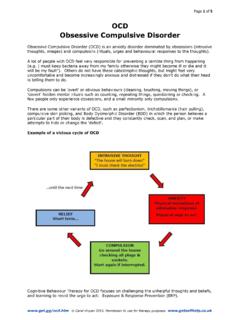
4 Overcoming OCD requires patience, devotion, courage and deter-mination, but first it requires a clear understanding of what to do and justas importantly, what not to do. Read this booklet slowly and to apply what you read to your own problems and make these methodswork for OCD_Layout 1 16/09/2014 11:51 Page 1 INTRODUCTION TO OBSESSIONS & COMPULSIONSSome Definitions and repetitive, persistent ideas, thoughts, images or impulsesthat come into our minds and which are experienced as senseless orunpleasant.
5 The person recognises that these are his own thoughts but thatthey are unwanted and so he will attempt to resist or get rid of examples include: Recurrent thoughts of contamination by dirt, germs or HIV/AIDS. Recurrent thoughts or images that a member of the family or a friendmight become seriously ill, injured or die. Recurrent doubts about having caused an accident. Thoughts or images of committing acts of violence, sexual abuse orcausing other people harm. Recurrent obscene thoughts or blasphemous ideas, often linked to theidea that one might blurt these out or unknowingly write them down.
6 Recurrent worries about your own health or someone close, imaginingthat your thoughts can in some way influence their often directly linked to obsessions and are repeatedpatterns of behaviour or thought that are carried out because of a verystrong urge or feeling of pressure to do so. The behaviour often occurs inan attempt to prevent or produce some event or situation. We are deceivedinto believing that our compulsive behaviours can influence or resolve thethings we worry about and thereby make us feel better.
7 However, theactivity is often not really connected to the desired outcome, certainly ithas no real influence and is repeated senselessly. There is rarely anypleasure from carrying out the activity but it can bring temporary relieffrom feelings of tension, anxiety or OCD_Layout 1 16/09/2014 11:51 Page 2 Common examples include: Repeatedly washing hands, often in a very specific way, until they arevery sore and even bleeding. Constantly checking doors, gas appliances, taps, electrical goods andplugs.
8 Often this checking is done in a set sequence which must not bedisturbed otherwise the checking must start again from the beginning. Going back over the route you have just driven to check that youhaven t caused any accidents. Unsealing letters you ve written to check and recheck the contents. Touching light switches or the corners of a room or specific objects ina set manner. Constant washing or disinfecting work surfaces, crockery or utensils. Always neatening or straightening items to put them in their exactplace.
9 Repeated use of the toilet before certain events in order to be safe orto be able to enjoy them. Repeated washing of clothes even when they re perfectly clean. Constantly seeking reassurance from friends and family that what youhave done was OK or can also be covert or hidden mental activities which no-onebut the sufferer knows are going on. Examples of covert compulsionsinclude: When reading, the need to end with a good word, letter, or pagenumber. Also, the need to miss out a certain line, re-read bits or avoidcertain bad words.
10 Saying silently a specific set of words, or conjuring up a specificimage whenever one hears about or predicts a problem or disaster. Swapping unacceptable words or images that come to mind for safe ones. Spending vast amounts of time and effort trying to remember specificdetails of a conversation, event or TV programme. The need to think a specific thought or think of a specific image onseeing an object of a certain colour. Endless counting rituals, numbers or letters, associated with OCD_Layout 1 16/09/2014 11:51 Page 3 How Common is OCD?