Transcription of Managing Wounds with Exposed Tendon - PolyMem
1 6 OSTOMY wound MANAGEMENT OCTOBER 2009 are anatomical structures that connect bone to muscle. They are composed of parallel bundles of collagenfiber1and often appear as striated white or creamy yellow structures in wound are nourished by blood vessels and by diffusion ofnutrients from synovial nourishment is disruptedwhen the Tendon is Exposed , meticulous care must be providedto prevent both infection and desiccation, either of which canlead to loss of Tendon may be Exposed intrauma Wounds , such as massive crush injuries or fractures, StageIV pressure ulcers, diabetic ulcers, and contaminated or infectedsurgical often affected include Wounds of the feet,Achilles, hands, and arms. Tendons heal in the same manner as other Wounds : cells mi-grate to the area of injury and synthesize collagen.
2 Factors thatcan affect Tendon healing include age, general health, extent ofinjury, scar formation, and patient cooperation with development and scar tissue complicate the healingprocess. When the Tendon loses its ability to glide within the Tendon sheath during movement, joint function becomes impaired and surgical intervention may be wound care must include maintaining moisture. Hydrogel and nonadherent dressings may be employed with acover dressing to facilitate moisture needs. Negative pressurewound therapy (NPWT) and collagen matrix dressings also maybe used. KCI s (San Antonio, TX) NPWT guidelines5require pro-tection of tendons from direct contact with their foam dressingsin order to reduce risk of Tendon injury. The company recom-mends covering tendons with a thick layer of natural tissue, non-adherent porous material, or bioengineered tissue before NPWTis administered.
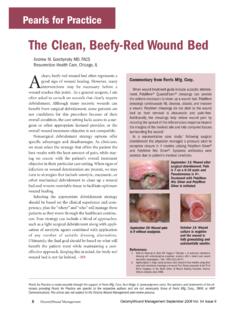
3 Also, granulation formation over tendons can bedifficult and slow; plastic surgery may be indicated. References1. Copstead LC, Banasik JL. Pathophysiology Biological and BehavioralPerspectives,2nd ed. Philadelphia, PA: Saunders; Trumble TE. Principles of Hand Surgery and Therapy. Philadelphia, PA: ; Bucholz RW, Heckman JD, Court-Brown CM (eds). Fractures in Adults, Philadelphia, PA: Lippincott, Williams Brotzman SB (ed). Clinical Orthopaedic Rehabilitation. St. Louis, MO:Mosby; Kinetic Concepts Incorporated (2007). Therapy Clinical at: Accessed September 29, FOR PRACTICEM anaging Wounds with Exposed TendonDiane Davis-Zeek, MS, APN, NP-C, CWOCNW ound, Ostomy and Continence CareNorthwest Community HospitalArlington Heights, IL Commentary from Ferris Mfg. Corp.
4 PolyMem dressings are ideal for Managing woundswith Exposed tendons because they are nonadherent andhelp maintain appropriate moisture balance for all generic versions of the patented PolyMemQuadraFoam dressings are available. In a representative case study,1an immunocompro-mised man with neuropathy secondary to Hansen s dis-ease (leprosy) presented with a 10 cm x 4 cm x 2 cm deepfoot wound that included two Exposed tendons. One ten-don was Exposed cm above the base of the debriding the wound , the cavity was loosely filledand the Exposed Tendon cradled with PolyMem Wic Cavity Filler, then covered with additional PolyMem dress-ings. Sixteen days after PolyMem dressings were initiated,the wound was superficial with both tendons securelysurrounded by new tissue. The dressings provided theappropriate moisture balance for the tendons and granu-lation tissue formation as well as continuous cleansing ofthe wound so additional cleansing during dressingchanges was unnecessary.
5 Preserving the tendons re-sulted in the patient retaining foot mobility. PolyMem delivers unique value to any wound care 1. Benskin, L. Quick healing of deep neuropathic foot ulcers using poly-meric membrane dressings and cavity filler. Poster presented at theSymposium on Advanced wound Care, San Antonio, TX. April 30 toMay 3, 2006. Pearls for Practice is made possible through the support of Ferris Mfg. Corp, Burr Ridge, IL ( ). The opinions and statements of the clinicians providingPearls for Practice are specific to the respective authors and are not necessarily those of Ferris Mfg. Corp., OWM, or HMP Communications. This article was not subjectto the Ostomy wound Management peer-review process. July 7: wound , afterdebridement, 10 cm x 4cm x 2 cm deep, withtwo Exposed long Exposed Tendon is cm above the baseof the 23: The wound issuperficial; exposedtendons are securelysurrounded by new tissue.
6 The wound wasclosed August 14.