Transcription of Maneuver Enhancement Brigade
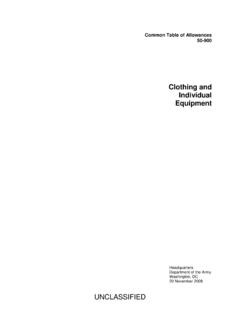
1 FM 3-81 Maneuver Enhancement BrigadeNOVEMBER 2021 DISTRIBUTION RESTRICTION:Approved for public release; distribution is unlimited. This publication supersedes FM 3-81, dated 21 April , DEPARTMENT OF THE ARMYThis publication is available at the Army Publishing Directorate site , and the Central Army Registry site *FM 3-81 DISTRIBUTION RESTRICTION: Approved for public release; distribution is unlimited. *This publication supersedes FM 3-81, dated 21 April 3-81 i Field Manual No. 3- 81 Headquarters Department of the Army Washington, , 09 November 2021 Maneuver Enhancement Brigade Contents Page iv INTRODUCTION .. v Chapter 1 Maneuver Enhancement Brigade .. 1-1 Maneuver Enhancement Brigade Overview.
2 1-1 Operational Framework .. 1-7 Support to Decisive Action .. 1-9 Operational and Mission Variables .. 1- 12 Threat .. 1- 14 Support to Army Operations .. 1- 15 Chapter 2 ORGANIC AND TASK ORGANIZED STRUCTURE .. 2-1 Section I Organic Structure .. 2-1 Headquarters Support Company .. 2-2 Brigade Signal Company .. 2-7 Section II Task-Organized Structure .. 2-8 Engineer .. 2-8 Military Police .. 2- 15 Chemical, Biological, Radiological, and Nuclear .. 2- 21 Civil Affairs .. 2- 25 Explosive Ordnance Disposal .. 2- 26 Military Intelligence 2- 27 Air Defense Artillery .. 2- 29 Tactical Combat Force .. 2- 30 Chapter 3 SUPPORT AREA OPERATIONS .. 3-1 Support Area Overview.
3 3-1 Support Area Operations .. 3-3 Support Area Considerations .. 3-6 Support Areas by Echelon .. 3- 10 Chapter 4 SUPPORT AREA RESPONSIBILITIES .. 4-1 Terrain Management .. 4-1 Information Collection .. 4-4 Civil-Military Operations .. 4-6 Control Movement .. 4-7 Clearance of Fires .. 4-7 Contents ii FM 3-81 09 November 2021 Security .. 4-7 Personnel Recovery .. 4- 16 Airspace Management .. 4- 16 Stability .. 4- 17 Mobility and Countermobility .. 4- 17 Rear Command 4- 18 Chapter 5 SUSTAINMENT .. 5-1 Planning .. 5-1 Logistics Elements .. 5-4 Health Service Support Section .. 5-9 Appendix A SYNCHRONIZE AND COORDINATE PROTECTION .. A-1 Appendix B DEFENSE SUPPORT OF CIVIL AUTHORITIES.
4 B-1 Appendix C LINES OF COMMUNICATION CONSIDERATIONS .. C-1 Appendix D SUPPORT AREA TENANT UNITS .. D-1 Appendix E BASE CAMP AND BASE CLUSTER SECUIRTY AND DEFENSE .. E-1 GLOSSARY .. Glossary-1 REFERENCES .. References-1 INDEX .. Index-1 Figures Figure 1-1. Notional MEB task organization .. 1-2 Figure 1-2. Example of corps as an intermediate land force headquarters .. 1-5 Figure 1-3. Example division organization .. 1-6 Figure 1-4. Notional MEB support to a corps .. 1-8 Fi gure 1-5. Elements of decisive action .. 1- 10 Figure 2-1. MEB organic structure .. 2-1 Figure 2-2. HSC .. 2-2 Figure 2-3. Brigade signal company .. 2-8 Figure 2-4. Notional task-organized structure for the MEB.
5 2-8 Figure 3-1. Corps contiguous AO .. 3-2 Figure 3-2. Corps noncontiguous AO .. 3-3 Figure 3-3. Doctrinal template of notional depths and frontages .. 3-7 Figure 4-1. Example of an established division support area .. 4-2 Figure A-1. Protection in support of large-scale combat operations .. A-5 Figure A-2. Example criticality, vulnerability, and threat probability values .. A-9 Figure A-3. Example of protection prioritization during transitions .. A- 12 Figure A-4. Scheme of protection example .. A- 13 Figure A-5. Integration of protection throughout the operations process .. A- 15 Figure A-6. Example protection running estimate .. A- 22 Figure B-1. DSCA core tasks with examples.
6 B-1 Figure C-1. Example movement corridor .. C-5 Figure E-1. Framework for base camp security and defense .. E-5 Contents 09 November 2021 FM 3-81 iii Figure E-2. Example format for a base camp defense plan ..E-13 Tables Introductory table-1. Modified Army terms .. vi Table 1-1. Levels of threat .. 1-2 Table 2-1. Engineer mission planning and capabilities .. 2-9 Table 2-2. Military police mission planning and capabilities .. 2- 16 Table 2-3. CBRN mission planning and capabilities .. 2- 22 Table 2-4. CA mission planning and capabilities .. 2- 26 Table 2-5. EOD mission planning and 2- 27 Table 2-6. Military intelligence mission planning and capabilities .. 2- 28 Table 2-7.
7 ADA mission planning and capabilities .. 2- 30 Table 2-8. TCF mission planning and capabilities .. 2- 31 Table 3-1. Support area responsibilities and supporting tasks .. 3-4 Table 4-1. MEB information collection capabilities .. 4-5 Table 5-1. Logistics considerations for tactical operations .. 5-3 Table A-1. Example protection risk analysis table ..A-9 Table A-2. Example protection prioritization list ..A-11 Table A-3. Protection integration to MDMP ..A-17 Table A-4. Example protection working group activities ..A-20 Table D-1. Engineer mission planning and capabilities .. D-1 Table D-2. Military police capabilities .. D-2 Table D-3. CBRN mission planning and D-4 Table D-4.
8 CA mission planning and capabilities .. D-5 Table D-5. ADA mission planning and capabilities .. D-6 Table D-6. Aviation Brigade capabilities .. D-7 Table D-7. Sustainment capabilities .. D-8 Table D-8. Medical capabilities .. D-8 iv FM 3-81 09 November 2021 Preface FM 3-81 provides Maneuver Enhancement Brigade (MEB) doctrine. The manual is linked to joint and Army doctrine to ensure that it is useful to joint and Army commanders and staffs. To comprehend the doctrine contained in this manual, readers must first understand the nature of unified land operations as described in ADP 3-0 and FM 3-0. In addition, readers must fully understand the fundamentals of the operations process contained in ADP 5-0, the principles of mission command described in ADP 6-0, the tactics contained in ADP 3-90, the protection tasks discussed in ADP 3-37, and the employment of Army forces (ARFOR) described in FM 3-94.
9 The principal audience for FM 3-81 is commanders and staff elements at all echelons and MEB units that are primarily tasked with conducting support area operations. Trainers and educators throughout the Army will also use this manual. The other intended audience for this manual is leaders and staff sections within units that will employ a MEB or may operate under the command and control of the MEB. This manual should also be used to guide joint, interagency, and multinational higher headquarters commanders and staffs on MEB employment. Commanders, staffs, and subordinates must ensure that their decisions and actions comply with applicable United States, international, and in some cases host-nation laws and regulations.
10 Commanders at all levels will ensure that their Soldiers operate in accordance with the law of war and the rules of engagement. (See FM 6-27.) FM 3-81 uses joint terms where applicable. For joint and Army definitions shown in the text, the term is italicized and the number of the proponent publication follows the definition. Terms for which FM 3-81 is the proponent publication (the authority) are marked with an asterisk (*) in the glossary; their definitions are boldfaced in the text. These terms and their definitions will be included in the next revision of FM FM 3-81 applies to the Active Army, Army National Guard/Army National Guard of the United States and United States Army Reserve unless otherwise stated.