Transcription of Manifest Destiny
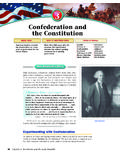
1 Manifest Destiny MAIN IDEA WHY IT MATTERS NOW Terms & Names Through settlement and war, The actions Americans took Manifest Destiny James K. Polk the United States greatly during this period established Santa Fe Trail Republic of expanded its boundaries the current borders of the 48 Oregon Trail California during the mid-1800s. contiguous states. Stephen F. Austin Treaty of Texas Revolution Guadalupe the Alamo Hidalgo Sam Houston One American's Story In 1821, Stephen F. Austin led the rst of several groups of American settlers to a fertile area along the Brazos River. Drawn by the promise of inexpensive land and economic opportunity, Austin established a colony of American settlers in Tejas, or Texas, then the northernmost province of the Mexican state of Coahuila. However, Austin's plans didn't work out as well as he had hoped; 12 years later, he found himself in a Mexican prison and his new homeland in an uproar. After his release, Austin spoke about the impending crisis between Texas and Mexico.
2 A PERSONAL VOICE STEPHEN F. AUSTIN. Texas needs peace, and a local government; its inhabitants are farmers, and they need a calm and quiet life.. [But] my efforts to serve Texas involved me in the labyrinth of Mexican politics. I was arrested, and have suffered a long persecution and imprisonment.. I fully hoped to have found Texas at peace and in tranquillity, but regret to nd it in commotion; all disorganized, all in anarchy, and threatened with immediate hostilities.. Can this state of things exist without precip- itating the country into a war? I think it cannot.. quoted in Lone Star: A History of Texas and Texans Stephen F. Austin Austin's prediction was correct. War did break out in Texas twice. First, Texans rebelled against the Mexican government. Then, the United States went to war against Mexico over the boundaries of Texas. These con icts were the climax of decades of competition over the western half of North America a competition that involved the United States, Mexico, Native Americans, and various European nations.
3 The end result of the competition would be control over a huge swath of the continent, from the Atlantic to the Paci c. Settling the Frontier As various presidents established policies in the early 19th century that expand- ed territory, American settlers pushed rst into the Northwest Territory and then headed farther west. 130 CHAPTER 3 The Growth of a Young Nation AMERICANS PURSUE Manifest Destiny For a quarter century after the War of 1812, only a few Americans explored the West. Then, in the 1840s, expan- sion fever gripped the country. Many Americans began to believe that their move- ment westward was predestined by God. The phrase Manifest Destiny . expressed the belief that the United States was ordained to expand to the Paci c Ocean and into Mexican and Native American territory. Many Americans also believed that this Destiny was Manifest , or obvious and inevitable. Most Americans had practical reasons for moving west. For settlers, the abun- dance of land was the greatest attraction.
4 As the number of western settlers climbed, merchants and manufacturers followed, seeking new markets for their MAIN IDEA goods. Many Americans also trekked west because of personal economic problems Predicting in the East. The panic of 1837, for example, had disastrous Effects consequences and convinced many Americans that they A How might would be better off attempting a fresh start in the West. A. Manifest Destiny HISTORICAL. later affect TRAILS WEST The settlers and traders who made the trek relations with west used a series of old Native American trails as well as new S P O TLIG H T. Native Americans? routes. One of the busiest routes was the Santa Fe Trail, which stretched 780 miles from Independence, Missouri, to Santa Fe in the Mexican province of New Mexico. (See map on page 132.) Each spring from 1821 through the 1860s, American traders loaded their covered wagons with goods and set off toward Santa Fe. For about the rst 150 miles, traders traveled individu- ally.
5 After that, fearing attacks by Native Americans, traders banded into organized groups of up to 100 wagons. Cooperation, though, came to an abrupt end when Santa Fe came into view. Traders raced off on their own as each tried to be the rst to arrive. After a few days of trading, they loaded their wagons with goods, restocked their animals, JIM BECKWOURTH. and headed back to Missouri. 1798 1867? The Oregon Trail stretched from Independence, James Pierson Beckwour th (or Missouri, to Oregon City, Oregon. It was blazed in 1836 by Beckwir th) was the toughest kind of pioneer, a mountain two Methodist missionaries named Marcus and Narcissa man. The son of an African- Whitman. By driving their wagon as far as Fort Boise (near American woman, he ventured present-day Boise, Idaho), they proved that wagons could westward with a fur-trading expe- travel on the Oregon Trail. dition in 1823 and found the Following the Whitmans' lead, many pioneers migrated place that would become his home for nearly the next quar ter west on the Oregon Trail.
6 Some bought prairie schooners, . centur y the Rocky Mountains. wooden-wheeled wagons covered with sailcloth and pulled He greatly impressed the Crow, by oxen. Most walked, however, pushing handcarts loaded who gave him the name Bloody with a few precious possessions, food, and other supplies. Arm because of his skill as a The trip took months, even if all went well. fighter. Beckwourth served from 1837. Background THE MORMON MIGRATION One group migrated west- until 1848 as an Army scout and The Mormon ward along the Oregon Trail to escape persecution. These trading-post operator. In 1848, religion was he discovered a passage in the people were the Mormons, a religious community that controversial for Sierra Nevada range that led to its belief in would play a major role in the development of the West. California's Sacramento Valley polygamy, a Founded by Joseph Smith in upstate New York in 1827, the and decided to settle down near practice that Mormon community moved to Ohio and then Illinois to the pass and become a rancher.
7 Allowed a man escape persecution. After an anti-Mormon mob murdered In the spring of 1852 I estab- to have more Smith, a leader named Brigham Young urged the Mormons lished myself in Beckwourth than one wife. to move farther west. Thousands of believers walked to Valley, and nally found myself transformed into a hotel-keeper Nebraska, across Wyoming to the Rockies, and then south- and chief of a trading-post.. west. In 1847, the Mormons stopped at the edge of the desert near the Great Salt Lake, in what is now Utah. Young boldly REVIEW UNIT 131. American Trails West, 1860.. The interior of a covered wagon as it may have looked on its way west. E. NG. Blackfoot RA. R. Portland C olu m bia R. Sioux O. Yakima Nez Perc . Crow DE. C K. CASCA. M. Sn i Y. Mi ss ak Cheyenne s issi e Fort Hall so R iv pp uri er i R. G. R i ver M O U N. i r RE. ve N. Pawnee P la tte AT. R iv Council Bluffs er Great Salt Lake Salt Lake City PL. Sacramento Nauvoo SIE.
8 AIN. San Francisco T A I N S. St. Louis RR. Independence r A. ve S. Ri NE. o Ute VA. D rad A olo toff Ar C. n Cu ka nsa imarro s R. Navajo C Cherokee i ve Creek r Santa Fe Seminole ve r Los Angeles Fort Smith sissippi Ri Choctaw de Chickasaw Gran Rio Mis Re PAC IF IC. d Ri ve OCEAN El Paso r 120 W. 90 W. Butterfield Overland Mail California Trail N. Mormon Trail E. Old Spanish Trail W. Oregon Trail S. Sante Fe Trail 0 100 200 miles 0 100 200 kilometers GEOGRAPHY SKILLBUILDER. 1. Region Approximately how long was the trail from St. Louis to El Paso? 2. Movement At a wagon train speed of 15 miles a day, about how long would A Navajo man and woman in photographs taken by Edward S. Curtis. that trip take? 132 CHAPTER 3 The Growth of a Young Nation MAIN IDEA declared, This is the place. Soon they had coaxed settlements and farms from the bleak landscape by irrigating their elds. Salt Lake City blossomed out of the Analyzing Motives land the Mormons called Deseret.
9 B. B Why did the SETTING BOUNDARIES In the early 1840s, Great Britain still claimed areas near Mormons move the Canadian border in parts of what are now Maine and Minnesota. The Webster- farther west in their search for Ashburton Treaty of 1842 settled these territorial disputes in the East and the a new home? Midwest, but the two nations merely continued the joint occupation of the Oregon Territory that they had rst established in 1818. In 1846 the two countries agreed to extend the mainland boundary along the 49th parallel westward from the Rocky Mountains to Puget Sound, establishing the current boundary between the United States and Canada. Unfortunately, establishing the boundary in the Southwest with Mexico would not be so peaceful. Texan Independence After 300 years of Spanish rule, only a few thousand Mexican settlers had migrat- ed to what is now Texas. After 1820, that changed as Texas became an important region in Mexico and then an independent republic.
10 MEXICAN INDEPENDENCE AND TEXAN LAND GRANTS The mission system used by Spain declined after Mexico had won independence from Spain in 1821. After freeing the missions from Spanish control, the Mexican government offered the surrounding lands to government of cials and ranchers. To make the land more secure and stable, the Mexican government also encouraged Americans to settle in Texas. MAIN IDEA. Many Americans rushed at the chance to buy inexpensive land in Texas. The population of Anglo, or English-speaking, settlers from the United States Developing Historical soon surpassed the population of Tejanos, or Mexican settlers, who lived in Perspective Texas. Among the more prominent leaders of these American settlers was C Why did many Stephen F. Austin. C. Americans initially Austin's father, Moses Austin, had received a land grant from Spain to estab- settle in Texas? lish a colony between the Brazos and Colorado rivers but died before he was able to carry out his plans.