Transcription of Manufacturing Readiness Level (MRL) Deskbook
1 Manufacturing Readiness Level (MRL) Deskbook Version August 2015 Prepared by the OSD Manufacturing Technology Program In collaboration with The Joint Service/Industry MRL Working Group i This document is not a DOD requirement and is being offered as a Best Practice : This version has changes made to the Criteria matrix in the appendix to agree with V dated 15 December 2014. : This version has changes made to add changes coming from the 2014 Workshop to address the new DODI and User comments. : This version has corrections in the Matrix to version ii Table of Contents Table of Contents .. ii Executive Summary .. 1 1. Introduction .. 2 Manufacturing Risks Recognized in Policy .. 2 Guidance Issued in Support of Policy .. 4 Overarching Best Practices for Complying with Policy and Guidance .. 7 Purpose and Organization of this Document.
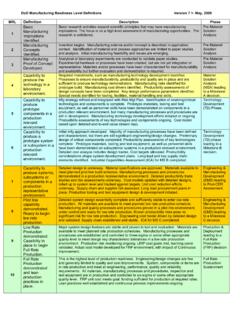
2 8 2. Manufacturing Readiness Levels .. 10 Introduction to Manufacturing Readiness Levels .. 10 MRLs and Their Relationship to TRLs .. 10 Manufacturing Readiness Levels Defined .. 11 Definition of Terms .. 14 MRL Threads and Sub-Threads .. 16 3. MRLs and the Acquisition Management System .. 19 Introduction .. 19 Manufacturing Readiness during Pre-Systems Acquisition .. 21 Manufacturing Readiness During Systems Acquisition .. 25 4. Conducting Assessments of Manufacturing Readiness .. 29 Introduction .. 29 Determine Initial Assessment Scope .. 30 Determine Assessment Taxonomy and Schedule .. 31 Form and Orient Assessment Team .. 33 Orient Contractors Being Assessed .. 35 Request Contractors Perform Self-Assessment .. 35 Set Agenda for Site Visits .. 36 Conduct the Assessment of Manufacturing Readiness .. 36 iii Prepare the Assessment Report.
3 39 5. Manufacturing Maturation Plans and Risk 41 Introduction .. 41 Development of a Manufacturing Maturation Plan .. 42 Risk Management Best Practices .. 42 6. Applying MRLs in Contract Language .. 45 Introduction .. 45 Strategies for Competitive RFP Language .. 45 Manufacturing Readiness RFP Language for Source Selection .. 46 SOO Language For All RFPs .. 47 SOW Language For Contracts .. 48 Other Deliverables .. 49 7. A Tool for Performing Assessments of Manufacturing Readiness .. 50 The MRL Users Guide .. 50 Description of the Mega-Data Sheet .. 50 Compatibility .. 51 APPENDIX A Detailed MRL Criteria .. 1 Table A-1. Manufacturing Readiness Levels for the Technology and Industrial Base Thread .. 1 Table A-2. Manufacturing Readiness Levels for the Design Thread .. 2 Table A-3. Manufacturing Readiness Levels for the Cost and Funding Thread.
4 4 Table A-4. Manufacturing Readiness Levels for the Materials Thread .. 6 Table A-5. Manufacturing Readiness Levels for the Process Capability and Control Thread .. 8 Table A-6 Manufacturing Readiness Levels for the Quality Management Thread .. 9 Table A-7. Manufacturing Readiness Levels for the Manufacturing Personnel Thread .. 11 Table A-8. Manufacturing Readiness Levels for the Facilities Thread .. 12 Table A-9. Manufacturing Readiness Levels for the Manufacturing Management Thread .. 13 APPENDIX B Acronyms .. 1 iv List of Figures Figure 3-1. Relationship of MRLs to Decision Points, Milestones, Technical Reviews, and TRLs .. 20 Figure 4-1. Sample Process Flow for Conducting .. 29 Figure 4-2. Example of Added Detail Derived from Site Visits .. 38 1 Executive Summary Manufacturing status and risk evaluations have been performed as part of defense acquisition programs for years in a variety of forms.
5 These evaluations, while often highly structured and well managed, did not use a uniform metric to measure and communicate Manufacturing risk and Readiness . They were not conducted on technology development efforts or in early acquisition phases. Furthermore, the frequency of these types of evaluations has declined since the 1990s. Paralleling this decline, Manufacturing -related impacts on cost and schedule have grown. New policy was established to address this problem in Department of Defense Instruction , Operation of the Defense Acquisition System. It establishes target maturity criteria for measuring risks associated with Manufacturing processes at Milestones A, B, and C and Full Rate Production. However, quantitative assessments are necessary to determine whether these criteria have been met.
6 Assessments of Manufacturing Readiness utilizing the Manufacturing Readiness Level (MRL) criteria have been designed to manage Manufacturing risk in acquisition while increasing the ability of the technology development projects to transition new technology to weapon system applications. MRL criteria create a measurement scale and vocabulary for assessing and discussing Manufacturing maturity and risk. Using the MRL criteria, an assessment of Manufacturing Readiness is a structured evaluation of a technology, component, Manufacturing process, weapon system or subsystem. It is performed to: Define current Level of Manufacturing maturity Identify maturity shortfalls and associated costs and risks Provide the basis for Manufacturing maturation and risk management This document provides best practices for conducting assessments of Manufacturing Readiness .
7 It is designed for acquisition program managers and managers of those technology development projects and pre-systems acquisition technology demonstration projects intending to transition directly to the acquisition community as well as the people who are involved in conducting the assessments. 2 1. Introduction Manufacturing Risks Recognized in Policy Manufacturing status and risk evaluations have been performed as part of defense acquisition programs for years in a variety of forms ( Production Readiness Reviews, Manufacturing Management/Production Capability Reviews, etc.)(1). These reviews, while often highly structured and well managed, did not use a uniform metric to measure and communicate Manufacturing risk and Readiness . They were not conducted on technology development efforts or in early acquisition phases.
8 Furthermore, the frequency of these types of reviews has declined sharply since the 1990s. Paralleling this decline, Manufacturing -related impacts on cost, schedule, and performance have grown. Studies by the Government Accountability Office (GAO) cite a lack of Manufacturing knowledge at key decision points as a leading cause of acquisition program cost growth and schedule slippages in major DoD acquisition programs(2). Consequently, policy has been developed to strengthen the way in which Manufacturing issues and risks are considered in the defense acquisition system. There is a long standing policy on Manufacturing -related content of acquisition strategies. Defense Federal Acquisition Regulation Supplement (DFARS) Section (Contents of Written Acquisition Plans)(3) mandates specific national technology and industrial base considerations are included in acquisition strategies for major defense acquisition programs as follows.
9 An analysis of the capabilities of the national technology and industrial base to develop, produce, maintain, and support such program, including consideration of factors related to foreign dependency Consideration of requirements for efficient manufacture during the design and production of the systems to be procured under the program The use of advanced Manufacturing technology, processes, and systems during the research and development phase and the production phase of the program 1 Manufacturing risk is one element of overall technical risk to the program. 2 Defense Acquisitions: Assessment of Selected Weapon Programs, Government Accountability Office (GAO -09-326SP), March 30, 2009. Similar conclusions were made in prior GAO reports issued annually around the same time of the year.
10 These reports may be accessed at 3 Sub-Part , Acquisition Plans, Defense Federal Acquisition Regulation Supplement (DFARS), revised July 29, 2009; 1. Introduction 3 To the maximum extent practicable, the use of contract solicitations that encourage competing offerors to acquire, for use in the performance of the contract, modern technology, production equipment, and production systems (including hardware and software) that increase the productivity of the offerors and reduce the life-cycle costs Methods to encourage investment by domestic sources in advanced Manufacturing technology production equipment and processes through: (i) recognition of the contractor s investment in advanced Manufacturing technology production equipment, processes, and organization of work systems that build on workers skill and experience, and work force skill development in the development of the contract objective.