Transcription of Mark Petersen - Applied Mathematics
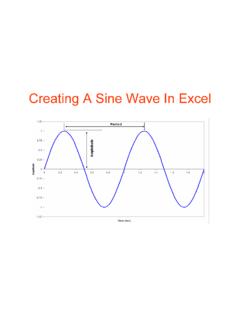
1 1 Mathematical HarmoniesMark PetersenWhat is music? When you hear a flutist, a signal is sent from her fingers to your ears. Asthe flute is played, it vibrates. The vibrations travel through the air and vibrate youreardrums. These vibrations are fast oscillations in air pressure, which your ear detects BasicsThe simplest model of a musical sound is a sine wave, were the domain (x-axis) is timeand the range (y-axis) is pressure.)2sin(ftAP where: P pressure, in decibels or Pascalst time, in secondsAamplitude (height of the wave) or volume, in decibels or Pascalsf frequency or pitch, in period, in seconds is the duration of one wave.
2 FT1 Figure 1. A sine wave with amplitude A = 60 dB and frequency f = 100 general, a sound has two characteristics: pitch and volume. The pitch, or note played,corresponds to the frequency of the wave. High notes have high frequencies, so thepressure varies quickly. Low notes have low frequencies. Frequency is measured inHertz (Hz), which is the number of waves per 2. Two notes, both with amplitude A = 60 dB. The lower note has frequencyf = 100 Hz (solid). The higher note has frequency f = 125 Hz (dashed).T = sec2 Figure 3. Frequency ranges of various instruments, in Hz. Audible frequenciesrange from 20 Hz to 20,000 , or loudness, corresponds to the amplitude of the pressure.
3 When one hears loudmusic, like at a rock concert, the large pressure oscillations may be felt by the 4. A loud note at A = 60 dB (solid) and a quiet note at A = 40 dB (dashed).Both notes have a frequency of f = 100 5. Intensities of various sounds on a linear and logarithmic is normally measured in Pascals, which is force per unit area (1 Pa = 1 N/m2).As shown in Figure 5, most sounds are less than _ Pa, while loud ones are between 5 and10. The decibel scale is a log pressure scale, which is used for volume so that the quietsounds are spread out. Pascals are converted to decibels as follows:5102log*20 PadBppThe constant 5102 was chosen because 5102 Pa is considered the hearingthreshold.
4 This is where the dBp is zero, because when Pa1025 Pap, we have01log*20 of Octaves and HarmonicsIn order to understand why certain combinations of notes make harmony and others donot, we will study the simplest instrument, a single string. The formula for the frequencyof a vibrating string isdensitylinetensionlengthfrequency *21 where: frequency is in Hertz = 1/seclength is in meterstension is a force, in Newtons = kg*m/sec2line density is the string thickness, in kg/mNotice that we may change the frequency, or pitch, in three ways:1. Tighten the string: tensionresults in: frequency2. Use a thicker string: line densityresults in: frequency3.
5 Use fingers on frets1: lengthresults in: frequencySpecifically, frequency is inversely proportional to the length of the string. This means ifI halve the length of the string, the frequency will double. It turns out that a doubledfrequency is an octave higher. Using these facts, we may construct the following of vibrating stringlow low low Af = 55 Hzlow low Af = 110 Hzlow Af = 220 Hzmiddle Af = 440 Hz 1 Frets are the vertical bars on the neck of a 6. Octaves of a vibrating sequence of frequencies of these octaves: 55, 110, 220, 440, is a geometricsequence.
6 A geometric sequence is a sequence where the previous term is multiplied by aconstant. In this case, the constant is two. A very simple example of a geometricsequence is 2, 4, 8, 16, 32, If this sequence were graphed, it would look like anexponential important point here is:The frequencies of octaves form a geometric fact has many physical manifestations, such as: Low instruments must be much larger than high instruments. In general, aninstrument which is an octave lower must be twice as large. For example, in thestring family, as we progress from violin, viola, cello, to bass, the cello is large andthe bass is very large.
7 Organ pipes must also double in size to go down an octave. This is why the organpipes at the front of a church, if arranged in descending order, approximate anexponential curve. Frets on a guitar are far apart at the neck and close together near the body, a patternwhich also appears on log graphing paper. Frets and log paper both follow an inverseexponential we could watch our simple string vibrate with a slow motion camera, we would seethat it vibrates in many modes, as shown below. The main mode is the fundamentalfrequency or first harmonic, and gives the note its specified frequency. The string mayvibrate in higher modes, or harmonics, at various times or of vibrating stringlow low low Af = 55 Hzfundamentallow low Af = 110 Hzsecondlow Ef = 165 Hzthirdlow Af = 220 Hzfourthmiddle C#f = 275 Hzfifthmiddle Ef = 330 Hzsixthapprox.
8 Middle G f = 385 HzseventhMmiddle Af = 440 Hzeighth1/21/31/41/51/65 Figure 7. Harmonics of a vibrating sequence of frequencies of these harmonics: 55, 110, 165, 220, 275, form anarithmetic sequence. An arithmetic sequence is a sequence where a constant is added tothe previous term. In this case, the constant is 55. A simple example of an arithmeticsequence is 2, 4, 6, 8, 10, To summarize our important points, The frequencies of octaves form a geometric frequencies of harmonics form an arithmetic us overlay an arithmetic sequence (harmonics) on a geometric sequence (the octaves):Arithmetic (harmonics)2468101214161820 Geometric (octaves)24816 Number terms in between:zeroonethree sevenFigure 8.
9 Numerical example of harmonics overlaid on zero one three sevenFigure 9. Harmonics of low low low A (as on Figure 7) shown as vertical lines below thekeyboard. Frequencies are shown above the may have noticed that the harmonics of A include C# and E, which are the notes ofan A-major chord. We will return to this issue after some that the number of arithmetic terms between each geometric is 0, 1, 3, 7, Figure the harmonics of low low low A, which have the same of InstrumentsTwo characteristics of a musical sound are volume and pitch.
10 How does one know thedifference between a flute and a violin, even when they play the same note and volume?If we measured the air pressure near a flute, oboe, and violin all playing middle A(440 Hz), it would look like this:Figure 10. Pressure variations with time of a flute, oboe, and pressure signals look very different, even though the amplitude and fundamentalfrequencies are all the same. This difference is caused by the relative amplitudes of thehigher harmonics. This can be seen when the volume of each harmonic is graphedseparately, as 11. Amplitudes of the harmonics of a flute, oboe, and violin playing middle A2.