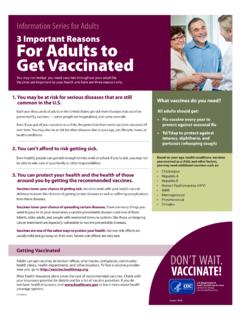
Transcription of Masks for Kids
1 Masks for KidsShould my child wear a mask?Yes. Good data1,2 shows that a mask (any mask), when worn properly, reduces transmission of respiratory viruses, including COVID 19. The potential benefits to kids wearing Masks are:Mask wearing has been shown to help reduce virus transmission both from contagious wearers and to vulnerable know that going to school safely is important for child development, education and mental health. Going to school involves mixing with kids from other households and with teachers, which carries risks of virus transmission. Doing all we can to minimise transmission, including vaccinating and wearing Masks , all adds up to keeping kids learning healthily, happily and safely at school. Masks are one of the ways that we can make kids lives as safe as possible while still playing, learning and socialising. How effective are Masks at preventing COVID in children?Research from the USA shows that:What about Omicron?
2 We know that Omicron is more easily transmitted than previous COVID variants including Delta. Evidence from the USA8 and Australia s eastern states9 also suggests that severe disease with Omicron is quite rare in children. Most of the data about the effectiveness of mask wearing is from the pre-Omicron era. Despite this, there isn t any real-world data to suggest that mask wearing works less well against Omicron than previous variants. schools where students didn t wear Masks were almost 4 times as likely to have a COVID outbreak than schools where students did wear masks4 Outside of schools, studies show that for adults, wearing a mask in community indoor public settings decreased the odds of contracting COVID. The best evidence for this is from the USA, where wearing any type of mask halved the chance of being COVID the risk of the wearer contracting COVID and other respiratory infectionsReduce the risk of the wearer spreading COVID to their classmates and teachersReduce the risk of outbreaks and staff absences in schools that disrupt learning and socialisation123and that the rate of new COVID cases in school age kids after school re-opened were twice as high in areas without masking at school5 compared to those with mask wearing at school.
3 Similar protection from mask wearing was found in a study of schools in Germany6. Why do kids need to wear Masks if they re not getting very sick with COVID?Although children are at lower risk of severe COVID-19 infection (only 1-2% of children 5-11 years are admitted to hospital with COVID-19), a small number do get very unwell. Later impacts such as the inflammatory condition MIS-C occur in about 1 in every 2500 children, and a small proportion of children will have prolonged symptoms post infection. Children can also transmit the virus to loved ones, including the elderly, who are at greatest risk from the harms of about at home, or during social, sport and other activities? For children in high school, Masks should be worn in the same circumstances as recommended for adults. For younger children, mask wearing when playing or attending extra-curricular activities might not be practical. When there aren t requirements for mask wearing in place, your family can make a personal choice together about mask wearing, balancing the risks from COVID with how restrictive your child individually finds mask wearing.
4 Do keep in mind that while most cases of COVID in children don t result in severe disease, some kids are more at risk than others due to underlying medical conditions. What type of mask should children wear?The best mask is one that fits well and is comfortable enough for your child to wear all main groups of mask available are cloth Masks , surgical Masks , and Particulate Filter Respirators (PFRs)10. Cloth Masks are often home-made, and can be made with colours and prints that kids find appealing. There are lots of different designs, some with nose wires, some with filter inserts. They are usually intended to be washed and reused. In general, cloth Masks provide the least protection, since they tend to let particles through the fabric, as well as around the edges of the mask. Three-ply cloth Masks appear to be more effective than single and two ply-products. Surgical Masks (also known as medical Masks ) are single-use items, usually held on with ear-loops.
5 These are not washable. They work best when the nose-wire is shaped to fit the face. They filter out more particles than most cloth Masks , though air still enters and exits around the edge of the (usually labelled as P2, N95, KN95 or KF94) are a type of mask that is designed to tightly seal on the face, so air only gets in and out by passing through the mask material, which is specially made to block most particles from entering (including the aerosolised droplets that contain virus). These are used by healthcare workers in high risk settings, though are increasingly available in the community. They must fit well to work properly. Most young children won t be able to fit a PFR, and/or won t tolerate the tight fit for long periods of time. Older children might choose to wear a PFR. There is some evidence (mostly from laboratories rather than real world ) to indicate that PFRs might be more effective in limiting COVID transmission than surgical or cloth masks3.
6 The evidence comparing different types of Masks is variable, and there aren t any studies in children. Overall, studies indicate that some mask is better than no mask at all7. Surgical masksPFR masksCloth masksWhat about teachers?Teachers wearing Masks protects them directly, protects kids, and helps minimise staff absences so schooling can continue with minimal interruptions. When physical distance can be maintained, teachers are permitted in many jurisdictions to remove Masks when it s considered necessary for teaching and communication. What about younger kids?In younger children (early primary and pre-school), mask wearing is more challenging, with younger kids less likely to achieve a good mask fit, and less likely to wear a mask effectively. Data suggests that young children are at lower risk of severe disease if they do contract COVID (Though rare severe disease cases do occur, as do long COVID and PIMS-TS).
7 How to help your kids wear a mask properlyFirst, it s important to talk with your kids about why you re asking them to wear a mask. There are some good resources available at the Telethon Kids Institute website to help you discuss COVID with your kids in an age-appropriate possible, your child might like to try different styles of mask and choose the one they like best. It s important that whatever mask they choose is comfortable enough to be worn all day at ways to get a mask to fit better12:There are some specially made child-size Masks available (cloth, surgical and PFR Masks ) from different retailersAn adult surgical mask may fit a child better if the ear loops are tied close to the mask, and the extra mask material tucked into the maskDouble-masking with surgical mask underneath and a cloth mask on top (let your child choose a fabric they like) can be a lot of fabric to wear, but might increase effectiveness, and lets your child choose a design that they like sure you kids know how to safely take a break from wearing a mask if it gets uncomfortable, and to change if it gets wet/dirty (they ll need replacement supplies in their school bag or with their teacher).
8 What about communication and socialising?Some parents worry that wearing Masks will impair children s developing language, communication and social skills. Research undertaken since the onset of the COVID pandemic has shown that young children retain their ability to understand spoken words13 and to read emotions on faces14,15 when people are wearing Masks (though other studies have shown a reduction in facial recognition ability when both children and adults are tested with new faces16).The last two years have seen an increase in mental health challenges for kids and adults, in Australia17 and across the world18. Experts have suggested that putting in place strategies that allow us to safely maintain or get back to normal activities, like schooling, is one of the most powerful things we can do to support kids wellbeing19. COVID-19 incidence was 37% lower in schools that required teachers and staff members to use there any reasons why my child SHOULDN T wear a mask?
9 There are rare specific situations where your child s GP might recommend that they don t wear a mask, usually to do with existing medical problems. For the vast majority of children, mask wearing is entirely safe. Studies have shown that mask wearing does not have a negative effect on children s oxygen and carbon dioxide levels20,21. What other things should we be doing to stay safe? Masks are just one part of keeping kids safe, healthy and happy during the COVID pandemic. Other important steps include:Social distancing play in smaller groups is activities are best, with lower transmission compared to indoors22. Keep doing things that are fun and support your family s mental wellbeing whatever changes in behaviour you make need to be sustainable for a long period of in touch with family even over about the exposure risks of parents and other household members household transmission is where most children contract COVID23,24, for children who are eligible, and for adults around them when they re too young or otherwise unable to be vaccinated.
10 1 Effectiveness of Mask Wearing to Control Community Spread of SARS-CoV-2 | Infectious Diseases | JAMA | JAMA Network2 An upper bound on one-to-one exposure to infectious human respiratory particles | PNAS4 Association Between K 12 School Mask Policies and School-Associated COVID-19 Outbreaks Maricopa and Pima Counties, Arizona, July August 2021 | MMWR ( )5 Pediatric COVID-19 Cases in Counties With and Without School Mask Requirements United States, July 1 September 4, 2021 | MMWR ( )6 Frontiers | Impact of Changes in Infection Control Measures on the Dynamics of COVID-19 Infections in Schools and Pre-schools | Public Health ( )7 Effectiveness of Face Mask or Respirator Use in Indoor Public Settings for Prevention of SARS-CoV-2 Infection California, February December 2021 | MMWR ( )8 COVID infection severity in children under 5 years old before and after Omicron emergence in the US ( )9 NSW Health.