Transcription of MASTER OF BUSINESS ADMINISTRATION Qualification code ...
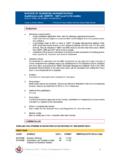
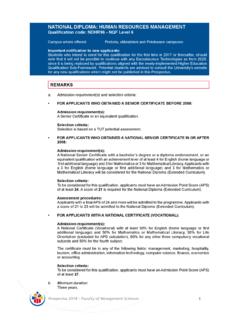
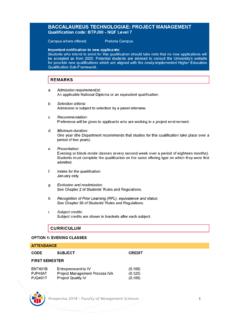
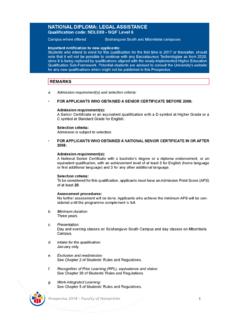
1 1 Prospectus 2019 - Faculty of Management Sciences MASTER OF BUSINESS ADMINISTRATIONQ ualification code: MMBT01 - NQF Level 9 (180 credits) SAQA ID: 97399, CHE NUMBER: H/H16/E019 CANC ampus where offered: Pretoria Campus (Nana Sita Street)REMARKSa. Admission requirement(s): A duly completed application form, with the following supporting documents - A bachelor honours degree or a relevant NQF Level 8 degree from a recognised acade-mic institution. A percentage mark of 50% or more in GMAT (Graduate Management Aptitude Test), GRE (Graduate Record Exam) or GAT (General Aptitude Test from the TUT BUSINESS School).
2 Results obtained in GMAT and GRE must not be older than three years. Marks from GMAT, GRE and GAT will be treated equally. A minimum of five years in a BUSINESS or BUSINESS -related environment including govern-ment, parastatals, academic and research Selection criteria:All candidates for admission into the MBA programme will be required to take and pass a 3-hour comprehensive aptitude exam to be administered at TUT BUSINESS School. Students who have taken and passed the GMAT (Graduate Management Aptitude Test) or the GRE (Graduate Record Exam) in the past three years will be exempted from writing the 3-hour exam.
3 A non-refundable fee is Duration:A minimum of three years and a maximum of five Presentation:Block-mode classes and research. Classes are offered in trimesters in the form of compulsory lectures. Classes are held from 07:00 to 14:15 on Intake for the Exclusion and readmission:See Chapter 2 of Students' Rules and Dissertation: A proposal should be approved at the Faculty Committee for Postgraduate Studies before a student can register for the Rules on postgraduate studies:See Chapter 8 of Students Rules and Regulations. i. Module credits:Module credits are shown in brackets after each MODULES ARE OFFERED IN SEMESTERS AS DETERMINED BY THE YEARCODE MODULE NQF-L CREDIT PREREQUISITE MODULE(S) AFM639M Accounting and Financial (9) (11,25) Management2 Prospectus 2019 - Faculty of Management SciencesDAT639M Quantitative and Qualitative Data (9) (11,25) Analyses for BUSINESS StudiesLOB639M Leadership and Organisational (9) (11,25) BehaviourMMA639M Macro and Micro Economic (9) (11,25) Analyses MMG639M Marketing Management and (9)
4 (11,25) Globalisation OMR639M Operations Management and (9) (11,25) Operations ResearchTOTAL CREDITS FOR THE FIRST YEAR: 67,50 SECOND YEARCODE MODULE NQF-L CREDIT PREREQUISITE MODULE(S)BST639M BUSINESS Strategy (9) (11,25) HRC639M Human Resources and Change (9) (11,25) ManagementRMD639M Research Methodology (9) (11,25) plus any three of the following electives:IEM639M International and Environmental (9) (11,25) ManagementMTI639M Management of Technology and (9) (11,25) Innovation PMT639M Project Management (9) (11,25) PSD639M Public Sector Management and (9) (11,25) Service Delivery QME639M Quality Management and (9) (11,25) Monitoring and Evaluation TED639M Technological Entrepreneurship (9) (11,25) and Sustainable DevelopmentTOTAL CREDITS FOR THE SECOND YEAR.
5 67,50 THIRD YEARS tudents will only be allowed to register for the following after a proposal has been approved. (Refer to paragraph f in the remarks)CODE MODULE NQF-L CREDIT PREREQUISITE MODULE(S)MBA639M MBA Dissertation (year module) (9) (45,00) Research Methodology MBA639R MBA Dissertation (year module) (9) (00,00) (re-registration) TOTAL CREDITS FOR THE THIRD YEAR: 45,00 TOTAL CREDITS FOR THE Qualification : 1803 Prospectus 2019 - Faculty of Management SciencesMODULE INFORMATION (OVERVIEW OF SYLLABUS)The syllabus content is subject to change to accommodate industry changes.
6 Please note that a more detailed syllabus is available at the Department or in the study guide that is applicable to a particular module. On 12 September 2018, the syllabus content was defined as follows: AACCOUNTING AND FINANCIAL MANAGEMENT (AFM639M) 1 X 4-HOUR PAPER (OPEN BOOK)(Module custodian: BUSINESS School)South African accounting procedures and guidelines for BUSINESS administrators, the South African tax system, time value of money, financial statement analysis and interpretation, working capital management, investment in capital projects, financing decisions, dividend decisions, BUSINESS valuation, mergers and take-overs, objectives of managerial finance, cost analysis and behaviour patterns, costing systems and cost allocation, budget planning and control, decision-making, performance budget planning and control, performance appraisal through statement analysis, activity-based accounting.
7 Strategic management accounting and control. (Total tuition time: 40 hours)BBUSINESS STRATEGY (BST639M) 1 X 4-HOUR PAPER (OPEN BOOK)(Module custodian: BUSINESS School)Introduction to Strategy. Nature and value of strategic management, the strategic management process, strategic positioning. Strategic capabilities. Strategic purpose and culture. Strategic directions and corporate level strategy. International strategy. Strategic innovation, entrepreneurship and evaluation of strategy. Strategy in action: development process and organising for success. Strategy in action: resourcing, change management and practice.
8 (Total tuition time: 36 hours)HHUMAN RESOURCES AND CHANGE MANAGEMENT (HRC639M) 1 X 4-HOUR PAPER (OPEN BOOK)(Module custodian: BUSINESS School)Optimal management strategies, manpower utilisation, the rights and responsibilities of employees, labour related matters in the context of South Africa, commonly used global and local human resources management strategies, environmental issues, affirmative action, human resource development, factors that affect human productivity in complex organisations, creating a strategic organisation, creating a learning organisation, the professional development and training of employees in complex organisations, strategic industrial relations management, key success factors and measures.
9 Implementation of strategies, performance management contracts, assessment of productivity at the workplace, good governance, utilisation of modern and innovative methods, sharing and dissemination of BUSINESS -related and personal information at the workplace, utilisation of latest technologies, software applications, problem-solving and decision-making, data warehousing, information systems, and e-commerce. (Total tuition time: 40 hours)IINTERNATIONAL AND ENVIRONMENTAL 1 X 4-HOUR PAPER (OPEN BOOK)MANAGEMENT (IEM639M)(Module custodian: BUSINESS School)
10 Principles of international management, the development, operation and maintenance of multinational operations, Knowledge and skills that are required for successful international entrepreneurial operations, basics of environmental management systems, overview of environmental standards, the ISO 14000 Series of Standards, environmental impacts and legal requirements, environmental aspects and impacts, planning an environmental policy, environmental auditing, eco-balances, environmental reporting, developing an environmental management programme, operational control, and emergency preparedness and response.