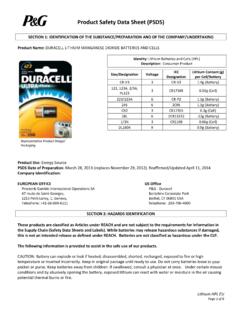
Transcription of Material/Product Safety Data Sheet (MSDS-PSDS)
1 msds Li-ion Rev. 8 February 2009 Material/Product Safety data Sheet ( msds -PSDS) MP / VL products Revision 8 Date 02/2009 Lithium-Ion single cells and multi-cell battery pack 1. Identification of the Substance or Preparation and Company product Rechargeable lithium-ion single cells and multi-cell battery packs Production sites Saft America Inc. Saft 313 Crescent Street Rue Georges Leclanch Valdese BP 1039 North Carolina 28690 86060 Poitiers cedex 9 USA FRANCE Tel. No. +1 (828) 874 4111 +33 (0)5 49 55 48 48 Fax No.
2 +1 (828) 874 2431 +33 (0)5 49 55 48 50 (section Contact ) Emergency contacts +1 (703) 527 3887 (CHEMTREC Service Center) within the USA : 800 424 9300 2. Composition and Information on Ingredients Each cell consists of a hermetically sealed metallic container containing a number of chemicals and materials of construction of which the following could potentially be hazardous upon release. There is no potential for exposure to these ingredients unless the cell leaks, or opens, following high temperature, mechanical or electrical abuse. Ingredient Content* (wt. %) CAS # ACGIH (TLV) OSHA (PEL) Lithium metal 0(in spite of their name, these batteries do not contain lithium metal) LiCoO2(Lithium cobalt oxide) 19-35 % 12190-79-3 mg/m38 hours as dust and fumes 5 mg/m3as dust and fumes Organic solvents 12-15 % EA (Ethyl Acetate)EC (Ethylene Carbonate) DMC (Di Methyl Carbonate) 141-78-6 96-49-1 616-38-6 None established None established LiPF6(Lithium Hexafluoro phosphate) 3 %21324-40-3 None established None established msds Li-ion Rev.
3 8 February 2009 PVDF < 1 %24937-79-9 None established None established Copper (Cu) 9-18 % 7440-50-8 mg/m3as fume mg/m3as dust and mist mg/m3as fume mg/m3as dust and mist Aluminium (Al) 17-27 % 7429-50-5 mg/m3, as dust mg/m3, as soluble salt Graphite and Carbon 13-18%7782-42-5 1333-86-4 mg/m3, TWA for carbon mg/m3, as dust Steel, Nickel, and inert components Balance Balance * Quantities may vary a little with cell model ACGIH : American Council of Governmental Industrial Hygienists TLV : Threshold Limit Value is personal exposure limit, determined y ACGIH. 3. Hazards Identification The rechargeable lithium-ion batteries described in this product Safety data Sheet are sealed units which are not hazardous when used according to the recommendations of the manufacturer and as long as their integrity is maintained.
4 Do not short circuit, puncture, incinerate, crush, immerse in water, force discharge or expose to temperatures above the declared operating temperature range of the product . Risk of fire or explosion. Under normal conditions of use, the active materials and liquid electrolyte contained in the cells and batteries are not exposed to the outside, provided the battery integrity is maintained and seals remain intact. Risk of exposure only in case of abuse (mechanical, thermal, electrical) which leads to the activation of Safety valves and/or the rupture of the battery container. Electrolyte leakage, electrode materials reaction with moisture/water or battery vent/explosion/fire may follow, depending upon the circumstances. 4. First Aid Measures (in case of leaking or accidentally opened cells) In case of accumulator breakage or burst, please evacuate employees from the contaminated area and ensure maximal ventilation in order to break-up corrosive gas, smoke and unpleasant odors.
5 If it occurs, by accident, following measures must be taken: Inhalation Not anticipated under normal use. Remove from exposure. Remove to fresh air. Rest and keep warm. In severe cases obtain medical attention. Skin contact Not anticipated under normal use. Wash off skin thoroughly with water. Remove contaminated clothing and wash before reuse. In severe cases obtain medical attention. Eye contact Not anticipated under normal use. Irrigate thoroughly with water for at least 15 minutes. Obtain medical attention. Ingestion Not anticipated under normal use. Wash out mouth thoroughly with water and give plenty of water to drink. Obtain medical attention. Further treatment All cases of eye contamination, persistent skin irritation and casualties who have swallowed this substance or been affected by breathing its vapours should be seen by a doctor.
6 msds Li-ion Rev. 8 February 2009 5. Fire Fighting Measures Dry chemical type or CO2extinguishers, Halon, or copious quantities of water or water-based foam can be used to cool down burning Li-ion cells and batteries. During water application, caution should be exercised as burning pieces of flammable particles may be ejected from the fire. In case of fire, it is recommended to wear self-contained breathing apparatus, to avoid contact with irritant fumes. Evacuate all persons from immediate area of fire. Do not re-enter the area until it has been adequately purged of the fire vapour and extinguishing agent. 6. Accidental Release Measures In case of electrolyte leakage from a cell or battery, do not inhale the gas as possible.
7 Remove personnel from area. If the skin has come into contact with the electrolyte, it should be washed thoroughly with water. Using protective glasses and gloves, sand or earth should be used to absorb any exuded material . Seal leaking battery (unless hot) and contaminated absorbent material in plastic bag and dispose of as Special Waste in accordance with local regulations. 7. Handling and Storage Handling Do not crush, pierce, short (+) and (-) battery terminals with conductive ( metal) goods, which would end up into excessive heating. Do not directly heat or solder. Do not throw into fire. Do not mix batteries of different types and brands. Do not mix new and used batteries. Keep batteries in non conductive ( plastic) trays.
8 Do not disassemble, mutilate or mechanically abuse cells and batteries. Storage Store in a cool (preferably below 30 C) and ventilated area, away from moisture, sources of heat, open flames, food and drink. Keep adequate clearance between walls and batteries. Temperature above 70 C may result in battery leakage and rupture. Since short circuit can cause burn, leakage and rupture hazard, keep batteries in original packaging until use and do not jumble them. Other Follow Manufacturers recommendations regarding maximum recommended currents and operating temperature range. Applying pressure on deforming the battery may lead to disassembly followed by eye, skin and throat irritation. Do not immerse in water. The Li-ion cells and batteries are not designed to be recharged from external power sources besides specific Li-ion charger models approved by Saft.
9 Connecting to inappropriate power supplies can result in fire or explosion. 8. Exposure Controls & Personal Protection Occupational exposure standard See section 2 msds Li-ion Rev. 8 February 2009 Respiratory protection In all fire situations, use self-contained breathing apparatus. Hand protection In the event of leaking or ruptured cells, wear gloves. Eye protection Safety glasses are recommended in case of leaking or ruptured cells Other In the event of leakage or ruptured cells, wear chemical apron. 9. Physical and Chemical Properties Note: The following points are not applicable unless in case of leaking or damaged batteries with internal components sipping out. Appearance Solid object with cylindrical or prismatic shape Odour Odourless (unless in case of damaged product with leaking electrolyte) pH Not applicable Flash point Not applicable Flammability Not applicable Relative density > 2 g/cm3 Solubility (water) Not applicable, unless inner components are exposed Solubility (other) Not applicable 10.
10 Stability and Reactivity The product is stable under conditions described in Section 7. Conditions to above 70 C or incinerate. Deformation. Mutilation. Crushing. Piercing. Disassembly. Short circuiting. Exposition over a long period to humid conditions. Materials to avoid Strong mineral acids, alkali solutions, strong oxidising materials and conductive materials Hazardous decomposition Products HF, CO, CO211. Toxicological Information Signs & symptoms None, unless battery ruptures. In the event of exposure to internal contents, corrosive fumes will be very irritating to skin, eyes and mucous membranes. Overexposure can cause symptoms of non-fibrotic lung injury and membrane irritation. Inhalation Lung irritant. Skin contact Skin irritant Eye contact Eye irritant.