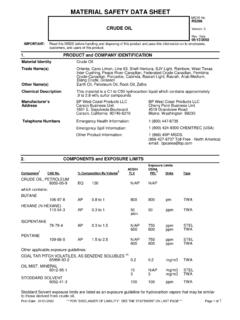
Transcription of MATERIAL SAFETY DATA SHEET
1 MATERIAL SAFETY data SHEET . msds No. RS296. CRUDE OIL Version: 5. Rev. Date 05/13/2002. IMPORTANT: Read this msds before handling and disposing of this product and pass this information on to employees, customers, and users of this product. 1. PRODUCT and COMPANY IDENTIFICATION. MATERIAL Identity Crude Oil Trade Name(s) Oriente, Cano Limon, Line 63, Shell-Ventura, SJV Light, Rainbow, West Texas Inter-Cushing, Peace River-Canadian, Federated Crude-Canadian, Pembina Crude-Canadian, Forcados, Cabinda, Basrah Light, Basrah, Arab Medium, Elang Crude, Girassol Other Name(s) Earth Oil, Petroleum Oil, Rock Oil, Zafiro Chemical Description This MATERIAL is a C1 to C50 hydrocarbon liquid which contains approximately.
2 9 to wt% sulfur compounds Manufacturer's BP West Coast Products LLC BP West Coast Products LLC. Address Carson Business Unit Cherry Point Business Unit 1801 E. Sepulveda Boulevard 4519 Grandview Road Carson, California 90749-6210 Blaine, Washington 98230. Telephone Numbers Emergency Health Information: 1 (800) 447-8735. Emergency Spill Information: 1 (800) 424-9300 CHEMTREC (USA). Other Product Information: 1 (866) 4BP- msds . (866-427-6737 Toll Free - North America). email: 2. COMPONENTS and EXPOSURE LIMITS.
3 Exposure Limits ACGIH OSHA. 1 `CAS No. 2 3. Component % Composition By Volume TLV PEL Units Type CRUDE OIL, PETROLEUM. 8002-05-9 EQ 100 N/AP N/AP. which contains: BUTANE. 106-97-8 AP to 1 800 800 pm TWA. HEXANE (N-HEXANE). 110-54-3 AP to 1 50 50 ppm TWA. skin ISOPENTANE. 78-78-4 AP to N/AP 750 ppm STEL. 600 600 ppm TWA. PENTANE. 109-66-0 AP to N/AP 750 ppm STEL. 600 600 ppm TWA. Other applicable exposure guidelines: (4). COAL TAR PITCH VOLATILES, AS BENZENE SOLUBLES. 65996-93-2 mg/m3 TWA. OIL MIST, MINERAL.
4 8012-95-1 10 N/AP mg/m3 STEL. 5 5 mg/m3 TWA. STODDARD SOLVENT. 8052-41-3 100 100 ppm TWA. Stoddard Solvent exposure limits are listed as an exposure guideline for hydrocarbon vapors that may be similar to those derived from crude oil. Print Date: 01/01/2002 **FOR DISCLAIMER OF LIABILITY , SEE THE STATEMENT ON LAST PAGE** Page 1 of 7. CRUDE OIL msds No. RS296. Since specific exposure standards or control limits have not been established for this MATERIAL , the exposure limits shown here are suggested as minimum control guidelines.
5 1 (1) (2) (3) (4). Carcinogen displayed after Component Name. Listed by NTP, IARC, OSHA, Other 2. See Abbreviations on last page 3. The OSHA exposure limits were changed in 1993 due to a federal court ruling. ARCO has chosen to list the 1989 OSHA exposure limits in this document as they are generally more stringent and therefore more protective than the current exposure limits. (Refer to 29 CFR ). 3. HAZARD IDENTIFICATION. IMMEDIATE HAZARDS. DANGER. HIGHLY FLAMMABLE! OSHA/NFPA Class 1B flammable liquid. KEEP AWAY FROM HEAT, SPARKS, AND.
6 OPEN FLAME! CONTAINS PETROLEUM DISTILLATES! Avoid breathing vapors or mists. Use only with adequate ventilation. If swallowed, do not induce vomiting since aspiration into the lungs may cause chemical pneumonia. Obtain prompt medical attention. May cause irritation or more serious skin disorders! May be harmful if inhaled! May cause irritation of the nose, throat, and lungs, headache, dizziness, drowsiness, loss of coordination, fatigue, nausea and labored breathing. May cause irregular heartbeats. Avoid prolonged or repeated liquid, mist, and vapor contact with eyes, skin, and respiratory tract.
7 Wash hands thoroughly after handling. Sulfur compounds in this MATERIAL may decompose to release hydrogen sulfide gas which may accumulate to potentially lethal concentrations in enclosed air spaces. Vapor concentrations of hydrogen sulfide above 50 ppm, or prolonged exposure at lower concentrations, may saturate human odor perceptions so that the smell of gas may not be apparent. DO NOT DEPEND ON THE SENSE OF SMELL TO DETECT HYDROGEN SULFIDE! Long-term tests show that similar crude oils have produced skin tumors on laboratory animals.
8 Crude oils contain some polycyclic aromatic hydrocarbons which have been shown to be carcinogenic after prolonged or repeated skin contact in laboratory animals. Routes of Exposure Signs and Symptoms Inhalation Vapors or mists from this MATERIAL , at concentrations greater than the recommended (Primary) exposure limits in Section 2, can cause irritation of the nose, throat, and lungs, headache, dizziness, drowsiness, loss of coordination, fatigue, nausea and labored breathing. Airborne concentrations above the recommended exposure limits are not anticipated during normal workplace activities due to the slow evaporation of this MATERIAL at ambient temperatures.
9 Exposure to moderate airborne concentrations of hydrogen sulfide (less than 50 ppm) can result in irritation of the eyes, nose and throat, headache, dizziness, shortness of breath, nausea and nervousness. Exposure to hydrogen sulfide vapor above 200 ppm may cause irritation of mucous membranes, inflammation of the lungs, accumulation of fluid in the lungs, irregular heartbeats, unconsciousness with convulsions or impaired breathing with suffocation. Exposure to higher concentrations of hydrogen sulfide vapor (above 500 ppm).
10 May cause rapid death. Eye Contact May cause slight eye irritation. Skin Contact Moderate skin irritation may occur upon short-term exposure. Exposure to sunlight may increase the degree of skin irritation. Absorption through the skin may occur and produce toxic effects (see Summary of Chronic Hazards). Ingestion May cause irritation of the mouth, throat and gastrointestinal tract leading to nausea, vomiting, diarrhea, and restlessness. May cause headache, dizziness, drowsiness, loss of coordination, fatigue, nausea and labored breathing.