Transcription of MATERIAL SAFETY DATA SHEET Alcohol based hand …
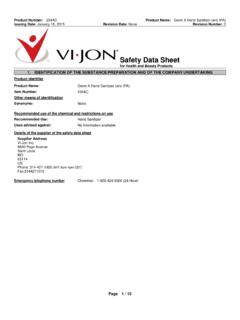
1 MATERIAL SAFETY data SHEET Alcohol based hand sanitizer at 70% abv Document Owner Head Centre of Excellence Intrinsic - 60025452 Effective Date: 30 March 2020 Revision Date: 30 March 2010 Revision number: 01 SECTION 1. Product and Company Identification Product Identifier Product code: Ethanol base hand sanitizer ( MATERIAL code 3029447) Relevant identified uses of the product Alcohol based hand sanitizer: Intended for topical use (human skin only) Details of the supplier of the SAFETY data SHEET Company: DISTELL Aan de Wagenweg Stellenbosch 7600 Telephone: +2721 809 7000 (Tel) Fax: +2786 770-0005 (Fax) SECTION 2. Hazards Identification Classification Classification (EC 200-578-6) Flammable liquids, Category 4 H225: Highly Flammable liquid and vapour. Eye irritation, Category 2B H319: Causes serious eye irritation.
2 Label elements Labelling (REGULATION (EC) No 1272/2008) Hazard pictograms: Signal word: Danger Precautionary statements Prevention P210: Keep away from heat/sparks/open flames/hot surfaces No smoking. P233: Keep container tightly closed. P240: Ground/bond container and receiving equipment. P241: Use explosion-proof electrical / ventilating / lighting equipment. P242: Use only non-sparking tools. P243: Take precautionary measures against static discharge. Response P305 + P351 + P338: If in eyes: Rinse cautiously with water for several minutes. Remove contact lenses, if present. Continue rinsing. P370 + P378: In case of fire: Use powder, Alcohol -resistant foam or carbon dioxide for extinction. Storage P403 + P235: Store in a well-ventilated place. Keep cool. Disposal P501: Dispose of contents / container to an approved waste disposal plant in accordance with local / regional regulations.
3 SECTION 3. Composition/information on ingredients Ingredient name CAS-No. EC-No %v/v Ethanol 64-17-5 200-578-6 69 -71 Glycerine 56-81-5 200-289-5 Methanol 67-56-1 200-659-6 Water 7732-18-5 231-791-2 Balance SECTION 4. First aid measures Description of first aid measures General advice: Move out of dangerous area. Show this SAFETY data SHEET to the doctor in attendance. Do not leave the victim unattended. If inhaled: Move casualty to fresh air and keep at rest. If breathing is difficult, give oxygen. If not breathing, give artificial respiration. Get medical attention. In case of skin contact: If on skin, rinse well with water. Remove affected clothing. In case of eye contact: Immediately flush eye(s) with plenty of water. Get medical attention. If swallowed: Do not induce vomiting!
4 Never give anything by mouth to an unconscious person. If conscious, wash out mouth with water. Get medical attention. SECTION 5. Fire fighting measures Extinguishing media Suitable extinguishing media: Dry chemical Alcohol -resistant foam Carbon dioxide (CO2) Water spray Special hazards arising from the chemical Specific hazards during fire fighting: Emits toxic fumes (carbon oxides) under fire conditions. Vapours can travel to a source of ignition and flash back. Containers may explode in a fire. Cool containers from a distance using water spray. Sensitive to static discharge. Advise for firefighters Special protective equipment for firefighters: Wear self-contained, approved breathing apparatus and full protective clothing, including eye protection and boots. MATERIAL can react violently with water (spattering and misting) and react with metals to produce flammable hydrogen gas.
5 SECTION 6. Accidental release measures Personal precautions, protective equipment and emergency procedures Personal precautions: Use personal protective equipment. Remove all sources of ignition. Evacuate personnel to safe areas. Beware of vapours accumulating to form explosive concentrations. Vapours can accumulate in low areas. Environmental precautions Environmental precautions: Prevent product from entering drains. Prevent further leakage or spillage if safe to do so. If the product contaminates rivers and lakes or drains inform respective authorities. Methods and materials for containment and cleaning up Methods for cleaning up: Contain spillage, and then collect with non-combustible absorbent materials ( sand, earth, diatomaceous earth, vermiculite) and place in container for disposal according to local / national regulations (see section 13).
6 SECTION 7. Handling and storage Precaustions for safe handling Advice on safe handling: Use with adequate ventilation and grounding. Wash thoroughly after using. Keep container closed when not in use. Conditions for safe storage, including any incompatibilities Requirements for storage areas and containers: No smoking. Keep containers tightly closed in a cool and well-ventilated place. Electrical installations / working materials must comply with the technological SAFETY standards. SECTION 8. Exposure controls/personal protection Occupational exposure controls Ventilation and appropriate grounding of containers. Component Exposure limits Basis Entity Ethyl Alcohol 1000 ppm 1900 mg/m3 Recommended Exposure Limit NIOSH 1000 ppm 1900 mg/m3 Permissible Exposure Limit OSHA 1000 ppm 1800 mg/m3 Short Term Exposure Limit ACGIH Exposure controls Personal protective equipment Eye protection: Tightly fitting SAFETY goggles.
7 Skin: Nitrile or rubber gloves, apron or lab coat. Inhalation: Provide local exhaust, preferably mechanical. If exposure levels are excessive, use an approved respirator. Environmental exposure controls General advice: Prevent product from entering drains. Prevent further leakage or spillage if safe to do so. If the product contaminates rivers and lakes or drains inform respective authorities. SECTION 9. Physical and chemical properties Information on basic physical and chemical properties Appearance: Clear liquid (water like in appearance) Odour: Alcoholic in nature could be perceived as slightly sweet Flash point: 12 - 17 C Vapour pressure: 59 mm Hg at 20 C Solubility: Miscible with water SECTION 10. Stability and reactivity Reactivity None Chemical stability The product is chemically stable.
8 Possibility of hazardous reactions Hazardous reactions: Will not occur. Conditions to avoid Conditions to avoid: Heat, flames and sparks. Incompatible materials Materials to avoid: Alkali metals, ammonia, oxidizing agents, peroxides Hazardous decomposition products Hazardous decomposition products: Carbon oxides SECTION 11. Toxicological information Information on toxicological effects Acute oral toxicity (ethanol): LD50 rat: 7,060 mg/kg; literature value Acute inhalation toxicity (ethanol): LC50 rat: 66,000 mg/L; literature value; 4h Acute dermal toxicity (ethanol): LDLo rabbit: 20,000mg/kg; literature value Skin and eye contact: Redness, pain SECTION 12. Ecological information Aquatic toxicity fish: In high concentration it harms fish and plankton; LC50 (fish, 96 hours) SECTION 13.
9 Disposal considerations Waste treatment methods Waste product or residues: Dispose of in accordance with local regulations. Product containers: Dispose of in accordance with local regulations. SECTION 14. Transport information UN No : 1170 ADR/RID class : 3 ADR/RID Item No : 3b ADR/RID hazard identity No : 3 IMDG shipping name : Ethanol IMDG class : 3 IMDG packaging group : II IMDG marine pollutant : No IMDG EMS No : F-E, S-D IMDG MFAG table No : 3074 IATA shipping name : Ethanol Solutions IATA class : 3 IATA subsidiary risk(s) : Flammable liquid SECTION 15. Regulatory information EEC hazard classification 200-578-6 Risk Phases R11 SAFETY Phases S2, S7, S9, S16, S33 National Legislation Hazardous Substances Act 15 of 1973 and Regulations Occupational Health and SAFETY Act 85 of 1993 (Hazardous Chemical Substances Regulations) International Legislation IATA Dangerous Goods Regulation (DGR) 59th Edition 2018 IMDG Code, International Maritime Dangerous Goods Code, 2008 Edition, Volume 1 & 2 SECTION 16.
10 Other information DISCLAIMER OF LIABILITY: The information provided in this SAFETY data SHEET is correct to the best of our knowledge, information and belief at the date of its publication. The user must determine the suitability of the information for its particular purpose, ensure compliance with existing laws and regulations, and be aware that other or additional SAFETY or performance considerations may arise when using, handling and/ or storing the MATERIAL . The information in this SAFETY data SHEET does not purport to be all inclusive or a guarantee as to the properties of the MATERIAL supplied, and should be used only as a guide for safe handling, use, processing, storage, transportation, disposal and release. The information relates only to the specific MATERIAL designated and may not be valid for such MATERIAL used in combination with any other materials or in any process, unless specified in the text.