Transcription of MATERIAL SAFETY DATA SHEET - Battery NZ
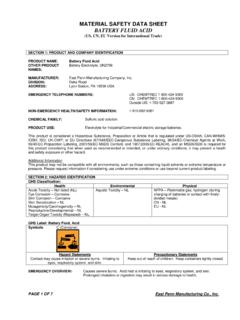
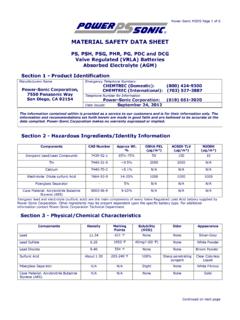
1 MATERIAL SAFETY data SHEET WET-CHARGED LEAD- acid Battery PAGE 1 OF 7 SECTION 1: MATERIAL IDENTIFICATION Product Name : Wet-charged Lead- acid Battery Description : Wet and moist charged batteries, Filled with acid Chemical Family : Electric Storage Battery UN Identification Number : UN2794 Packing Group : III Hazardous Class : 8 Hazchem Code : 2W Label/Placard required : Corrosive Company Name : SUPERCHARGE BATTERIES PTY. LTDA ddress : 1B Chicago Avenue, Blacktown, NSW 2148 Contact : Phone: 02-9830-0000 Fax: 02-9830-0099 Date Issued : March 1, 2014 SECTION 2: HAZARD IDENTIFICATION SECTION 3: PHYSICAL data COMPONENTS DENSITY g/cm3 MELTING/BOILING (M/B) POINT SOLUBILITY (H2O) ODOR APPEARANCE Lead C, F (M) None None Sliver-Gray Metal Lead Sulfate 1170 C, 2138 F (B) 40 mg/l (15 C, 59 F) None White crystals or powder Lead Dioxide 290 C, 554 F (M) None None Dark brown Powder Sulfuric acid ~ 95 C -115 C , 203 F - 240 F (B) 100% Sharp, penetrating, pungent odor Clear to cloudy liquid Case MATERIAL .
2 Polypropylene (PP) ~ 130-171 C 266 F -340 F (M) None None Solid MATERIAL SAFETY data SHEET WET-CHARGED LEAD- acid Battery PAGE 2 OF 7 SECTION 4: FLAMMABILITY data Extinguishing Media Dry Chemical, foam, or C0 2 Unusual Fire and Explosion Hazard: Hydrogen and oxygen gases are produced in the cells during normal Battery operations; hydrogen is flammable and oxygen supports combustion. These gases enter the air through the vent caps / holes. To avoid the chance of a fire or explosion, keep sparks and other sources of ignition away from the Battery . Flammable Limits in Air, % by Vol. LEL - UEL (Hydrogen) None Flash point 253 C (Hydrogen) Special Fire Fighting Procedures Use positive pressure, self-contained breathing apparatus.
3 Beware of acid splatter during water application and wear acid -resistant clothing, gloves, face and eye protection. If batteries are on-charge, shut-off power to the charging equipment but note that strings of series connected batteries, may still pose risk of electric shock even when charging equipment is shutdown. SECTION 5: REACTIVITY data COMPONENT Lead/lead compounds Stability Stable Incompatibility Potassium, carbides, sulfides, peroxides, phosphorus, sulfurs, ketone, ester, petrolatum Decomposition products Oxides of lead and sulfur. Condition to avoid High temperature, Sparks and other sources of ignition COMPONENT Sulfuric acid Stability Stable Incompatibility Reactive metals, strong bases, most organic compounds Decomposition products Sulfuric dioxide, trioxide, hydrogen sulfide, hydrogen Condition to avoid Prohibit smoking, sparks, etc.
4 From Battery charging area. Avoid mixing acid with other chemicals. POLYMERIZATION Sulfuric acid will not polymerize SECTION 6: HEALTH HAZARD data Under normal conditions of Battery use, internal components should not be hazardous to people s health. The following information is provided for Battery electrolyte ( acid ) and lead for exposure that may occur during Battery production or under container/case breakage or under extreme heat conditions such as fire. Routes of Entry: Sulfuric acid : Harmful by all routes of entry. Lead Compounds: Hazardous exposure can occur only when product is heated, oxidized, or otherwise processed or damaged to create dust, vapor or fume.
5 Inhalation: Sulfuric acid : Breathing sulfuric acid vapors and mists may cause severe respiratory problems. Lead Compounds: Dust or fumes may cause irritation of upper respiratory tract or lungs. Skin Contact: Sulfuric acid : Severe irritation, burns and ulceration. Lead Compounds: Not absorbed through the skin. Ingestion: Sulfuric acid : May cause severe irritation of the mouth, throat, esophagus, and stomach. Lead Compounds: May cause abdominal pain, nausea, vomiting, diarrhea, and severe cramping. Acute ingestion should be treated by a physician MATERIAL SAFETY data SHEET WET-CHARGED LEAD- acid Battery Acute Health Hazards: Sulfuric acid : Severe skin irritation, burns, damage to cornea may cause blindness, upper respiratory irritation.
6 Lead Compounds: May cause abdominal pain, nausea, headaches, vomiting, loss of appetite, severe cramping, muscular aches and weakness, and difficulty sleeping. The toxic effects of lead are cumulative and slow to appear. It affects the kidneys, reproductive and central nervous systems. The symptoms of lead overexposure are listed above. Exposure to lead from a Battery most often occurs during lead reclamation operations through the breathing or ingestion of lead dust or fumes. Chronic Health Hazards: Sulfuric acid : Possible scarring of the cornea, inflammation of the nose, throat and bronchial tubes, possible erosion of tooth enamel. Lead Compounds: May cause anemia, damage to kidneys and nervous system, and damage to reproductive system in both males and females.
7 Medical Conditions Generally Aggravated by Exposure Inorganic lead and its compounds can aggravate chronic forms of kidney, liver, and neurological diseases. Contact of Battery electrolyte ( acid ) with the skin may aggravate skin diseases such as eczema and contact dermatitis. Overexposure to sulfuric acid mist may cause lung damage and aggravate pulmonary conditions. Emergency and First Aid Procedures Inhalation Sulfuric acid : Remove to fresh air immediately. If breathing is difficult, give oxygen Lead Compounds: Remove from exposure, gargle, wash nose and lips, consult physician Ingestion Sulfuric acid : Do not induce vomiting, consult a physician immediately. Lead Compounds: Consult a physician immediately Eyes Sulfuric acid : Flush immediately with water for 15 minutes, consult a physician.
8 Lead Compounds: Flush immediately with water for 15 minutes, consult a physician Skin Sulfuric acid : Flush with large amounts of water for at least 15 minutes, remove any contaminated clothing. If irritation develops seek medical attention. Lead Compounds: Wash with soap and water. Proposition 65 Warning: Battery posts, terminals and related accessories contain lead and lead compounds, chemical known to the State of California to cause cancer and reproductive harm. Batteries also contain other chemicals known to the State of California to cause cancer. Wash hands after handling. SECTION 7: CARCINOGENICITY Carcinogenicity Sulfuric acid : The National Toxicological Program (NTP) and The International Agency for Research on Cancer (IARC) have classified strong inorganic acid mist containing sulfuric acid as a Category 1 carcinogen, a substance that is carcinogenic to humans.
9 The ACGIH has classified strong inorganic acid mist containing sulfuric acid as an A2 carcinogen (suspected human carcinogen). These classifications do not apply to liquid forms of sulfuric acid or sulfuric acid solutions contained within a Battery . Inorganic acid mist (sulfuric acid mist) is not generated under normal use of this product. Misuse of the product , such as overcharging, may result in the generation of sulfuric acid mist. Lead Compounds: Human studies are inconclusive regarding lead exposure and an increased cancer risk. The EPA and the International Agency for Research on Cancer (IARC) have categorized lead and inorganic lead compounds as a B2 classification (probable/possible human carcinogen) based on sufficient animal evidence and inadequate human evidence.
10 PAGE 3 of 7 MATERIAL SAFETY data SHEET WET-CHARGED LEAD- acid Battery SECTION 8: PRECAUTIONS FOR SAFE HANDLING AND USE Spill or Leak Procedures In case the release occurs, stop flow of MATERIAL : contain/absorb small spills with dry sand, earth, and vermiculite. If possible, carefully neutralize spilled electrolyte with soda ash, sodium bicarbonate, lime, etc. Wear acid -resistant clothing, boots, gloves, and face shield. Do not allow discharge of un-neutralized acid to sewer. Waste Disposal Method Spent Batteries - send to secondary lead smelter for recycling. Follow applicable federal, state and local regulations Neutralize as in preceding step. Collect neutralized MATERIAL in sealed container and handle as hazardous waste as applicable.